

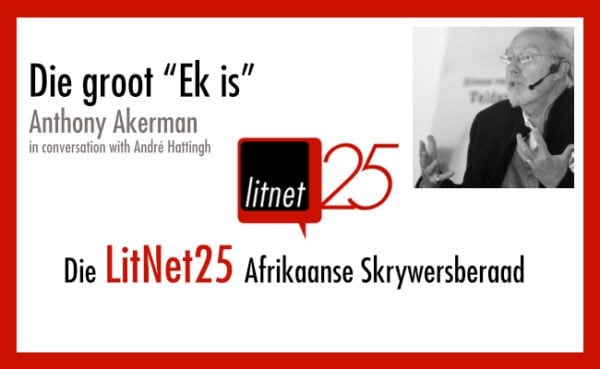
Anthony Akerman is a director and playwright who has also written extensively for radio and television. His award-winning stage plays include Somewhere on the border, Dark outsider and Old boys.
Akerman spent many years in exile during the apartheid years.
He grew up in a good household near Durban. At a delicate age, he learned that he was adopted. It shook his sense of identity, as he no longer was the boy he had been brought up to be. In his recently completed memoir, Lucky bastard, Akerman focuses primarily on how his life was shaped by the knowledge of his adoption.
In this interview (see video), held at the 2025 Etienne van Heerden Veldsoirée, Akerman is in conversation with André Hattingh.
See also
Alan Kirkaldy: Lucky bastard by Anthony Akerman: a review
Izak de Vries: Lucky bastard by Anthony Akerman, a reader impression
First sip: Lucky Bastard by Anthony Akerman
Anthony Akerman: Book review: Hoerkind by Herman Lategan is “a rare privilege”
André Hattingh: My leaves stay green: a soupçon
Anthony Akerman: What Guy Butler saw
Anthony Akerman and Athol Fugard: A sense of direction
Anthony Akerman: “Wrong Fugard”
Anthony Akerman: On some women writers
Anthony Akerman: André Brink’s Kennis van die aand – published 50 years ago – was the first Afrikaans literary work to be banned
Albert Grundlingh: Frederik van Zyl Slabbert (1940–2010) en die kwessie van Afrikaneridentiteit
Heindrich Wyngaard: “Wie (se fout) is ek?” Mymeringe (nee, stukkies) oor identiteit
Riana Scheepers: Ek wat vuur bemin en altyd waaghalsig was
Mphuthumi Ntabeni: Kemi Badenoch: The Africa that was not born in her
Igno van Niekerk: Waarom ek boekfeeste bywoon
Tom Dreyer: Die Groot “Ek is”: heuning uit die karkas van ’n leeu
Rory Riordan: The paradox of the biographer
Read more contributions here:
Veldsoirée-borge/Veldsoirée sponsors


Die Tuishuise & Victoria Manor

