

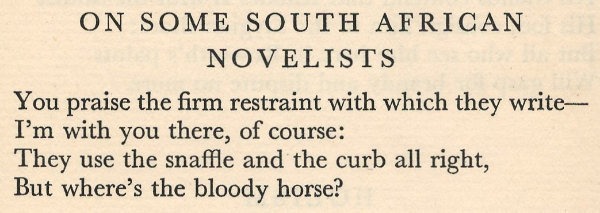
Roy Campbell's epigram for Sarah Gertrude Millin, Adamastor 1930
“Remember that the book which bores you when you are twenty or thirty will open doors for you when you are forty or fifty – and vice versa. Don’t read a book out of its right time for you.” – Doris Lessing, The golden notebook
As a first-year undergraduate, I had a panic attack when the canon of world literature fired a warning shot across my bow. The academic path stretching out ahead of me seemed strewn with insurmountable obstacles. How would I ever manage to read all those hefty literary tomes – The divine comedy, The Canterbury tales, Paradise lost, Don Quixote, David Copperfield, Middlemarch, War and peace, Moby Dick, Buddenbrooks and Ulysses – and find time to smoke dope, get laid, listen to music and have a life?
When I encountered Doris Lessing and came across the quotation I’ve used as an epigraph, I felt less apologetic about the lacunae in my reading. And if Doris Lessing said it was okay to buy a book on an impulse and leave it unread on your bookshelf for up to 20 years, who was I to disagree?
 But when I read Pauline Smith’s The Little Karoo for the first time, I did wonder why I’d waited so long. She really was good, and I wanted to read more. So, I took the five-minute stroll from my apartment in the red-light district to Antiquariaat Schuhmacher, a second-hand bookdealer on the Geldersekade, and asked whether they had any South African books. They did, and I made two purchases. One was Pauline Smith’s novel The Beadle, and the other was a second impression of Roy Campbell’s Sons of the mistral (1941), which I picked up for next to nothing. There clearly wasn’t much demand for Campbell in Amsterdam.
Campbell rated Pauline Smith. Although I didn’t know this when I was standing there handing over ƒ21,50 to the book dealer, in December 1926 a youthful Campbell had the following to say about her in a letter to CJ Sibbett, an advertising man from Cape Town, who was to become both a friend and a benefactor:
Yes I know and admire Pauline Smith’s work. She is the only woman-novelist that is any good out here. “The Little Karroo” has some very fine work in it. “The Beadle” though not so good, shows that she is capable of developing. Most of the women-writers I know would have gone on repeating themselves once they had discovered so excellent a mannerism as that employed in “The Pain”. To repeat oneself is the secret of popular success – it's called “fulfilling one’s promise” – and should be shunned like Hellfire by an artist. Most women-artists are unable to resist “fulfilling their promise”. But here is one who isn’t. Good luck to her.
If a slightly misogynist tone seeps through in his reference to “women-writers”, that can be ascribed to how he felt towards the popular novelist Sarah Gertrude Millin, who was soon to become the butt of his most famous and stinging epigram, “On some South African novelists”.

Pauline Smith (Photograph supplied)
I went back to my flat and found a suitable place for The beadle alongside Ralph Iron’s The story of an African farm (1892 edition) in my meagre – but growing – collection of South African classics. I had every intention of reading it, but was soon distracted after having taken the decision to visit South Africa for the first time in 14 years. I thought it’d lend me an air of nonchalant confidence if I booked my flight and only then applied for a visa – almost as an afterthought. My dealings with the South African embassy had been stilted since 1978 when they started renewing my passport for a year at a time. As soon as I could, I renounced my citizenship and became Dutch – something they seemed to take rather personally. They also knew my play Somewhere on the border had recently been performed in South Africa, where it had stirred up controversy and, in the words of the Directorate of Publications, had placed the South African Armed Forces “in an extremely bad light”. I was subjected to an uncomfortable interview that mercifully stopped short of an anal probe, after which I was drawn into a cat-and-mouse game with embassy staffers which continued until the day before I was scheduled to fly home. That’s when they told me my visa had been declined.
With all that going on, I must have forgotten about The beadle. Five years later, it was packed into a box and transported to Johannesburg, where it took up a new place on yet another bookcase, between The big sleep and Portnoy’s complaint. If Doris Lessing thought reading a book 20 years after you’d bought it was perfectly acceptable, when I took it down and opened it the other day, I realised it had been waiting forlornly on my various bookshelves for 35 years. Then I saw the inscription above my name and the date of purchase. I obviously hadn’t paid close attention at the time. What did it mean? Pauline Smith died in 1959, so she couldn’t literally have given instructions in 1970 to MAB – whoever that was – to give the book to Elisabeth Eybers.
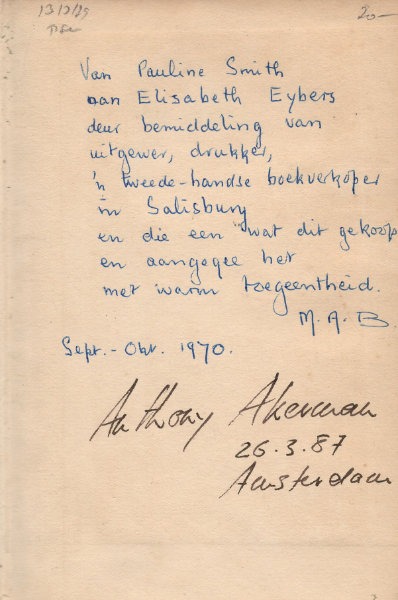
But who was the mysterious MAB who, on a visit to Rhodesia, had paid 4/6 to a second-hand bookdealer in Salisbury – either The Treasure Trove or The Book Exchange, according to my informants – and “passed it on with warm affection”? If anyone knew the answer to that question, it would be Ena Jansen. Ena is, among many things, an eminent Eybers scholar, who became her friend and, in 1996, wrote the outstanding Afstand en verbintenis (Distance and connection) about Eybers’s life and work in Amsterdam. She told me MAB was Marié Antoinette Botha, whose married name was Bax. Although she was three years older than Eybers, they’d both studied at Wits in the 1930s and remained close friends, and after Eybers settled in Amsterdam in 1961, Marié often stayed with her in the Van Breestraat.

The Photograph of Marie Antoinette Botha forms part of the Wits University Archives and is published with kind permission of the University of the Witwatersrand, Johannesburg, in South Africa.
So, how did the novel end up in Schuhmacher 17 years later? Ena said Eybers was forever giving books away. Perhaps she downsized when she moved from the Van Breestraat to the Stadionkade in 1979, and ever since then it had been waiting patiently for me to walk through the door. Although we’d lived in the same city, I’d never met Elisabeth Eybers. She’d already turned 60 by the time I arrived in Amsterdam in 1975 and was never part of the South African exile diaspora. She was reclusive, didn’t give radio and television interviews and seldom expressed herself publicly on political issues. She was respected in Dutch literary circles, and, as Ena has pointed out, her poetry was probably the only Afrikaans poetry readily accessible to Dutch readers in the original.
In 1989, she agreed to be interviewed for the Dutch literary magazine Tirade. The interview – conducted by Tomas Lieske and Willem Jan Otten – was scheduled for early 1990 to coincide with her 75th birthday. Willem Jan was a friend, and I remember having supper with him shortly after he’d interviewed her. He was still trying to get his head around the fact that he’d actually interviewed “the very first poetess in the entire language”. It was an excellent interview, and in September 1994 my English translation was published in New Contrast. I was passing through Amsterdam in December that year and hoped I’d be able to drop it off and finally meet her.

Elisabeth Eybers (Photograph by Ena Jansen)
I don’t recall whether Ena gave me Eybers’s phone number or whether she was listed in the telephone directory, but I made a cold call, introduced myself – probably speaking Dutch – and asked whether I could deliver copies of New Contrast in person. She told me she was recuperating from knee replacement surgery and still needed a walking frame to get around, and she apologised for not feeling up to being hospitable. We spoke for about 20 minutes, switching between Dutch, English and Afrikaans. She gave me her address, and I promised to post her the magazines. I told her about my play Dark outsider, and she said she was “deeply interested” in Roy Campbell. It had already been broadcast on what was then Radio South Africa, and I offered to send her an audio cassette. Before we ended our call, she mentioned she was turning 80 in February. She added that she now felt too old to travel and would in all likelihood never visit South Africa again. That made me profoundly sad. By then, she’d lived in Amsterdam for 33 years, yet she spoke both English and Dutch with an unmistakable Afrikaans accent.

After arriving home on a flight from hell – well, let me not exaggerate, on a Balkan Bulgarian Airlines flight crewed by unsmiling former KGB agents – I received a letter from her thanking me for the copies of New Contrast and the audio cassette. She added apologetically that she was “technically backward” and didn’t have a cassette player, but that her daughter Jeanne had promised to lend her one. She ended off with the words, “All my best wishes for your literary career!” I never did hear whether she managed to play the cassette, and she never again visited South Africa. In 2007, she was laid to rest in Amsterdam’s Zorgvlied Cemetery.
I don’t think The beadle is less good than anything else Pauline Smith wrote. She powerfully conjures up the prelapsarian Little Karoo of her childhood, populates this world with vividly drawn characters and, from early on, introduces an unsettling sense of foreboding. She’s a consummate storyteller and brings her novel to a conclusion that’s satisfying, moving and unsentimental. While I was turning the pages of this 1938 Nelson classic, I imagined Elisabeth Eybers sitting in an armchair with this novel in her lap, staring through the window at a wintry Amsterdam sky and being overcome by a sense of longing for Pauline Smith’s Aangenaam Valley. Then, she picked up the book given to her by her dear friend Marié and resumed turning the pages – the same pages I was turning 52 years later. In that moment, I experienced a visceral connection with the very first poetess in the Afrikaans language – and I felt especially privileged to have received from her the blessing with which she ended her letter.
See also:
Elisabeth Eybers se “soetste kettery”: Die woord en die Woord in haar poësie
Uit NALN se argief: Ena Jansen se eerste onderhoud met Elisabeth Eybers
Kommentaar
What a lovely read, thank you.
Thank you for the unique way you share your memories and remind us of the honour we owe our literary lineage.
Wonderful, Anthony. A beautiful tale brushed with the fine dust of memory. Serendipitously, I read Lessing's The golden notebook only this year with deep admiration (having set it aside after only a dozen pages in my twenties), and immediately felt like the later Krapp in Samuel Beckett's Krapp's last tape as I reflected on the price of time versus the cost of delay.
Baie dankie vir 'n pragverhaal oor Suid-Afrikaanse skryfsters! Ons waardeer die deel van die interessante navorsing.
'n Innemende blik op van ons vroueskrywers. Anthony Akerman het 'n boeiende skryfstyl wat reg laat geskied aan sy deeglike navorsing. Baie dankie hiervoor.
"Somer en herfs en winter trek in wye onafgebroke wisseling deur die land maar sy bly draer van die lente want liefde het haar verhef bo die getye."
So het ek in tye van vertwyfeling en hartseer my gewend. Dan na die Bybel dan na "Die Groot Verseboek". So het ek die deernis en passie van E Eybers ervaar en dit het my gedra. Toe en nou.
Die verhaal van jou ongelese boek met die pragtige uitnodiging om dit hartlik te ontvang is mooi. Maar ook swanger met die herinnering van ou vriendskappe en mededeelsaamheid tussen ikone onderling. Die prentjie van my troos wat uit 'n klein venster in haar eie herfs die triestige Europese weer moet aanskou is hartseer, maar ook inspirerend. Dankie.