

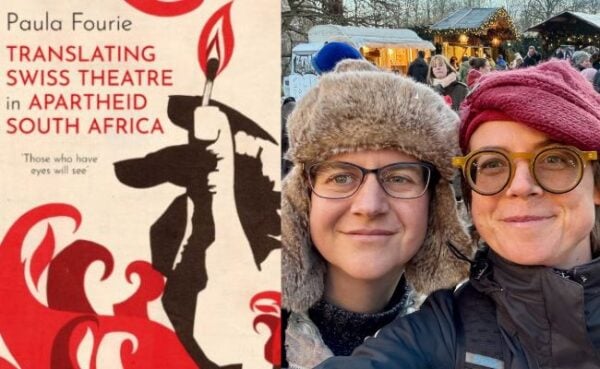
Boekomslag: Boydell Press; foto van Elsje en Paula Fourie: ©Paula Fourie
Paula Fourie, skrywer van Translating Swiss theatre in apartheid South Africa, is in hierdie tweetalige onderhoud in gesprek met haar suster, Elsje Fourie, medeprofessor in Globale Sosiologie aan die Universiteit Maastricht.
Elsje: Jou boek is op Jeugdag 2026 gepubliseer. Baie geluk! Voor enigiets anders is dit miskien interessant vir lesers om te hoor wat jou eie agtergrond is. Hoe het jy by Afrikaanse en Duitse teaternavorsing uitgekom?
Paula: Ek het nog altyd geweet ek wil skryf, dat woorde ’n kernrol speel in hoe ek die wêreld teëkom en ook liefhet, tog het ek iewers langs die pad besluit ek wil musiek studeer. Hierdie twee bane, skryf en musiek, het eers saamgeloop in ’n biografie van die ontslape musikant en musiekteaterlegende Taliep Petersen – die onderwerp van my PhD in musiekwetenskap – en later in suiwere teater en teaternavorsing. My oorlede man, Athol Fugard, het ook ’n invloed gehad – dis immers saam met hom dat ek my eerste ervarings as dramaturg en somtydse regisseur gehad het.
........
Ek het nog altyd geweet ek wil skryf, dat woorde ’n kernrol speel in hoe ek die wêreld teëkom en ook liefhet, tog het ek iewers langs die pad besluit ek wil musiek studeer. Hierdie twee bane, skryf en musiek, het eers saamgeloop in ’n biografie van die ontslape musikant en musiekteaterlegende Taliep Petersen – die onderwerp van my PhD in musiekwetenskap – en later in suiwere teater en teaternavorsing. My oorlede man, Athol Fugard, het ook ’n invloed gehad – dis immers saam met hom dat ek my eerste ervarings as dramaturg en somtydse regisseur gehad het.
.........
In hierdie boek kyk ek na apartheid-era- Afrikaanse vertalings van twee van die grootste naoorlogse Switserse dramaturge, Friedrich Dürrenmatt en Max Frisch. Ek het hieraan gewerk as deel van ’n postdoktorale genootskap aan die Berner Fachhochschule (HKB) onder die vaandel van ’n groter projek, “Cultural relations between Switzerland and South Africa, 1948–1994”, wat deur die Switserse Nasionale Wetenskapstigting (SNSF) befonds is. Chris Walton – die departementshoof tydens my BMus-studie aan Tukkies wat sedertdien na Switserland verhuis het – het die projek geloods en het my genader om te kyk na die rol van Switserse teater in Suid-Afrika. Hy het gemeen dat ek presies die regte persoon is vir hierdie navorsing.
Hier speel my taalagtergrond ’n rol. Ons het as kinders in ’n diplomaatgesin in Londen, New York, Wene en Pretoria grootgeword. Die grootste gedeelte van my skoolopleiding was in Duits en Afrikaans. Tog het ek saam met jou en ons broer Etienne hoofsaaklik Engels by die huis gepraat, seker maar ’n gewoonte wat ons aangeleer het omdat julle nog altyd in Engelse skole was. Ek praat in dié boek oor my “linguistic skins”, talige “velle” wat ek geleer het om te verwissel na gelang van omstandighede. Hulle het my gehelp om my weg deur verskillende kulturele kontekste en lande te vind, maar ek was nooit heeltemal dieselfde mens in elk nie. En juis omdat dié velle my nooit volkome gepas het nie, het hulle my ander talige identiteite beklemtoon. Snaaks genoeg het ek nog nooit méér Afrikaans gevoel as toe ek Duitse skole bygewoon het nie, eers in Oostenryk en later in Pretoria.
.......
Ek praat in dié boek oor my “linguistic skins”, talige “velle” wat ek geleer het om te verwissel na gelang van omstandighede. Hulle het my gehelp om my weg deur verskillende kulturele kontekste en lande te vind, maar ek was nooit heeltemal dieselfde mens in elk nie. En juis omdat dié velle my nooit volkome gepas het nie, het hulle my ander talige identiteite beklemtoon. Snaaks genoeg het ek nog nooit méér Afrikaans gevoel as toe ek Duitse skole bygewoon het nie, eers in Oostenryk en later in Pretoria.
.........
Ek het ook nog nooit méér Amerikaans gevoel as tussen Afrikaners toe ek op 13 vir die eerste keer in Afrikaans moes skoolgegaan nie.
Ek vertel in dié boek ook ’n staaltjie uit ons kinderjare: hoe ek op agtjarige ouderdom — op die punt om vanuit die American International School waar jy en Etienne skoolgegaan het — na die plaaslike Weense Volksschule oor te skuif sonder dat ek Duits kon praat, ontdek het dat die woorde vir “olifant” in al drie tale amper dieselfde was. Daaruit het ek geleer dat taal nie net ’n plek vir verskil is nie, maar ook van gemeenskaplikheid – beide werklik, in ’n gedeelde woordeskat, en iets denkbeeldigs, in die gevoel van geborgenheid wat sulke raakpunte skep.
Elsje: Okay, switching to English now, the language in which you wrote your book. Your work is the result of careful archival research and painstaking oral history; most of the material you worked with has not been published before. What was the most enjoyable part of this research process? What was the biggest surprise?
Paula: Looking back at the past five years, what I enjoyed most was also that which at the time could be the most frustrating – getting my hands dirty doing primary research. Sometimes I felt like a detective searching for a particularly elusive past.
Trying to conduct interviews with translators, actors and directors involved in staging Afrikaans translations of Frisch and Dürrenmatt in the 1960s and 1970s was challenging. Some of them did not want to be interviewed. Others had only vague memories of the productions in question. Others were simply not around anymore. So it made me very happy when I did manage to conduct a successful interview.
The same can be said for finding relevant archival material. I spent months digging through badly organised theatre and government archives and searching online repositories for traces of Frisch and Dürrenmatt in Afrikaans. Imagine my joy when the family of Mario Schiess – a Swiss-born South African director who was responsible for staging Afrikaans productions of Frisch’s Biedermann und die Brandstifter (1962) and Andorra (1964), Dürrenmatt’s Die Physiker (1963), Die Ehe des Herrn Mississippi (1966) and Der Meteor (1967) – dropped off several boxes containing scripts, programmes and photographs of his work.
The biggest surprise has to be the sheer volume of Swiss literature translated into Afrikaans during the apartheid years. Besides the usual suspect, Johanna Spyri’s Heidi, five Dürrenmatt novels and six plays were translated, while one of Frisch’s novels and four of his plays appeared in Afrikaans.
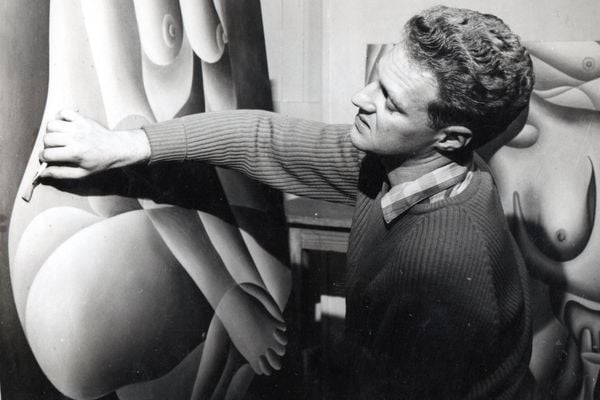
Reon Meij as Hugo Nyffenschwander in Die Meteoor deur die Hakahana Players opgevoer, 1967. (Hierdie foto is afkomstig van en verskyn met toestemming van Michelle Schiess van die Schiess-familie se privaatversameling.)
Elsje: You focus on Swiss plays. What is it about this country that makes your findings distinctive? How would your conclusions have differed if you’d focused on, say, British plays?
Paula: You’ve picked a particularly interesting example.
One of my key interviewees, theatre director Pieter Fourie (no relation), contrasted what he called the British “kollektiewe skuldkompleks” with the “neutrale, vrye gees” of the Swiss, who have no colonial conscience to assuage.
Dürrenmatt and Frisch appeared on Afrikaans stages against the backdrop of the playwrights’ boycott during which mainly British playwrights would not allow their work to be performed in front of segregated audiences. Because laws governing the performing arts made it virtually impossible during the 1960s to have multiracial audiences, their plays were simply not performed. Frisch and Dürrenmatt made no such demands, and their work was seized on by both English and Afrikaans directors who wished to expose their audiences to European theatre. Along the way they earned handsome royalties.
Does this make the Swiss playwrights opportunistic supporters of the apartheid regime? The reality is more complex than that, as was the boycott itself.
Within South Africa, it wasn’t even universally supported by those who wished to bring about political change. Athol Fugard, who had initially sparked the boycott by writing an open letter to playwrights abroad, eventually argued that it only served to entrench the status quo and isolate ordinary South Africans from new ideas, what he called “a fundamental source in terms of human action”. In an interview with me he pointed out: “Between the censors and the cultural boycott, we were all in danger of intellectual starvation.”
My perhaps unexpected finding is that, more often than not, Frisch’s and Dürrenmatt’s plays were enlisted as vehicles to smuggle fresh and contentious ideas into a stifling intellectual climate, and so they became part of the gradual shift in white and Afrikaner consciousnesses that helped pave the way for democratic reform.
Embedded in this story is a warning that present-day cultural boycotts may be counterproductive, sheltering the very worldviews they aim to challenge.
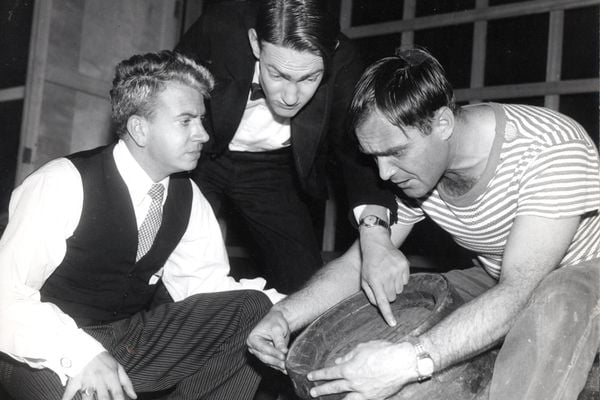
Biedermann (Braam Cilliers), Eisenring (Jan Strydom), en Schmitz (Johann Geyer) met ’n vat petrol in Mario Schiess se 1962 Die Brandstigters. (Hierdie foto is afkomstig van en verskyn met toestemming van Michelle Schiess van die Schiess-familie se privaatversameling.)
Elsje: My own forthcoming book (Palgrave, 2027) is interested in how literature shape readers’ imaginaries of places and communities of which they have little or no direct experience. How did the plays of Frisch and Dürrenmatt influence how apartheid audiences imagined Switzerland and their relationship to this country? Did these stagings work to reify the sense of European common identity that the Nationalist government sought to promote, for example? Or did they rather reinforce a sense of strangeness and cultural distance?
Paula: Predominantly the former, since Afrikaans translations were overwhelmingly domesticated – to borrow a term from translation theorist Lawrence Venuti – allowing audiences to forget that they were translations at all. Those who did remember could only marvel at the seamless transposition to South African soil. And so translated European plays – whether German, Russian, Swiss, Spanish, French or Norwegian – effectively helped constitute a canon of Afrikaans theatre works. But the effect of this wasn’t always the same.
When Bartho Smit’s Afrikaans translation of Der Besuch der alten Dame received its high-profile premiere at a government-funded theatre in 1962, it certainly reassured Afrikaners that the cultural other, in this case German-speaking Switzerland, was no other at all, but the genealogical and cultural self. This was a deliberate strategy, and an old one. Since colonial times, both English and Afrikaans speakers had used culture – and the presumed superiority of Western culture – to justify their presence and political role in Southern Africa.
But when the domesticated Die Brandstigters, Pieter Fourie’s Afrikaans production of Biedermann und die Brandstifter was staged in 1978, in a country rocked by violent protests and acts of sabotage aimed against the apartheid government, the close identification with the world of the play worked differently. Frisch’s play put European ideas in Afrikaans mouths. I argue in this book that in South Africa, Frisch’s famous “Lehrstück ohne Lehre”, did contain a clear message: If the system is not reformed constructively from within, it will be torn apart from without. The production itself is an important example of NP Van Wyk Louw’s “lojale verset” in action.
Other plays, such as the controversial Die Meteoor with its nudity, implied sex scenes and protagonist who persistently refuses to believe in the miracle of his own resurrection, couldn’t help but emphasise the cultural distance between South Africa and Europe. Two weeks before the curtain was due to go up on Schiess’s production, the Little Theatre in Pretoria owned by the Department of Education suddenly refused to have the play staged there. At the time, Die Burger reported that pressure had been exerted “op hoë vlak” to derail it. Yet its translator, Henriette Lemmer, didn’t flinch during translation, nor did she imagine anyone would be offended by the piece. “Ons probeer mos nie nou die Afrikaanse gees weer te gee nie,” she explained to me during an interview. “Ons probeer die Switserse ding te doen. En ek meen, hulle is al lankal liberaal wat dit betref, nè?”
Translating Swiss theatre in apartheid South Africa: “Those who have eyes will see” is onder die Creative Commons-lisensie CC BY-NC beskikbaar as ’n ooptoegang e-boek en kan gratis deur enigiemand afgelaai word by hierdie skakel: https://openaccess.boydellandbrewercms.com/?id=-321981.
- Belangstellendes word hartlik uitgenooi na die boekbekendstelling op Maandag 31 Augustus, waartydens Paula met Cornelia Faasen sal gesels. Dit vind plaas om 17:00 by Africa Open Instituut, Okkershuis, Stellenbosch.
Also read:
’n Bedrywige Woordfees vir Paula Fourie met Taliep, Babyboy Kleintjies en Athol
Die hond met die stert sonder swaai | The dog with the broken wag: ’n onderhoud met Paula Fourie
Revisiting Orpheus McAdoo: Paula Fourie interviews David Kramer