

https://capetownopera.co.za/orpheus-mcadoo/
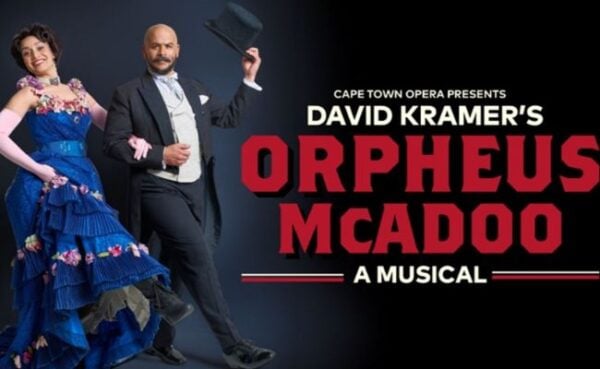
In 2015, David Kramer staged his musical, Orpheus in Africa, at the Fugard Theatre in Cape Town. This year, the reworked musical, now titled Orpheus McAdoo, returns to the stage in a collaboration with Cape Town Opera. Once more, Kramer shares the remarkable true story of the Virginia Jubilee Concert Company, whose performances in the 1890s introduced South Africa to the soul-stirring sound of jubilee singing.

David Kramer (photo credit: John Hogg, 2011)
Paula Fourie interviews David Kramer on Orpheus McAdoo.
Paula: In telling the story of Orpheus McAdoo – an American impresario and descendant of enslaved people who brought jubilee music to South Africa – you have, as often in the past, turned your attention to our country’s forgotten histories. When and how did you first encounter McAdoo? Who was he, and why did he catch your interest?
David: I first came across Orpheus McAdoo’s story about ten years ago while reading Denis-Constant Martin’s Coon Carnival. I was immediately intrigued by his description of the African American troupe known as the Virginia Jubilee and Concert Company. At first, I wasn’t entirely sure what "jubilee" music was, or what kind of performances had so captivated South African audiences in the late 19th century. But the more I learned about McAdoo – the man himself and the scale of his success in both South Africa and Australia – the more convinced I became that his largely forgotten story deserved to be retold. It seemed to me to have all the elements of a compelling stage musical.
Paula: Ten years have passed since the first iteration of this show, Orpheus in Africa, opened at the Fugard Theatre in 2015. Like so many of your musicals – Ghoema (2005), your final collaboration with Taliep Petersen, comes to mind – the first version is rarely the definitive one. What are the most important differences between that first musical and what audiences will see at Artscape this October?
David: When I first staged Orpheus in Africa at the Fugard Theatre, I stayed quite close to the historical record as I then understood it. But I struggled to find a truly satisfying ending. That early version was framed by a narrator, Lucy Moten, which was interesting but lacked the emotional drive I was after. Apart from Orpheus himself, many of the other characters – his wife, Mattie Allen, and his brother, Eugene, in particular – felt underdeveloped.
With this new production, I’ve allowed myself greater dramatic freedom. Mattie is now imagined as a vaudeville dancer who joins the Virginia Jubilee Company at the suggestion of their patron, Lady Loch. And instead of Eugene, I’ve introduced a character inspired by another member of the company, Richard Collins. These changes have given the story more depth and humanity, and a stronger emotional heartbeat.
........
With this new production, I’ve allowed myself greater dramatic freedom. Mattie is now imagined as a vaudeville dancer who joins the Virginia Jubilee Company at the suggestion of their patron, Lady Loch. And instead of Eugene, I’ve introduced a character inspired by another member of the company, Richard Collins. These changes have given the story more depth and humanity, and a stronger emotional heartbeat.
........
Paula: The first time you staged this story, you were working with actors who could sing. Now, collaborating with Cape Town Opera, you’re staging it with singers who can act. How has that shift shaped the show itself?
David: Collaborating with Cape Town Opera has given the production a new dimension. Having trained opera singers in the cast allows us to recreate, with real power, the sound of the Virginia Jubilee Choir. I want audiences to feel what it might have been like to hear that choir 130 years ago. And, since we still have actors who can sing, we’re able to combine dramatic storytelling with that extraordinary vocal richness – the best of both worlds.
Paula: As you and Taliep so eloquently showed in Ghoema, South Africa’s syncretic musical forms draw on influences from as far afield as South-East Asia and, as Orpheus McAdoo’s story underscores, the United States. What impact did McAdoo have on South African music?
David: I believe McAdoo and his company had a lasting influence on South African musical traditions. The popularity of choral singing and isicathamiya that developed among migrant workers in the late 19th and early 20th centuries may well trace some of its inspiration to those early Jubilee performances. Their concerts also likely shaped the presentation style of “Cape Malay choirs" – the costumes, the harmonies, even the sense of pride in collective singing.
Paula: Many Afrikaans folk songs in the FAK Songbook are borrowed – translations or adaptations of melodies from elsewhere. In your show, the fictionalised Virginia Jubilee Singers perform "My Sweet Ellie Rhee", Septimus Winner’s American Civil War song on which "My Sarie Marais" is based. Is there any historical evidence that the Virginia Jubilee Singers introduced this tune to South Africa?
David: There’s no firm historical evidence that the Virginia Jubilee Singers introduced "My Sweet Ellie Rhee" to South Africa, but the idea fascinates me. Some suggest that American miners sang the song in the Transvaal and that it somehow evolved into “Sarie Marais”. I find that hard to believe. The poet JD Toerien, who wrote the Afrikaans lyrics, was Cape-based, and it’s unlikely he would have encountered miners from the north.
However, "My Sweet Ellie Rhee" is exactly the kind of sentimental ballad that featured in McAdoo’s company repertoire, and since they were the musical sensation of the day, Toerien may well have heard it performed. My inclusion of the song in the show is therefore a creative speculation – but one that feels plausible and dramatically satisfying.

Paula Fourie (photo credit: Brenda Veldtman)
Paula: Much of your stage work over the past 40-odd years shares a feature: your shows aim to educate as well as entertain. How do you maintain that balance, and what pitfalls have you encountered along the way?
David: By focusing on the entertainment first. The moment it starts feeling like a lecture, you’ve lost the audience. The key is to create compelling characters who want something and who drive the story forward. If the drama is truthful and the characters are engaging, the history or the message comes through naturally.
........
The moment it starts feeling like a lecture, you’ve lost the audience. The key is to create compelling characters who want something and who drive the story forward. If the drama is truthful and the characters are engaging, the history or the message comes through naturally.
.........
Paula: German-born ethnomusicologist Veit Erlmann relays an incident that is dramatised in Orpheus in Africa: on 29 March 1898, Richard H Collins, a tenor with the Virginia Jubilee Singers, was at the Inchanga railway station bar near Durban when trooper L’Estrange of the Natal Police asked him, in Zulu, what he was doing. "Who are you talking to?" Collins replied. "I have as much right in the bar as you have." L’Estrange tried to arrest him, and a scuffle followed. In the end, court proceedings were suspended. What do you make of the fact that a black American could claim rights in colonial Natal that many black South Africans could not – and do you hear echoes of this disparity in the music and stories you work with?
David: The Virginia Jubilee Singers had the blessing and patronage of Lord Henry Loch, the governor of the Cape, and his wife, Lady Elizabeth. That gave them a kind of protection and social standing that local black South Africans didn’t enjoy. I’m not sure McAdoo or his company were always aware of those disparities, but their privileged position certainly allowed them to move through colonial society in a way others could not.
Paula: A graduate of the Hampton Institute in Virginia, McAdoo was committed to the uplifting of black audiences through education and upward mobility. Yet, he also adapted to changing tastes, incorporating elements and dances drawn from minstrelsy. How do you think he reconciled that contradiction?
David: I think McAdoo was, above all, an impresario. His decisions were guided by the need to survive and to keep his company afloat. His tours depended entirely on box office income, so he had to stay attuned to changing public tastes. By the late 19th century, the enthusiasm for jubilee music was waning, and he cleverly adapted – introducing variety elements and comic sketches – without abandoning his dignity or his belief in upliftment through art.
Paula: Do you have anything in common with Orpheus McAdoo? Would you have done anything differently?
David: As someone who has often had to finance my own productions through ticket sales, I feel a real kinship with him. That constant balancing act between creative ambition and financial reality – I know it well. I don’t think I would have done it any differently.
Paula: If you could sit across from Orpheus McAdoo himself, what would you ask him?
David: I’d ask how he managed it all – how he financed those early tours, and whether he ever worried that his outspoken views on racism might backfire. I’d want to know what it took to keep a company together for years on the road – how he handled fatigue, money troubles and internal tensions. And, most of all, whether he felt he truly succeeded in his mission of uplifting both his audiences and his performers.
Paula: Conversely, if you could whisk him out of the 1800s and bring him to South Africa today, what would you tell him – and what do you think would surprise him most?
David: It’s hard to imagine, but I think he’d be disappointed – and shocked by the general decline in musicianship. He might be surprised that, despite all the progress, so many of the challenges he spoke about still echo today.
Paula: Following his second South African tour, McAdoo died in Sydney in 1900, aged only 42. What do you think his trajectory might have been if he’d lived longer?
David: What fascinates me about McAdoo is how quickly he adapted to new trends and kept reinventing himself. In just ten years, he transformed his company and embraced new styles of entertainment without ever compromising his values or resorting to caricature.
........
What fascinates me about McAdoo is how quickly he adapted to new trends and kept reinventing himself. In just ten years, he transformed his company and embraced new styles of entertainment without ever compromising his values or resorting to caricature.
.........
Had he lived beyond 42, I believe he would have returned to America, embraced ragtime and helped shape a new form of African American entertainment. His name might have stood alongside the great innovators of his time – but history, unfortunately, didn’t give him that chance.
Buy tickets for Orpheus McAdoo here.
Also read:
Fotoblad – Die bekendstelling van David Kramer: ’n Biografie
’n Bedrywige Woordfees vir Paula Fourie met Taliep, Babyboy Kleintjies en Athol