

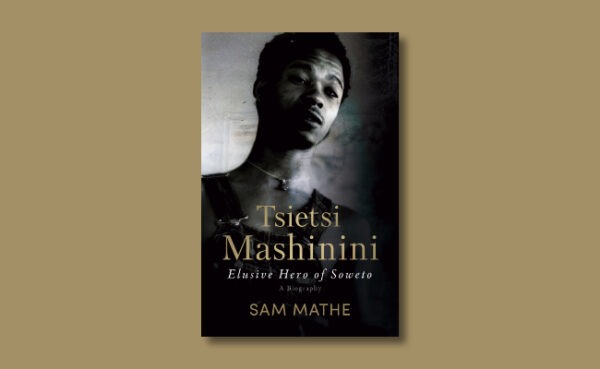
Title: Tsietsi Mashinini: Elusive hero of Soweto
Author: Sam Mathe
Publisher: Tafelberg
ISBN: 9780624095880
I
The national student uprising of 16 June 1976 remains a defining watershed in the history of South Africa’s internal resistance against the apartheid state. The uprising decisively broke the long period of political quietude that had settled over the country in the wake of the 1960 Sharpeville massacre and the subsequent banning of primary liberation movements. At the centre of this volcanic shift in youth-led resistance was a 19-year-old student from Morris Isaacson High School: Teboho Tsietsi MacDonald Mashinini. Acting as a highly charismatic orator and tactical organiser, Mashinini and some young school activists managed to mobilise a peaceful student protest that rapidly transformed into a countrywide rebellion.
His life is also a profound exilic tragedy. Denounced by the apartheid regime as a dangerous agitator, hunted by security forces and ultimately forced to flee into a volatile and factional exile, Mashinini chose to maintain strict political independence. His refusal to align with established liberation structures – the African National Congress or the Pan Africanist Congress – isolated him politically, and he died prematurely and under mysterious circumstances in Guinea in 1990.
Sam Mathe’s Tsietsi Mashinini: Elusive hero of Soweto, recently published by Jonathan Ball (2026), traces this life from the inside out: his ideological roots, his tactical operations, his exilic struggles with the South African Youth Revolutionary Council (SAYRCO), the unresolved circumstances of his death, and his contested place in post-apartheid national memory. The book is well informed and deeply researched, though it does require patience to read because it often swings unevenly in tone and speed: sometimes curt in summarising history, at other times, particularly in chapter three, given to information-dumping. Its finest chapter is the fourth, covering 16 June 1976, where Mathe reconstructs the events of that day brick by narrative brick with such vividness and moral precision that it alone could justify the book’s place in the historical canon.
Teboho Tsietsi Mashinini was born on 27 January 1957 in Central Western Jabavu, Soweto, the second of 13 children born to Nomkhitha Mashinini and Ramothibi Mashinini, a devout lay preacher in the Methodist Church. Growing up in a large household deeply integrated into local civic and church networks, he assumed the chairpersonship of the Methodist Wesley Youth Guild at the age of 16. His educational journey led from Amajeli Crèche in 1963, through Seoding Lower Primary and Itshepeng Higher Primary, before arriving at Morris Isaacson High School in 1971 – an institution whose reputation, Mathe notes, had been forged by exceptional leadership:
Largely due to the capable and visionary leadership of Kobe and his deputy and eventually successor Lekgau Mathabathe, Morrison Isaacson developed into one of Soweto’s leading schools, joining the elite league of Orlando (“The Rock”), Pimville (Musi) and Orlando West (Matseke) high schools. (32)
At Morris Isaacson, Mashinini was recognised as an exceptional student with a passionate love for literature. He was a school prefect, head of the debating team and an occasional freelance writer for the Rand Daily Mail Extra. Charismatic, athletic and deeply embedded in township youth culture, he loved theatre, softball, karate, swimming and tennis. His science teacher, Fanyana Mazibuko, recalled that while Mashinini had a decent grasp of science, his primary passions were languages and the social sciences. Culturally, he was drawn to the 1970s African-American hippie aesthetic – a prominent Afro, bell-bottom trousers, high-heeled shoes, peace signs – and carried himself with a confidence that refused to play second fiddle to anyone.
His local authority was cemented early by direct action against township criminal elements. Between 1974 and 1976, when violent gangs severely tormented Soweto communities, Mashinini confronted members of the notorious Damaras gang in White City, visiting them in their own homes and organising community-level resistance until the gang was dismantled. He had already established himself as a protector of his people before his political mobilisation began.
The defining catalyst of Mashinini’s political consciousness was his mentorship under Abram Onkgopotse Tiro. Expelled from the University of the North (Turfloop) for political activism, Tiro was a major figure in the Black Consciousness Movement and was briefly employed as a history teacher at Morris Isaacson in 1973. There, he actively mentored Mashinini, supplying him with literature on African liberation struggles, American slavery, the US Civil Rights Movement and the structural violence of the apartheid state. When Tiro was subsequently killed by an apartheid security police parcel bomb in Botswana, the loss only deepened Mashinini’s commitment. He joined the South African Students’ Movement (SASM), which was rebuilding active resistance cells inside Soweto high schools, and aligned himself wholly with the Black Consciousness ethos of psychological liberation, black pride and total rejection of white supremacy.
The immediate trigger of the 1976 revolt was the Department of Bantu Education’s 1974 Afrikaans Medium Decree, which forced black schools to use Afrikaans on equal terms with English for mathematics, arithmetic and social studies. Because neither pupils nor teachers spoke Afrikaans fluently, the decree was experienced as a deliberate attempt to impose an inferior education and cripple black academic performance. By mid-May 1976, localised strikes had already begun at Orlando West Junior School.
Recognising the need for a unified response, Mashinini proposed a general meeting on 13 June at the Orlando Donaldson Community Hall. Approximately 500 students representing various Soweto schools attended. Under his influence, the meeting established an Action Committee to coordinate a massive peaceful protest march for 16 June – the day examinations were scheduled to begin. To steel the nerves of anxious students, Mashinini quoted his favourite poem, Tennyson’s “The charge of the Light Brigade”: “O the wild charge they made!”
The Action Committee spent the next two days organising 11 distinct student streams to march from different schools, gathering support along the way, and converge at Orlando Stadium. Mashinini explicitly warned the student marshals to maintain absolute discipline and avoid any violence or provocation. On the morning of 16 June, following the 8:00 am school prayers at Morris Isaacson, he climbed onto the assembly podium, initiated a song and led the first group of students out of the gates, carrying a memorandum that read: “(W)e are the voice of the people and our demands shall be met.”
Mathe’s reconstruction of what followed is the biographical and narrative heart of the book. The chapter covering 16 June draws on eyewitness testimony, commission records, journalists’ accounts and oral histories to reconstruct the uprising almost minute by minute – and it is among the finest pieces of liberation historiography in recent South African writing.
The morning at Morris Isaacson is rendered with precision and atmosphere. Rather than saying the customary prayers, Mashinini led the students in a religious hymn and then in “Nkosi sikelel’ iAfrika” – a politically charged act that immediately announced the day’s intentions. Before leaving the school grounds, he repeatedly stressed discipline and warned against provocation. The scene reveals the dual character of the student movement: simultaneously steeped in the Christian tradition and in conscious political defiance.
The organisational sophistication Mathe uncovers challenges the apartheid state’s later characterisation of 16 June as a spontaneous eruption of violence. Eleven streams of marchers were carefully coordinated to converge on Orlando Stadium. As the Morris Isaacson contingent moved through Soweto, collecting pupils from Thesele Secondary and Naledi High, among others, the atmosphere initially resembled a festival more than an insurrection. Students sang freedom songs, exchanged Black Power salutes with motorists and consciously allowed even white motorists and delivery vehicles to pass unharmed.
One of the book’s most defiant episodes occurs when the march reaches Orlando West High School, where headmaster MP Mzaidume attempts to keep students in examination halls. The learners abandon their tests, tear up examination papers and pour out to join the march. The image is quietly devastating as a symbol of an informed generation visibly rejecting the educational machinery designed to subordinate them.
By late morning, police units under Lieutenant-Colonel Johannes Kleingeld had established positions near Orlando West High School. The students, now numbering between 10 and 20 thousand, found themselves converging on armed formations. Mathe presents competing versions of what happened next with care. While police would later claim they were responding to student aggression, eyewitnesses describe dogs, teargas and deliberate provocation preceding any exchange.
The killing of a police dog, released into the crowd and then stoned and burned by students, is treated by Mathe not as a sensational anecdote but as a symbolic turning point moment when the relationship between the state and its youth irretrievably collapsed. What followed was live fire. Students who minutes earlier had been singing hymns found themselves running in panic and confusion. Mathe restores the often-overlooked place of Hastings Ndlovu, widely regarded as the first child killed that day, and whose memory has frequently been overshadowed by the later death of Hector Pieterson.
The narrative reaches its emotional climax with that death. Rather than merely reproducing the iconic photograph, Mathe reconstructs the human drama behind it: Antoinette Pieterson’s frantic search for her younger brother moments before, Mbuyisa Makhubu’s desperate effort to carry the wounded child to safety, the intervention of journalists on the scene. Hector ceases to be a political symbol and becomes again a 12-year-old boy caught in the machinery of state violence. Mathe’s account is particularly affecting for the detail that Antoinette (the young woman of the famous photograph, running alongside Mbuyisa as he carries her brother’s body) had been searching for Hector in the chaos just minutes before the shot was fired.
Crucially, Mathe’s portrait of Mashinini during this violence contradicts later caricatures that cast him as a revolutionary firebrand seeking confrontation. As Soweto descended into chaos, he repeatedly urged students to disperse and go home. As students retaliated by stoning the police, burning vehicles and buildings, and attacking state structures like beer halls under the slogan “Less liquor, better education”, Mashinini climbed onto an upturned vehicle and desperately appealed for restraint. By 11:00 am, he was back at Morris Isaacson, advising students to stay home. The tragedy is that by then, events had already escaped the control of any individual leader. The bloodshed resulted not from the students’ original intentions, but from the state’s decision to confront children with armed force.
This chapter accomplishes something rare in liberation historiography; it neither romanticises nor diminishes the uprising. It recovers its human texture – the hymns sung before dawn, the nervous excitement of the marchers, the determination of student leaders, the fear of teachers, the sudden eruption of violence that transformed a school protest into a national rebellion. Tsietsi Mashinini’s story becomes, in these pages, more than the biography of an individual. It becomes a social history of a generation. Mashinini remains at its centre, but Mathe consistently situates him within the wider networks of teachers, parents, church leaders, Black Consciousness activists and ordinary students, who collectively made the uprising possible. The book’s greatest achievement in this section is showing how an intelligent, charismatic 19-year-old from Morris Isaacson High School became, for a brief historical moment, the embodiment of a generation’s refusal to submit to the capricious rules of their own oppression.
II
In the wake of the uprising, Mashinini became the most wanted man in Soweto and never slept in his own home again. On 2 August 1976, the Action Committee formally reconstituted itself as the Soweto Students’ Representative Council (SSRC) at Morris Isaacson, with Mashinini elected as its first president. Operating clandestinely, the SSRC issued press statements condemning police massacres and called for national class boycotts and economic stay-aways. Mashinini worked closely with Winnie Mandela and the Black Parents’ Association to organise and attend mass funerals for slain youth. The council’s highly secretive meetings were conducted at the Dube home of Drake Koka, nicknamed “The House of Exile”.
The state posted a R500 bounty for information leading to his arrest, and Colonel Visser of the Soweto CID publicly appealed for his surrender. Mashinini evaded capture through his background in theatre and his talent for disguise. When police surrounded Morris Isaacson and checked every student leaving, he walked past them in a girl’s dungarees and beret. On other occasions, he wore a balaclava and overalls to impersonate a manual labourer pushing a wheelbarrow on school grounds, or dressed as a Christian priest. Despite being hunted, he remained publicly defiant, boldly posing with friends in a Black Power salute outside the Moroka police station, a moment captured by photographer Peter Magubane.
Unable to capture Mashinini, the state redirected its fury at his family. His mother, Nomkhitha, was labelled a communist, fired from her job and permanently blacklisted. She was detained without trial for seven months at Standerton Prison, and subjected to relentless interrogation and repeated raids on the family home. His siblings were equally targeted; his brother Mpho was detained multiple times, and younger siblings were frequently held overnight. This sustained terror fractured the household: three of Mashinini’s brothers died in the mid-1990s, Ronald by suicide in 1995, Elvis of leukemia in 1996 and Tshepiso from a fall later that same year.
By late August 1976, survival inside South Africa had become impossible. In September, Pretoria minister Reverend Legotlo drove him across the border into Botswana. He entered exile determined to maintain the student movement’s political autonomy, flatly refusing to join either the ANC or the PAC; both, he argued, were “extinct internally” and out of touch with the active struggles inside the country. Adhering to the Black Consciousness maxim of self-reliance, he opposed the ANC’s multiracial alliance as a form of white paternalism, and was an equally staunch anti-communist, declaring any organisation allied with Moscow anathema. The ANC viewed him with mutual disdain. An undated, unsigned briefing document from the ANC archives, titled, “Who is Tsietsi Mashinini, and what does he stand for?”, characterised him as a threat, claiming that “counter-revolutionary forces” were exploiting him to confuse supporters and weaken the ANC internationally.
In exile, Mashinini travelled widely to build an independent youth-led vanguard. He addressed student groups at universities in the United States and the United Kingdom; met with West African heads of state, including Sékou Touré of Guinea and William Tolbert of Liberia; and addressed the United Nations on apartheid’s atrocities. In April 1979, the SSRC in exile formally launched SAYRCO in Lusaka, Zambia. With branches in Botswana, Lesotho, Nigeria, London and West Germany, SAYRCO aimed to launch an immediate offensive armed struggle inside South Africa, criticising the established liberation parties for excessive defensiveness.
SAYRCO was quickly destabilised. In late 1978, Mashinini gave an interview to Lucas Molete, a subeditor at PACE Magazine, unaware that PACE had been covertly established and funded by the apartheid state’s Department of Information using a R64 million military slush fund (the Information Scandal). When the intelligence link became public, his association with the publication threatened to discredit the entire movement. The SAYRCO leadership in Botswana suspended him, and Khotso Seatlholo assumed the presidency in July 1979.
Under Seatlholo, SAYRCO secured funding from the Nigerian government and sent cadres for military training with the PLO in Syria and Lebanon and with ZANU-PF in Zimbabwe. In June 1981, however, Seatlholo and fellow member Masabatha Loate were arrested during a clandestine meeting in Orlando East and sentenced to ten and five years on Robben Island respectively – a blow from which SAYRCO did not recover. Nigeria withdrew its funding, reverting to supporting the ANC and PAC, and the organisation collapsed definitively.
Following his suspension, Mashinini’s life descended into severe isolation and tragedy. In 1978, he had married Welma Campbell, a former Miss Liberia and daughter of a parliamentarian whom he had met at Miriam Makeba’s home; their wedding was attended by Makeba herself. The marriage produced two daughters, Nomkhitha and Thembi. But the cumulative weight of exile, political isolation and severance from home took a devastating toll. His brother Dee, who spent 13 years in exile, testified to the severity of this trauma: exiles were often confined to remote camps 500 kilometres from cities, with no communication from home and under constant threat of being labelled terrorists. Mashinini battled severe mental illness, depression and paranoia. Violent outbursts led to the collapse of his marriage within a few years.
By the late 1980s, he had drifted through various West African countries before settling in Conakry, Guinea, where Miriam Makeba took him in. Knowing he was struggling with mental illness, Makeba cared for him and hired a housekeeper to assist. On 5 July 1990, Mashinini died in a Conakry hospital. The Guinean government issued a letter to his family attributing death to “natural causes”. His body told a different story. When it was returned to South Africa, it was terribly disfigured: his left eye had fallen out into the coffin, his left ear was bleeding, his face was deeply bruised and a large scar crossed his forehead. His family took these injuries as evidence of a beating. Conspiracy theories followed, but nothing substantive was ever proven.
The mystery was deepened by Makeba’s silence. In her 2004 autobiography, she omitted any mention of Mashinini’s stay in her home, writing only: “I heard that he was in Senegal, then Nigeria, then all was quiet.” Yet when SAYRCO member Barney Mokgatle offered to travel to Guinea to assist in repatriating the body, Makeba actively discouraged him, warning, “I don’t want what happened to Tsietsi to happen to you,” suggesting she knew of something dangerous surrounding his death. She also refused to speak to filmmaker Portia Rankoane for the documentary Tsietsi, my hero, taking whatever she knew to her grave when she died on 9 November 2008. Mokgatle himself passed away on 13 November 2025, leaving the questions permanently unresolved. Some analysts suggest that Makeba’s close association with Mashinini contributed to her being denied an invitation to perform at Mandela’s inauguration in 1994 – a political snub that reflected the ANC’s long discomfort with the independent Pan-African current both figures represented.
The task of bringing his body home fell to his younger brother Dee, who worked desperately to prevent Tsietsi from being buried in West Africa. He eventually secured funding from the US Embassy to fly the body via Ghana Airlines to Harare, where Zimbabwean immigration officials refused to allow him to verify the remains. The body was ultimately transported to Johannesburg and interred at Soweto’s Avalon Cemetery. His granite headstone bears a simple, defiant epitaph: “Black Power”.
In the decades following the democratic transition, Mashinini’s legacy was initially marginalised by an ANC-led government preoccupied with its own historical narrative. Grassroots and civic organisations have consistently pushed back, and the City of Johannesburg has undertaken various municipal renaming initiatives to honour the leaders of 1976 – acts of spatial justice reclaiming the physical geography of Soweto from its apartheid past.
In June 2026, South Africa marks the fiftieth anniversary of the uprising. President Cyril Ramaphosa, Gauteng premier Panyaza Lesufi and Johannesburg mayor Dada Morero are leading a planned wreath-laying ceremony at the Hector Pieterson Memorial in Orlando West, followed by a solemn march to Orlando Stadium retracing the path taken by Mashinini and his peers. The Mputhi Street schoolyard at Morris Isaacson has been paved in red bricks to symbolise the blood shed that day, forming a key node on the 16 June Trail.
On 27 April 2011, President Jacob Zuma posthumously awarded Mashinini the National Order of Luthuli in Bronze for his contributions to the struggle for democracy. A significant administrative contradiction persists, however; numerous official historical databases and biographical archives incorrectly record that he received the Order in Gold. The discrepancy is symbolically revealing of an ongoing institutional hesitation to elevate an independent, anti-communist Black Consciousness icon to the highest tier of state recognition.
Fifty years on, contemporary youth and political commentators raise sharp criticisms of the socioeconomic conditions in modern South Africa. Township youth unemployment is referred to colloquially as “killing Mashinini again” – an indictment linking present structural failure to the betrayal of what the 1976 generation fought and died for. Activists speak of an imminent Mzansi Spring, warning that current conditions represent a powder keg that would make the 1976 revolt look modest by comparison. The legacy of Mashinini, Khotso Seatlholo and Onkgopotse Tiro is increasingly invoked by new social movements, most visibly the FeesMustFall campaign, seeking to resurrect the politics of Black Power and independent student mobilisation against the structural inequalities of post-apartheid South Africa.
Viewed in its entirety, Mathe’s biography is ultimately a meditation on memory, political ownership and historical erasure. By recovering the complexity of Mashinini’s life, his brilliance and independence, his ideological stubbornness, his exile and mental decline, and his unresolved death, the book restores to South African history one of its most consequential yet strangely neglected figures. Fifty years after the uprising, the central question the biography poses remains unsettlingly alive: What became of the dreams of the youth who marched behind Tsietsi Mashinini on that cold June morning in 1976? That the question still resonates so powerfully is perhaps the strongest argument for why this book matters, and a serious indictment of the post-’94 government’s failures to live up to the dream and sacrifices of those who fell along the road to better the lives of all South Africans.
See also:
Kommentaar
In West Africa during the early days of his exile, Tsietsi Mashinini, as guest of honour at a dinner, was served (as delicacy) the hand of a (western lowland?) gorilla. He politely declined the hand. My admiration for him increased exponentially after hearing this.