

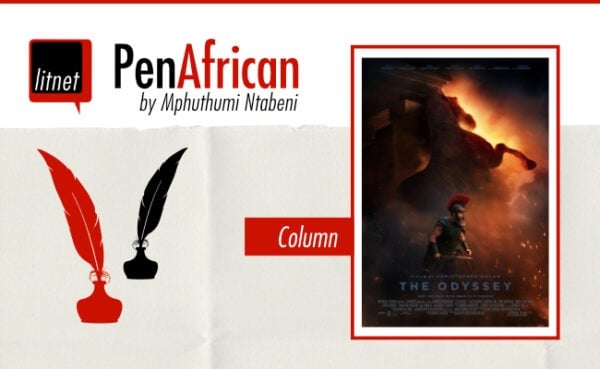
I finally gathered the strength to watch Christopher Nolan’s Odyssey this weekend. I was still slightly hyperventilating from attending what many call the “Karoo Brain Charge” at Nxuba ye Themba/Cradock, otherwise known as the Etienne van Heerden Veldsoirée.
As an African boy growing up in a small Karoo town, Komani in the Eastern Cape, I wasn’t allowed into the municipal library because my skin carried too much melanin. So, I never had the chance to discover Homer as a child or at school. I didn’t grow up talking or dreaming in Homeric classical language of the one-eyed Cyclops, the Sirens and their irresistible songs, the monstrous Scylla, the devouring whirlpool Charybdis, the witch Circe turning sailors into swine, bags of magical winds, or the despised beggar who cast off his rags to exact bloody revenge with a bow no one else could string.
...
But our intsomi gave us tales of equal grandeur. We had izigebenga (giants) and amagangqongqo (cannibals), and the mischievous tikoloshe.
...
Those stories of the Trojan War and Odysseus’s long voyage home were unavailable to me then. But our intsomi gave us tales of equal grandeur. We had izigebenga (giants) and amagangqongqo (cannibals), and the mischievous tikoloshe. Above all, there was Thuthula, the most beautiful woman in Rharhabe history, whose love drew the rival kings Ndlambe and Ngqika into a devastating conflict that culminated in the tragic Xhosa civil war at the Battle of Amalinda, at precisely the moment when British colonial expansion had begun the century-long dispossession of Xhosa land. Those were the greatest stories in the world to me. Many years and countless books later, I still think they are.
I first heard them when I was perched on the lap of my grandfather, a magnificent storyteller whom many people say I resemble. Like every child, I thought they were simply iintsomi, made-up mythical stories. Years later, after university, when I finally read Homer, I realised how familiar everything there felt. The landscapes were different, the names were different, but the rhythms of life and storytelling as means of moral education were the same.
I can’t say I ever became particularly fond of Odysseus himself. To me, he often seemed too much the trickster, too willing to sacrifice honour for cunning, the kind of restless hero that my culture, which encourages stability and ethical behaviour, has never fully admired. Yet, perhaps the mfengu, the wanderer, somewhere in my own blood couldn’t help but admire a man willing to sail beyond the edge of the known world simply to discover multitudes that lay inside himself.
Years later, reading Christopher Marlowe’s Doctor Faustus, I found myself thinking once again of Thuthula as I encountered those immortal lines about Helen of Troy:
Was this the face that launched a thousand ships,
And burned the topless towers of Ilium?
I am amused when billionaires and pseudo-intellectuals parade their sophisticated ignorance in things like promising to make a “historically accurate” version of The Odyssey. Perhaps someone should gently remind Elon Musk that the poem is mythology, not history. It is woven from ancient Greek legends and oral traditions accumulated over centuries. We cannot even say with certainty that there ever was a single poet called Homer. Many classicists have long argued that The Iliad and The Odyssey are the products of a long Hellenic oral tradition, eventually shaped into written form by different generations of singers and editors – much as the Hebrew Psalms emerged from multiple voices across centuries rather than a single author.
...
We already have our own Helen. Her name was Thuthula, the legendary beauty whose rivalry between Rharhabe kings, Ndlambe and Ngqika, helped ignite one of the most catastrophic civil conflicts in Xhosa history.
...
Now, here’s an idea that might actually justify a billionaire’s fortune. Instead of chasing a historically accurate Odyssey – or a historically accurate Trojan War, for that matter, since there is also still no conclusive archaeological or textual evidence that war ever happened or unfolded as Homer tells it – why not invest in a truly historical African epic? We already have our own Helen. Her name was Thuthula, the legendary beauty whose rivalry between Rharhabe kings, Ndlambe and Ngqika, helped ignite one of the most catastrophic civil conflicts in Xhosa history. The Battle of Amalinde did not merely pit brother against brother; it fatally weakened the nation at precisely the moment British imperial expansion was gathering force. Like the Trojan legend, it is a story of love, ambition, betrayal, heroism and national catastrophe. Unlike Troy, however, its political consequences are well documented in the historical record.
And there would be no tedious arguments about historical accuracy or the colour of the cast. Thuthula was African. Ndlambe and Ngqika were African. Amalinde was fought on African soil. Then again, Musk dislikes all things African with a subdued passion. The Battle of Amalinde is the epic that has been waiting all along for someone with the imagination, and the budget, to bring it to the screen. It delighted me even more, after I had become a writer myself, to discover in Derek Walcott’s Omeros an extraordinary poem which gives Homer a distinctly Caribbean voice, proving that the ancient Greeks belong not only to Europe but to anyone willing to inherit them.
Christopher Nolan has long been one of my favourite filmmakers. That is why I eagerly awaited his adaptation of The Odyssey. The nostos – the homeward journey – of resourceful Odysseus, the man of many turns who survives shipwrecks, monsters, gods, temptations and the loss of 600 companions and 12 ships before finally reaching Ithaca alone, felt to me perfectly suited to Nolan’s fascination with time, endurance and fractured identity. And the perfect demonstration of the trickery in Mr Ripple by Matt Damon convinced me he would be a perfect Odysseus. So, I was very curious to see how Nolan would handle the spectacle of the epic. How do you bring the Cyclops, Circe, Scylla, Charybdis and the wrath of Poseidon convincingly onto the screen without losing their mythical power? I was not disappointed. The cinematography is great. The interpretation of Homer’s poem is made for modern Hollywood after the recurring themes of Nolan: memory, guilt, identity, time manipulation, etc. But, if I am being honest, the movie really came alive to me during the last scene on the island of Ogygia, when the nymph Calypso, played by Charlize Theron, releases him. Even the quality of the dialogue changed into something I had always imagined Homer for the modern age would be:
You’re a man who needs to control his fate,
But you cannot control this.
You must give yourself to the storm,
Give yourself to Poseidon,
And take your punishment.
The nymph said this as she released him to his fate after keeping him on the island for seven years, feeding him the lotus fruit to make him forget about his past and future.
And then comes the ending. Odysseus returns home to discover that 108 suitors have occupied his house, consuming his wealth while pressuring his longsuffering wife, Penelope, to choose a new husband. Disguised as a beggar and aided by his now-grown son, Telemachus, he reveals himself only after stringing the great bow that no other man can bend. What follows is not forgiveness, but one of the bloodiest acts of revenge in all literature.
“Dogs,” he tells them, “did you think that I should not come from Troy? You have wasted my substance, forced my women servants to lie with you, and courted my wife while I was still alive. You feared neither God nor man. Now you shall die.”
And they do.
Every last one.
And then there is Penelope.
For all the monsters and miracles that fill The Odyssey, I suspect she may be its greatest wonder. For 20 years, she waits with extraordinary resolve. Every day, she fends off the suitors, weaving by daylight and secretly unravelling her work by night, buying time against the certainty with which everyone else has already declared her husband dead. Her fidelity is not merely sexual, but an act of endurance, memory and hope.
Perhaps that is another reason Homer never felt entirely foreign to me.
...
Growing up in the Eastern Cape, I knew women like Penelope, although we never called them by that name. We called them abafazi bomlindo – women of the vigil.
...
Growing up in the Eastern Cape, I knew women like Penelope, although we never called them by that name. We called them abafazi bomlindo – women of the vigil. They were our grandmothers and great-grandmothers who waited faithfully for husbands who had left to work on the mines of Johannesburg, on distant farms or in the cities, or who had gone away to wars from which many never returned. Some waited months, others years. They raised children alone, guarded the homestead, protected the family’s dignity and, in many cases, remained chaste despite loneliness and uncertainty. They lived between hope and grief, never knowing whether the next knock on the door would bring their husbands home or news that they would never return.
As children, we hardly recognised the quiet heroism of these women. They were simply our gogos, always there, tending fires, telling stories, keeping families stitched together. It was only much later, after I had read Homer, that I realised Penelope had lived among us all along. She wore no Greek robes, but wrapped herself in an iqhiya. She spoke Xhosa. She waited beneath African skies.
That is why I wondered whether Nolan would understand that The Odyssey is not simply the story of a wandering man, but equally the story of the woman who makes home worth returning to. Without Penelope, Odysseus’s voyage is merely an adventure. Because of her, it becomes a homecoming.
Nolan understood this. He recasts Odysseus as something approaching an ancient Christ figure, a man whose final journey becomes one of atonement rather than conquest. Instead of ending with the bloody restoration of his household, Odysseus’s story is extended into a pilgrimage of repentance, seeking to set right the moral disorder unleashed by human arrogance (hubris) and by the abandonment of Zeus’s divine order.
This emphasis throughout the movie shifts the story from revenge to redemption. Accompanied by Penelope (the faithful wife, the embodiment of umlindo, the long vigil of waiting), Odysseus journeys westward to honour his fallen companions and offer sacrifices to the gods for the transgressions of men. Having reclaimed Ithaca, he relinquishes the burdens of kingship to Telemachus, leaving his son to rule while he himself embarks on a final quest for reconciliation. This is a distinctly modern reading of Homer, one that overlays the ancient Greek epic with themes that resonate more with Christian notions of sacrifice, repentance and redemption than with the heroic ethic of the archaic world.
...
The Homeric poems occupy a path analogous to the Xhosa literary culture I grew up with, especially that of the imbongi and the oral performative style.
...
The Homeric poems occupy a path analogous to the Xhosa literary culture I grew up with, especially that of the imbongi and the oral performative style. Both, in certain respects, emerged from societies similar to the one my grandparents inherited. Honour mattered more than wealth. A person’s word carried the weight of law. Hospitality – xenia, their version of Ubuntu – was sacred. Hence we chose to name our now 13-year-old lastborn, Xenia. Genealogies were remembered with astonishing precision. The dead remained present among the living through memory, praise and ritual. Kings ruled, but their authority depended as much on persuasion as on force. The greatest shame was cowardice; the highest virtue was to leave behind a name worthy of remembrance. That was the world of Homer. It was also, in many ways, the world of the Xhosa before it came into deeper contact with Western culture.
The landscapes could not have been more different. One was enacted along the wine-dark Mediterranean; the other stretched across the valleys and rivers of the Eastern Cape. Yet, each civilisation understood that stories were never mere entertainment, but living archives, preserving law before law books, ethics before philosophy, and history before historians. Among the Xhosa, the imbongi was never simply a poet. He was the custodian of collective memory, the guardian of genealogy, the interpreter of custom and tradition, and the conscience of the nation. Through his voice, a people remembered who they had been and, therefore, who they were. Long before a child learned to read, they learned to listen to the imbongi.
That thought leaves me wondering whether we have misunderstood what is often lamented as the decline of reading. As books compete with podcasts, audiobooks, streaming platforms, social media and short-form video, perhaps we are not witnessing the death of storytelling so much as the return of one of its oldest forms. The digital age has made performance, voice and image central once again. In a curious twist, technology may be leading us back toward the oral culture from which literature itself first emerged.
There is something profoundly natural about this. Human beings are born into language long before they encounter writing. A baby listens, recognises voices, responds to rhythm and eventually learns to speak without formal instruction. Reading and writing, by contrast, are cultural technologies. They require years of deliberate cognitive training. Speech is our inheritance; literacy is our achievement. Perhaps the future of storytelling will not abandon the book, but simply remind us that for most of human history, including the worlds of Homer and the Xhosa, the spoken word came first.
As I grew older, I came to realise that Homer belonged to an oral civilisation before he belonged to literature. For centuries, The Iliad and The Odyssey lived not on the page, but in the memories and voices of singers who carried them from one generation to the next. The poems bear all the fingerprints of oral composition: repeated epithets, recurring phrases, familiar scenes and rhythmic patterns designed not simply for beauty but for remembrance. Writing did not create Homer; writing preserved him.
...
The storyteller was both library and librarian. Like Homer’s bards, he performed rather than recited.
...
That discovery startled me because it described the world I came from. My grandfather never held a manuscript when he told us iintsomi. He carried entire worlds in his memory. Praise poems, clan histories, folktales, proverbs and genealogies existed because someone remembered them. The storyteller was both library and librarian. Like Homer’s bards, he performed rather than recited. Every telling was faithful to the tradition, yet alive to the moment. No two performances were ever exactly alike.
The comparison becomes even more striking when one considers how both traditions encountered writing. Homer stands at the threshold where an ancient oral inheritance began its long journey into written literature, probably sometime in the eighth or seventh century BCE. The poems mark not the birth of Greek storytelling, but the moment its spoken memory acquired textual permanence.
Xhosa literature passed through a remarkably similar threshold, albeit much later and under very different historical circumstances. For centuries, the literary life of the Xhosa resided in the spoken word – in iintsomi, izibongo, idioms, proverbs, clan praises and historical narratives entrusted to memory rather than paper. Then, during the late eighteenth and especially nineteenth centuries, as missionaries introduced literacy and printing to the Eastern Cape, that vast oral inheritance encountered the written page. Figures such as Tiyo Soga, William Wellington Gqoba and later SEK Mqhayi did not invent Xhosa literature. They did for Xhosa what the scribes of antiquity did for Homeric stories by carrying an already ancient oral civilisation across the threshold into writing.
...
Before ink, there was voice. Before libraries, there were elders.
...
That is why I have never accepted the lazy assumption that literacy marks the beginning of civilisation. Books preserve memory; they do not necessarily create it. Before ink, there was voice. Before libraries, there were elders. Before authors, there were storytellers sitting beside evening fires while children listened with eyes wide open.
Perhaps that is why reading Homer after university felt less like discovering a foreign classic than recognising a distant relative for me. I was not entering an unfamiliar world. I was returning to one I had known all along, only this time its heroes had Greek names instead of Xhosa ones.
See also:
The importance of oral history in southern African historiography
Koeke, terte, Paris se twisappel en ’n bietjie Marita van der Vyver
Die appel – klik, kyk en word verlei om die mense van Iran te leer ken
Kommentaar
A wonderful and timely piece. Thank you, Mputhumi!