

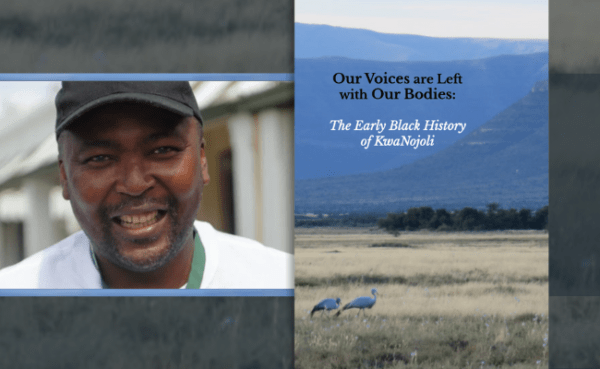
Mphuthumi Ntabeni (photo: Izak de Vries); book cover: Our voices are left with our bodies: The early black history of KwaNojoli (Jakes Gerwel Foundation)
In collaboration with the KwaNojoli (Somerset East) Museum and with the generous support of the National Heritage Council (NHC), the Jakes Gerwel Foundation launched a research project on Nojoli this year. Mphuthumi Ntabeni, an award-winning author and a native of the Eastern Cape with deep insight and knowledge of Xhosa history, is leading this project.
He talks to Naomi Meyer about his background, the project and the Eastern Cape.
Mpush, please tell me about your passion for the history of the Eastern Cape. Where did it all start?
Like most people who grew up in the apartheid era, I was not taught our early history. I came across this history later on in my life in the UK. Incidentally, because we were colonised by Britain, our early history is prevalent in British archives and is readily available there. Here, however, over 30 years since the beginning of our free democratic dispensation, this history is still not readily available, and our children are still not taught it in our schools. This, in my opinion, is a travesty of justice.
........
Here, however, over 30 years since the beginning of our free democratic dispensation, this history is still not readily available, and our children are still not taught it in our schools. This, in my opinion, is a travesty of justice.
........
You are an architect and an author, and now you are also involved in a movie project. What is KwaNojoli: The origins about?
Most people don't understand that the architectural field is about finding solutions for human habitation, so it is very much concerned with socioeconomic aspects of society. The CEO of the Jakes Gerwel Foundation, Theo Kemp, invited me to lead this project. The brief was about finding ways of promoting social cohesion in the town formerly known as Somerset East, now restored to its original name of KwaNojoli. The name change has caused many bad feelings among the denizens of the town. This is very much in the scope of my career. Perhaps not the documentary part. We had to include that because we wanted to record the views of people on the ground regarding the name change.
A booklet called Our voices are left with our bodies: The early black history of KwaNojoli will also be launched at the event. Please will you elaborate?
The booklet became necessary after we discovered that the majority of the people didn't know about the earlier history of the town. We thought it opportune to introduce people to it.
........
The booklet became necessary after we discovered that the majority of the people didn't know about the earlier history of the town. We thought it opportune to introduce people to it.
........
We also had to include numerous historical references for those who want to know more about them, or who want to argue with those who claim there are no credible historical references for the name KwaNojoli because it is based only on oral history, as if that doesn't matter.
The project is launched in collaboration with the KwaNojoli Museum and the support of the NHC, and the movie is shown at Paulet House. Maybe share with LitNet's readers a few words about your writer's residency at Paulet House a few years ago, if you wish?
My relationship with the JGF goes back to when I went to Paulet House for a residency three years ago. That is also where I first met you, Naomi. That residency introduced me to a number of wonderful local and international writers. That is also when I first met the CEO of the JGF, Theo Kemp. I would like to think he saw something in me that made him conclude that I'd be the best person to lead this project. As you know, I also have a passion for the early history of the Eastern Cape, which I deal with mostly in my historical novels.
This project is about the history of this beautiful region of our country, but you also mention that the booklet wishes “to explore some of the ways in which a living black history might be told”. Can you share some of your suggestions of ways to tell the living black history of the region? Or do you consider this also the living black history of the country?
We deliberately concentrate on the rich history of the area. It also happens to be the foundational history of the frontier towns of the Eastern Cape. Today, with advocate Tembeka Ngcukaitobi, we shall delve deep into this history in our discussion. As I am sure you are aware, it is an extremely sensitive history, because it involves the clearing of the Zuurveld for European settlement by the Dutch and the British. This is what Johan Graham and his cohorts, like Robert Hart (who occupied the first farm, Glen Avon, that became the centre of the town eventually known named by the then Governor Somerset after himself), have done. History is always told from the point of view of the victors. It requires deeper creativity and research to tell it from the point of view of the defeated, because you have to examine, refute and correct many of the victor's self-justifications, omissions and lies in the telling of that history. That is why I say we had to find a new way of telling that history, which includes the suppressed history also.
........
History is always told from the point of view of the victors. It requires deeper creativity and research to tell it from the point of view of the defeated, because you have to examine, refute and correct many of the victor's self-justifications, omissions and lies in the telling of that history. That is why I say we had to find a new way of telling that history, which includes the suppressed history also.
........
Why focus only on the black history, and not on the histories of all cultural groups of the region?
Though our focus is on black history – because it has been neglected and deliberately suppressed – we tell the entire history, including the over-represented colonial and Afrikaner history. From the booklet, you learn not only about Governor Somerset and Bruintjieshoogte, but also about what was there before the European arrival. You learn who Nojoli was, and how all these histories interlock and are joined at the hip, despite our pretensions. I would like to think that we learn the true history of the town and area. Many of our black intellectuals had their beginnings in that small town, because in those days it was one of the only places an educated black person could get work for their qualifications.
Where can people buy the booklet or watch the movie after the launch has taken place?
The booklet will not be for sale; it’ll be freely available from the website of the JGF after the launch. We shall also post the documentary on the website and YouTube for free access after the launch. The project was funded by the National Heritage Council for cultural and educational purposes, not for profit. It is part of all of our national heritage.
Also read: