

Read the Afrikaans version of this article.
There is a second half to the picture, and the public debate almost always misses it. A migrant is a worker who competes for jobs – but also a customer who helps create them: someone who buys bread, pays rent, takes a taxi, sends children to a crèche.
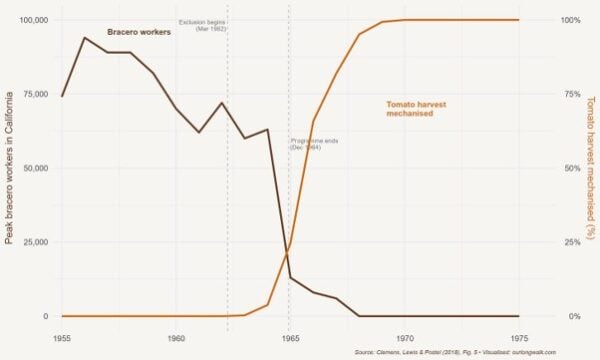
In the autumn of 1965, something was missing from the tomato fields of California. For two decades, close to half a million Mexican men had crossed the border each year to pick the crops that Americans ate. They were called braceros – hired hands, brought in under a government programme that had started during the war. Then, on the last day of 1964, Washington closed the programme down. The braceros went home.
Politicians had promised this would be good news for American workers. Take away the foreigners, the argument ran, and farmers would have no choice but to offer better wages to the locals who stayed behind. It was sold, in the language of the day, as an “active labour market policy”: Remove the migrants, lift up the natives. The logic felt like common sense. Fewer workers chasing the same jobs should mean higher pay.
It did not work out that way.
Three economists – Michael Clemens, Ethan Lewis and Hannah Postel – went back to the archives and measured what actually happened after the braceros left. If kicking out foreign workers really did raise wages for the people who remained, we should see it most clearly here, in the states that had leaned hardest on Mexican labour. Their own model predicted that farm wages in those states ought to jump by around 12%.
They jumped by almost nothing. Wages barely moved. Employment of domestic farm workers barely moved. The promised gain to American workers never came.
Where did the adjustment go instead? Into machines and into crops. In tomatoes, growers bought the Blackwelder mechanical harvester and let it do the stooping. In cotton and sugar beet, the same story – more machinery, fewer hands. Where a crop could not be mechanised, farmers often switched to one that could, or grew less of it. Wages stood still. The work itself was engineered away.
Click here for a larger version.
This is the first lesson, and it holds well beyond California: An economy that loses workers adapts. The gains its planners promise to the people left behind tend to flow instead to whatever does the job more cheaply – often a machine.
Back to the present, and a little closer to home. South Africa has seen another wave of anger at foreigners – marches, threats, men turned away from clinic doors and spaza shops, the now familiar demand that “illegal” foreigners be rounded up and removed. The cause, we are told, is obvious. Foreigners are taking South African jobs. Foreigners are driving crime. Get rid of them and ordinary South Africans will breathe easier.

© Clker-Free-Vector-Images (published on 11 April 2012, Pixabay.com) (free content license: https://pixabay.com/service/license-summary/)
These are confident claims. But the evidence behind them is thinner than the confidence suggests. We have little solid proof that foreign workers are the reason South Africans cannot find jobs, or that removing them would open those jobs to anyone else. What economics can speak to with more assurance is the other side of the ledger: the measurable consequences of acting on the anger.
Begin with our own history, because South Africa has run a version of the bracero experiment before. For much of the twentieth century, apartheid policy shaped the supply and price of black labour – through influx control, job reservation and, from the 1970s, rising wage pressure as black workers organised. As that labour grew scarcer and dearer in the formal economy, employers in mining, farming and manufacturing did what the Californian growers did: They mechanised. Machines replaced unskilled workers, and the economy settled onto a path that created steadily fewer jobs for the least skilled. Timothy Ngalande’s research on apartheid-era manufacturing traces this turn towards machines. The structural unemployment we live with today is partly its inheritance.
There is a second half to the picture, and the public debate almost always misses it. A migrant is a worker who competes for jobs – but also a customer who helps create them: someone who buys bread, pays rent, takes a taxi, sends children to a crèche. A 2026 study from Norway, by Sigurd Galaasen and colleagues, measured this second channel directly, tracking the electronic payments of an entire country. Workers more exposed to migrants’ spending saw their own incomes rise, strongly and persistently. By spending what they earn, migrants help pull native wages up.
This is what economists mean when they say migrants and locals are usually complements, not substitutes: Each makes the other more productive. ... Much of it is what migrants bring to the work itself – education, a trade, business experience, and the ideas, capital and networks that come with them. A Congolese electrician or an Ethiopian shopkeeper builds something that was not there before, and hires people to run it.
This is what economists mean when they say migrants and locals are usually complements, not substitutes: Each makes the other more productive. Some of that is the spending we have just seen. Much of it is what migrants bring to the work itself – education, a trade, business experience, and the ideas, capital and networks that come with them. A Congolese electrician or an Ethiopian shopkeeper builds something that was not there before, and hires people to run it. A second 2026 study, by Angel Aguiar and Stephen Devadoss, put a number on what cutting that link costs: Deporting just 30% of America’s undocumented workers, they estimate, would shrink United States output by more than 128 billion dollars, with the deepest losses in agriculture, food processing and construction.
It is true that perhaps this mutual benefit is weaker in a country like ours, with millions of unskilled workers already searching for jobs, than in a rich, labour-scarce economy like Norway; the effect may well be smaller here. And what is probably also true is that the gains from immigration and its costs fall on different South Africans. Those of us who never meet a migrant at the hiring queue – who employ them, at most, as domestic workers, or merely read essays like this one – enjoy the upside while seldom feeling the competition. The people who feel it are not us, and their anger is not simply prejudice.
Many of these migrants have lived here for decades – their children in South African schools, their spouses South African, often speaking the languages we speak. They have built lives and businesses inside an economy where they are active participants, and a deportation drive would tear at all of it.
Yet the case runs deeper than any wage calculation. Many of these migrants have lived here for decades – their children in South African schools, their spouses South African, often speaking the languages we speak. They have built lives and businesses inside an economy where they are active participants, and a deportation drive would tear at all of it.
It would tear, too, at a future we cannot yet see. Every threat and every removal tells the migrants who have not arrived – the ones who might have opened a business and taken on a few employees – that they are not welcome. The firms that fear keeps away are firms we never get to count.
And come they would, despite everything, because South Africa, for all its troubles, is still the richest economy for thousands of kilometres – the place where a life can be built. That is precisely why this is harder for us than for Canada or Australia, who draw their migrants from across oceans, and have no long, unpoliced border with a poorer world. We cannot wish our geography away.
So, what should we do? If the problem is really that too many people are here illegally, the economist’s answer is almost embarrassingly plain: Make them legal. South Africa has so many undocumented migrants largely because Home Affairs spent years as one of the state’s worst-run departments, where a lawful visa could take longer to obtain than a child takes to be born. The department is improving, but too slowly. Fix the queue, and much of the “illegality” simply dissolves.
Readers may hear an argument for open borders here. But that is not what I’m arguing for. A country is entitled to know who crosses into it, and our long, porous frontier is a real problem that deserves a real answer: a properly policed border, so that future migrants come through the front door and fewer are ever forced into the shadows. Legal status serves that same end. A person on the books can be taxed, counted and, where someone proves dangerous, traced and removed – provided we also build the capable police service we still lack.
The country does not need fewer people. It needs more of them here legally – starting businesses, paying taxes and employing the South Africans who badly need the work. Shipping thousands back – worse, leaving it to crowds at the clinic door and the spaza counter to decide who belongs – would leave the South Africans, who stay, poorer; and it would be inhumane besides.
The country does not need fewer people. It needs more of them here legally – starting businesses, paying taxes and employing the South Africans who badly need the work. Shipping thousands back – worse, leaving it to crowds at the clinic door and the spaza counter to decide who belongs – would leave the South Africans, who stay, poorer; and it would be inhumane besides.
Sending foreign workers home did not raise a single American farm wage in 1965, when replacing a picker meant buying an expensive new machine. Today, when a task can be handed to a machine – or a line of code – faster and more cheaply than ever, the gains from any deportation are even likelier to flow to capital than to the workers left behind. There is little reason to expect it would do more for us.
Wie wen as buitelandse werkers weggaan?
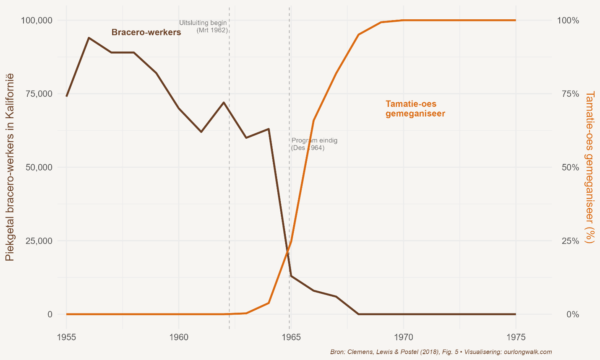
In die herfs van 1965 het Kalifornië se tamatievelde anders gelyk. Twee dekades lank het byna ’n halfmiljoen Mexikaanse mans elke jaar die grens oorgesteek om die tamaties te help oes. Hulle is bracero’s genoem – gehuurde werkers, ingebring as deel van ’n regeringsprogram wat tydens die Tweede Wêreldoorlog begin het. Toe, op die laaste dag van 1964, sluit Washington die program en stuur die bracero’s terug huis toe.
Politici het belowe dit sou goeie nuus vir Amerikaanse werkers wees. Haal die buitelanders uit die prentjie, het die argument gelui, en boere sou geen ander keuse hê as om beter lone aan plaaslike werkers te betaal nie. In die taal van die tyd is dit as “aktiewe arbeidsmarkbeleid” verkoop: Verwyder die migrante, gee die Amerikaners ’n hupstoot. Dit klink logies – minder werkers wat om dieselfde poste meeding behoort mos hoër lone te beteken.
Michael Clemens, Ethan Lewis en Hannah Postel, drie ekonome, het in die argiewe gaan krap om te meet wat werklik gebeur het nadat die bracero’s weg is. Indien dit waar is dat die afwesigheid van buitelandse werkerslone vir die plaaslike arbeiders opstoot, sou dit juis hiér, in die deelstate wat die swaarste op Mexikaanse arbeid steun, sigbaar wees. Hul eie model het voorspel dat plaaslone in daardie deelstate met sowat 12 persent behoort te styg.
Tot hul verbasing het die lone egter onveranderd gebly. Die indiensneming van plaaslike plaaswerkers het ook nie juis toegeneem nie. Die beloofde voordeel vir Amerikaanse werkers het nooit gekom nie. Waarheen het die besteding dan gegaan? Na nuwe tegnologie en na gewasse. Vir die tamatielande het produsente die Blackwelder meganiese oesmasjien gekoop en dít die bukwerk laat doen. In katoen en beet was dit dieselfde storie: Meer masjinerie en aansienlik minder hande. Waar die verbouing van ’n gewas nie gemeganiseer kon word nie, het boere eenvoudig minder daarvan geplant óf oorgeskakel na een wat wel kon. Lone het nie gestyg nie, en die werk self het verdwyn.
Klik hier vir ’n groter weergawe.
Hierdie eerste les geld lank nie nét vir Kalifornië nie: ’n Ekonomie wat werkers verloor, pas aan. Die voordele wat wetsbeplanners aan die mense wat agterbly, belowe het, vloei eerder na dit wat die werk goedkoper kan doen, soos masjiene.
Terug na die hede op eie bodem.
Suid-Afrika beleef vanjaar weer ’n vlaag woede teen buitelanders: optogte, dreigemente, mense wat by kliniekdeure en spazawinkels weggewys word, en die ou bekende eis dat “onwettige” buitelanders opgepak en verwyder moet word. Die rede, word ons vertel, is voor die hand liggend: Buitelanders vat Suid-Afrikaners se werk. Buitelanders dryf misdaad aan. Raak van hulle ontslae, en gewone Suid-Afrikaners sal beter lewens hê, word daar met groot sekerheid gesê. Ons het egter min bewyse dat buitelandse werkers wel die rede is waarom Suid-Afrikaners nie werk kry nie, of dat hul verwydering daardie poste vir iemand anders sal oopmaak. Wat ons wel beter kan meet, is wat gebeur wanneer daardie woede in beleid omgesit word.
Ons kan by ons eie geskiedenis begin, want Suid-Afrika het al voorheen ’n weergawe van die bracero-eksperiment probeer. Vir groot dele van die 20ste eeu het apartheidsbeleid die aanbod en prys van swart arbeid bepaal – deur instromingsbeheer, werkreservering en, sedert die 1970’s, toenemende loondruk toe swart werkers hulleself begin organiseer het. Namate dié arbeid in die formele ekonomie skaarser en duurder geword het, het werkgewers in die mynbou, landbou en vervaardiging gedoen wat die Kaliforniese produsente gedoen het: Hulle het gemeganiseer. Masjiene het ongeskoolde werkers vervang, en die ekonomie het op ’n pad beland waar al hoe minder blouboordjiewerksgeleenthede geskep is. Timothy Ngalande se navorsing oor die vervaardigingsektor in apartheidstyd wys hoe hierdie verhaal uitgespeel het. Die strukturele werkloosheid waarmee ons vandag sit, is deels die nalatenskap daarvan.
Werkers is ook nie net produsente nie. ’n Migrant is ’n werker wat om werk meeding, ja, maar is ook ’n klant wat help om werk te skep: iemand wat brood koop, huur betaal, taxi ry en kinders crèche toe stuur. ’n Noorweegse studie uit 2026, deur Sigurd Galaasen en kollegas, het hierdie invloed direk gemeet deur die elektroniese betalings van ’n hele land na te spoor. Plaaslike werkers wat meer aan migrante se besteding blootgestel is, se eie inkomste het sterk en toenemend gestyg. Deur te bestee wat hulle verdien, help migrante om plaaslike lone te verhoog. Dit is wat ekonome bedoel wanneer hulle sê migrante en plaaslike gemeenskappe vul mekaar aan. ’n Deel daarvan is die soort besteding wat ons pas genoem het. Baie daarvan lê ook in wat migrante na die werk self bring – opleiding, ’n ambag, sake-ervaring, en die idees, kapitaal en netwerke wat daarmee saamkom. ’n Kongolese elektrisiën of ’n Ethiopiese winkeleienaar bou iets wat nie voorheen daar was nie, en stel mense aan om dit te bedryf.
’n Tweede studie uit 2026, deur Angel Aguiar en Stephen Devadoss, plaas ’n syfer op wat dit kos om daardie skakel te knip: As net 30 persent van Amerika se ongedokumenteerde werkers gedeporteer word, skat hulle, sal die VSA se produksie met meer as $128 miljard krimp, met die grootste verliese in landbou, voedselverwerking en konstruksie.
Toegegee, hierdie wedersydse voordeel is dalk minder in ’n land soos ons s’n, waar miljoene mense daagliks werk soek, as in ’n ryk ekonomie soos Noorweë waar arbeid skaars is. Dit is waarskynlik ook waar dat die voordele van immigrasie en die koste daarvan anders uitspeel afhangend van wie jy is in Suid-Afrika. Dié van ons wat nooit saam met ’n immigrant in die tou staan vir werk nie, of wat hulle hoogstens as huiswerkers aanstel, of bloot opstelle soos hierdie een lees, geniet die voordeel, maar voel selde die mededinging. Die mense wat dit voel, is nie ons nie, en hul woede is nie net toe te skryf aan vooroordeel nie.
Maar dit gaan nie net oor lone nie. Baie van hierdie immigrante woon al dekades hier – hul kinders is in Suid-Afrikaanse skole, hul eggenote is Suid-Afrikaans, en dikwels praat hulle die tale wat ons praat. Hulle het lewens en ondernemings gebou binne ’n ekonomie waaraan hulle aktief deelneem, en ’n deportasieveldtog sal groot skade berokken.
Dit sal ook ’n toekoms ontwrig wat ons nog nie eens kan sien nie. Elke dreigement en elke verwydering sê vir die immigrante wat nog nie gekom het nie – dié wat dalk ’n onderneming sou begin en ’n paar mense sou aangestel het – dat hulle nie welkom is nie.
En hulle sóú gekom het, ten spyte van alles, want Suid-Afrika, met al sy probleme, is steeds die rykste ekonomie oor duisende kilometers heen – die plek waar ’n mens ’n lewe kan bou. Juis daarom is dit vir ons moeiliker as vir Kanada of Australië. Hulle migrante kom van oor die oseane; ons deel ’n lang, swak gepolisieerde grens met ’n armer streek. Ons kan nie ons geografie wegwens nie.
Wat staan ons dan te doen? As die probleem is dat te veel mense onwettig hier is, is die ekonoom se antwoord amper belaglik eenvoudig: Maak dit makliker om wettig hier te wees. Suid-Afrika het soveel ongedokumenteerde immigrante grootliks omdat Binnelandse Sake jare lank een van die swaks bestuurde staatsdepartemente was. Om ’n wettige visum te kry, kon langer neem as om ’n kind te hê. Die departement verbeter, maar te stadig. Maak die stelsel reg, en baie van die “onwettigheid” verdwyn vanself.
Lesers sal hierin ’n argument vir oop grense hoor. Dis nie wat ek voorstel nie. ’n Land is geregtig daarop om te weet wie sy grense oorsteek, en ons lang, poreuse grens is ’n werklike probleem wat ’n daadwerklike oplossing verdien: ’n grens wat behoorlik gepolisieer word, sodat toekomstige immigrante deur die voordeur inkom en minder mense voel hulle moet in die skadu’s skuil. Wettige status help met dieselfde doel. Iemand wat op die boeke is, kan belas en getel word; en waar iemand gevaarlik blyk te wees, kan hy opgespoor en verwyder word – mits ons ook die bekwame polisiediens bou wat ons steeds nie het nie.
Suid-Afrika het nie minder mense nodig nie. Dit het meer mense nodig wat wettig hier is – mense wat ondernemings begin, belasting betaal en Suid-Afrikaners in diens neem wat die werk bitter nodig het. Om duisende terug te stuur – erger nog, om dit aan skares by kliniekdeure en spazatoonbanke oor te laat om te besluit wie hier hoort – sal die Suid-Afrikaners wat agterbly, net armer maak. En dit is buitendien onmenslik.
Om buitelandse werkers huis toe te stuur, het in 1965 nie ’n enkele Amerikaanse plaasloon laat styg nie. Vandag kan ’n taak vinniger en goedkoper as ooit aan ’n masjien – of ’n reël kode – oorgelaat word. Die voordeel van enige deportasie sal dus waarskynlik weer na kapitaal vloei, nie na die werkers wat agterbly nie. Daar is min rede om te dink dit sal vir ons beter uitwerk.
Also read | Lees ook:
(Illegal) immigrants, migration and immigration: What is next?
Black African migrants are not the reason South Africa is broken