

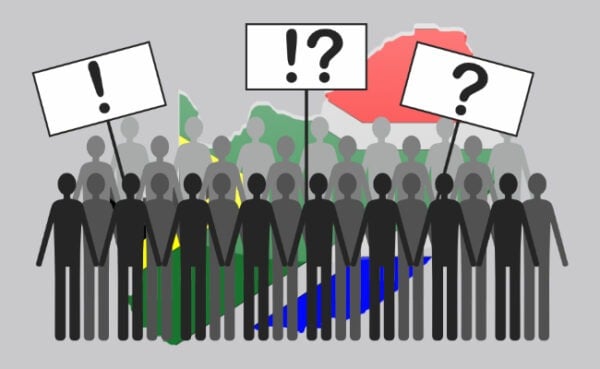
Images by succo and OpenClipart-Vectors from Pixabay
...
I have travelled to more than 22 other African countries, and in all those countries I was expected to produce a valid passport and sometimes even a visa. Was that unfair?
...
A few years ago, an anti-immigration group called Operation Dudula announced its arrival on the national scene. And not to be outdone, a few months ago, an even more influential group emerged. This one is called March and March, and is led by Jacinta Ngobese Zuma, a former DJ at KZN-based regional station Vuma FM. As if these two organisations are not giving enough of a headache to the government, there are also two “leaders” who are part of neither the Dudula movement nor March and March. They are Ngizwe Mchunu, a former Ukhozi FM DJ, and Nkosikhona “Phakelumthakathi” Ndabandaba, whose claim to fame – before this – was that he is apparently very good at stick fighting. These two gentlemen hold a lot of power and are able to mobilise and organise literally thousands of mainly Zulu men to march and amplify the anti-immigration narrative across different cities.
Fundamentally, these groups and individuals are saying the same thing: Anyone who enters the country must do so legally. And anyone who is not in the country legally should – in fact, must – leave the Republic of South Africa. There is also another element that says the “illegal foreigners” take jobs and businesses (especially spaza shops, hair salons, etc) which have always been run by South Africans. This sentiment, again, cements the view that illegal immigrants should leave.
These groups – some call them vigilante groups – have publicly made a deadline: 30 June 2026. By this date, which is just around the corner, all illegal immigrants should have left South Africa.
The government, at the highest level, has taken this matter seriously, such that on 7 June, President Cyril Ramaphosa addressed the nation and laid out a five-point plan. Key points included stricter law enforcement, which entails a major crackdown on the employment of undocumented workers, and border security and system reforms, which plans on preventing irregular entries and tightening immigration policies.
In recent days, the minister of police, Firoz Cachalia, confirmed that the South African Police Service (SAPS) has put a plan in place which will cost R600 million, to deal with any eventuality on and/or after the 30 June deadline.
Here are the facts that cannot be denied:
- Firstly, for decades, as a country we have never had an effective border management system. This is what has been termed by some among us as “open borders”. This has been exacerbated by corrupt government officials who, for a bribe, have allowed some people to enter the country illegally. This explains why our government has no clue how many people are currently in the country.
- Secondly, even for people who have entered the country legally, our government has no system of tracking them should they decide to overstay. And, as is to be expected, some have overstayed – for years. And then, thanks once again to corrupt government officials, you have people who have literally bought their citizenship.
- The third point to consider is that some of the illegal immigrants (also widely referred to as undocumented foreign nationals) end up, let us admit, being economically exploited by South Africans. These immigrants work in different sectors of the economy, including but not limited to agriculture, construction and retail (fuel stations, restaurants, supermarkets, etc). And then, some are exploited as domestic workers or men who maintain the gardens and yards in middle-class suburbia. In essence, there are South Africans who benefit handsomely from the fact that they pay salaries which are way below the government-prescribed living wage. Put simply, some South Africans benefit from the cheap labour of illegal immigrants.
It can also not be denied that there are some foreigners (in the country either legally or illegally) who are involved in criminal activities, from drug trafficking, tobacco smuggling and running prostitution rings, to illegal mining and smuggling stolen/hijacked cars out of South Africa. These individuals, just in case we have conveniently forgotten, work in cohorts with some South Africans, including corrupt police officials, who – after being given “cooldrink money” – continuously turn a blind eye to the criminal activities.
...
We are all Africans, and no African should be chased away from one part of the continent because of “imaginary” and/or “manmade” borders.
...
There are, it must be said, some South Africans who, based on their political outlook (mainly Pan-Africanism), are totally opposed to illegal foreigners being deported back to their countries. Their view is that “an African cannot be illegal in Africa”. Their stance is: We are all Africans, and no African should be chased away from one part of the continent because of “imaginary” and/or “manmade” borders. Some within this group even go on to say, “Everyone who is already in the country must just be made ‘legal’.”
The framework for that is not quite clear. The migration and immigration matter is quite complex, and there are no easy answers.
It is, however, clear that the first priority should be to prevent potential bloodshed on or after 30 June. It is obvious that – notwithstanding a handful of chartered flights and hired buses, mainly to Malawi – the vast majority of illegal immigrants are still in the country. And, as mentioned above, the government has no clue how many people are in the country illegally. The number is estimated to be a couple of million.
Therein lies a problem. On and/or after the deadline, will Dudula, March and March, and the likes of Ngizwe Mchunu stop people on the streets and ask for proof of citizenship? Will they also enter offices and other workplaces? That, as you can imagine, is bound to create friction between the state and these groupings.
The president, in his address to the nation, was very clear that the government will not tolerate violence, vigilantism or intimidation toward foreign nationals. Will we, in turn, see the government using what would be deemed heavy-handedness against its own citizens? What will the implication be, in both the short and the long term?
...
Something to consider as well is: What happens, for example, when a South African, after being asked for proof of citizenship, either refuses to produce an ID or is unable to prove that indeed he is a South African?
...
Something to consider as well is: What happens, for example, when a South African, after being asked for proof of citizenship, either refuses to produce an ID or is unable to prove that indeed he is a South African? Lest we forget, it was 18 years ago, in 2008, when we had “xenophobic violence”. In those few weeks, 62 people were murdered, and at least 21 of those were South Africans.
The point here is that whenever there is unrest, there is a high possibility that things can potentially degenerate very quickly and, in the process, people can die. This is best illustrated by what happened during the July 2021 unrest, when approximately 350 South Africans lost their lives. There are thieves, criminals and thugs who use such confusion to steal, rob, loot and kill, because, well, they know that the government’s resources are overstretched.
One question I keep asking myself is: Are the immigrants (both legal and illegal) already organising themselves, and are we going to see some of these immigrants literally fighting back and declaring, as some social media posts seem to suggest, that they will only leave South Africa in coffins?
...
There is absolutely nothing wrong – and this is my stance – when South Africans say, firstly, that everyone who enters our country must be in possession of the correct documentation and must do so at an official port of entry.
...
There is absolutely nothing wrong – and this is my stance – when South Africans say, firstly, that everyone who enters our country must be in possession of the correct documentation and must do so at an official port of entry. Secondly, no one should overstay their visit. Lastly, while in the country, obey all the laws of the Republic of South Africa. This is what all countries, as part of exercising their sovereign right, implement every single day. This is what the South African government was supposed to do for years. And this is not rocket science. It requires the government to take sovereignty and the rule of law seriously.
I have travelled to more than 22 other African countries, and in all those countries I was expected to produce a valid passport and sometimes even a visa. Was that unfair? Were those countries xenophobic toward me? No, not at all. Why must it be different when other people want to visit our country?
In any case, the chickens, finally, are coming home to roost – and it is not looking good. The gloves are off. Last month, Jacinta Ngobese-Zuma released a media statement where she stated categorically, among other things, “Ubuntu is suspended until further notice.”
In 2008, I visited the Kigali Genocide Memorial in Rwanda, where I not only witnessed documented accounts of the different atrocities, but also stood next to the mass grave where 250 000 bodies are interred. I realised how animosity and hatred can literally turn neighbours on each other and, in the process, unleash unimaginable violence. It is, therefore, very easy for me (within the 30 June deadline context) to think and imagine the worst.
...
You have to be extremely naive not to consider that there is the possibility of some violence one way or another on or around 30 June.
...
You have to be extremely naive not to consider that there is the possibility of some violence one way or another on or around 30 June. I do not want to sound pessimistic, and I hope I am wrong when I say it, but something big is potentially brewing, and unfortunately our government is, I fear, ill-prepared.
It is a known fact that some taxi associations have their own security companies. What I did not know, until recently, is that some of these security companies have also been protecting the spaza shops (run mainly by Ethiopians, Somalis and Pakistanis) for years. Just imagine the taxi industry on one side and the anti-immigration groups on the other side! That could, in the near future, be the perfect storm that no one saw coming.
Am I worried? Yes. Can the disaster be averted? Yes. We need strong, decisive leadership.
The time for speeches is over. What is required is visible action. The day after the president spoke about stricter law enforcement, including a major crackdown, I expected boots on the ground, including certain neighbourhoods being cordoned off and everyone being checked for their citizenship status. I expected to see joint operations (Home Affairs, police, labour inspectors, etc) in industrial areas in cities and major towns. But, as we can all attest, it has been business as usual.
I hope we do not, one day, look back and ask ourselves how we missed all the signs, signals and opportunities to avert a disaster. Let us hope for the best (but, pragmatically, prepare for the worst).
In the short term, let us secure the borders. All asylum applications must be processed efficiently. If their application, for whatever reason, is turned down, then they cannot be in the country. There must be an effective way of tracking visitors in our country. Corrupt government employees should be disciplined. And that should only be the beginning.
In the medium to long term, what this country needs is a total reset – a complete political overhaul. Otherwise, we will forever be jumping from one crisis to another. Until when?
- Sihle Khumalo is a South African award-winning and bestselling author. He has travelled, whether for business or pleasure, to more than 22 other African countries.
See also:
Black African migrants are not the reason South Africa is broken
Conversations beyond the comfort zone | Etienne van Heerden Veldsoirée 2023