

Photo: Engin Akyurt | Pixabay
...
We gain a certain understanding of Victorian classrooms at home and abroad, during the colonial period and after. We also learned of the contemporary cultures of neoliberal kitchens in neoliberal cities, and by implication, of many universities, their purposes of higher education and coercive relations of governance and management.
...
Introduction
A few months ago, a few colleagues and I were working in Cape Town. One of us, Professor Emeritus Gert van der Westhuizen, stayed on for a few days and was later joined by his wife, Leonie. As they travelled to the airport to return home in Pretoria, the car in which they were driving, was attacked at a street corner in Gugulethu. A rock smashed the window, hitting Leonie. A cellphone was grabbed. Cars with local residents guided Gert to the Gugulethu Health Centre. Leonie died a few days later. Her death deeply shocked our community. Gert and Leonie had been married for 59 years. Their four children have their own families, including several young children. Leonie was months away from completing her doctoral studies. Gert is now working on completing her thesis. He is working with us in trying to better understand violence and build a different, more humane academy, and a better South Africa. An injury to one must surely be an injury to all! Many South Africans understand this fact: violence in the new South Africa is part and parcel of the other crises in society. Including greed; in the words of PW Botha, referring to the black collaborators who worked the apartheid system: “Hulle het die sent voor die oog!” [I do not know how to capture that in English.] We also have a sense that things are deteriorating, or just “falling apart”. One can talk until the cows come home. It’s time to act – whether we presently understand everything properly or not.
Political violence, which is directed, organized, and programme-based differs from the types of violence explored below. “No justice. No peace.” is a well-known slogan of the American civil rights movement. It encapsulates an anti-pacifist position and the right of oppressed people to defend themselves. This is not the type of violence I wish to discuss. What interests me are (a) the day-to-day violence South Africans are gatvol of dealing with and (b) the hidden institutional violences embedded in daily life. The former is more well-known than the latter. I place them side by side because in important ways they are variations of one set of problems. This piece, therefore, seeks, in conversation with others, to contribute to understanding a variety of forms of violence:
- We shall start by discussing Diepsloot because it is repeatedly in the news and because it reminds me of the outrage one feels when thinking about Gert and Leonie.
- I then discuss violence in a kitchen in Bangkok. Diepsloot and Bangkok are of course very different places, a point I wish to stress. Violence is an issue of this place, in this part of Africa, as it is in other places, some of them across the globe.
- Similarly, in terms of time and history, I refer to violence in schools in Victorian England as a precursor to colonialism: and to violence in Montana, United States in the aftermath of colonial conquest. We or our parents and grandparents may find the stories about schools and classrooms from a different period, in different countries, familiar. Violence is transhistorical, contemporary and common in our schools today.
- I also discuss violence in higher education today because I think this area must still be properly researched. These untold stories about universities overlap with the other stories reviewed in the article. They point to a research agenda we are presently investigating.
- In ending the discussions, we connect the dots and briefly sketch the implications for change.
Across the topics considered above, I shall refer to cultural studies found in films and novels because they best capture what words and the language of the social sciences and statistics about violence do not. This brings us closer to the reality we wish practically to transform.
Diepsloot
As I write (end June 2023) the South African township, Diepsloot, is in the news once more. The community is up in arms about the crime in the area. Protests and demonstrations have been organized. A report in the Sowetan newspaper (23 June 2023) reads, “Mom in shock as son (15) is shot at Diepsloot home. One attack of many which sparked the [current] uprising”.
Screengrab from My Neighbour, The Rapist
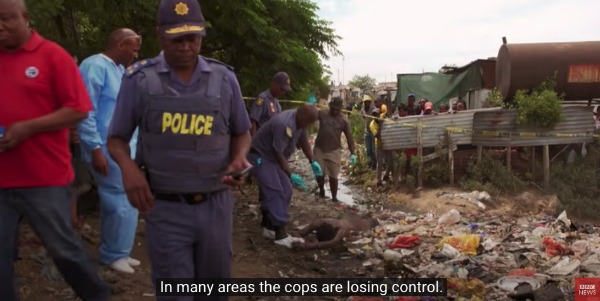
A few years ago, a journalist, Golden Mtika, who lived in Diepsloot, made a documentary about the pervasiveness of rape in his community (BBC, Africa Eye, 2018). It was called, “My neighbour, The rapist.” We learn from the documentary that almost one-third of the men here admit to having used force or threats to obtain sex. A community worker says, “They rape like there’s no tomorrow.” Below are extracts by rapists and a women’s vigilante group fighting rape.
We’d … rape your girlfriend with you watching us …
I’m HIV so I want to spread HIV.
If he [the boyfriend] doesn’t cooperate, we are going to have no choice,
but to stab him … Terminate him.
This is what the women say:
We burn the people [rapists]. Yes, we burn the people.
… we will kill you or burn you …
we start to hit first so that the person can die hard …
[then] we use tyre and petrol.
The use of tyres and petrol to torch collaborators of apartheid took place in black townships during the 1980s. Those of us who have middle-class sensibilities need a strong heart and stomach to watch Golden Mtika’s film. He relates that one of the rapists he knows was forcibly sodomized when he was a boy. He has become a serial rapist. Mtika attempts to get into the man’s head and is bewildered and shocked at the glimpses of horror he uncovers.
Apart from what the documentary implies about the new South Africa, this is also a problem of the Western academy. At one point, Mtika asks the vigilantes whether they had considered mistaken cases and had punished innocents. The question illustrates a broader problem in social science writing in which reality is sanitized and made palatable through the medium of the intellect and through the form in which reality is rewritten. Put another way, the form does not reflect visceral reality once processed in partial minds. A political implication could be it’s not as bad as we think.
Another question raised is, as Mtika implies, that responses from below and from those who suffer the most are not always problem-free.
One understands the desire to fight back and to defend because there is nobody else, least of all the post-apartheid state, to defend women in places like Diepsloot when night falls. But are the actions wise and with what consequences? Are there better alternatives to the resistance? This is one of the questions confronting communities in different parts of South Africa. If the state is weak, how do we take control of our lives? It is, at the least, a question of (a) what are the best resistance actions and (b) unity with other communities and the other groups in civil society. The two are interrelated.
Hunger
As South Africans, we tend to think of violence as a national, South African problem. Below I talk about violence as a:
(a) problem in the city of Bangkok;
(b) socio-economic problem of rich and poor and
(c) hidden and an open problem, embedded within the cultural life of an organization and the workplace.
We must not only think of violence as the type that occurs in Diepsloot against women. The divisions between the haves and the have-nots have grown globally within countries and between countries. South Africa reflects global trends as it simultaneously reflects national circumstances.
Source: IMDB
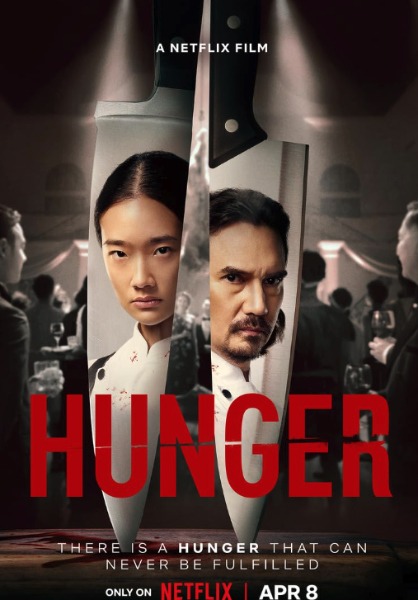
The name of the movie is Hunger (Jaturanrasamee, Mongkolsiri and Sukhum, 2023). It is also the name of a renowned Thai restaurant located in Bangkok. Hunger also refers to the ambition to succeed, to greed, and the sacrifices required en route to be top of one’s game – serving rich people. The chefs at Hunger cook excellent cuisine, albeit questionably defined. The leading characters are Chef Paul and the wannabe, talented upstart, Aoy. Chef Paul cooks “special” meals for those who can afford to hire him. Aoy hails from the underclasses and abandons her humble, family fried-noodle eatery to learn from the magnificent Chef Paul. Asked why she wants to work at Hunger, she replies, “I want to be special.” There’s desire, but also understated intensity, drive and perseverance in her acting and facial expressions. The leading actors and actresses all give wonderful performances. The understatedness of the acting mirrors the implicit dynamics of oppression and the abuse of power. What is transpiring beneath the surface thus becomes intertwined with what is occurring in the open for all to see.
The word special recurs throughout the movie. It reminds one of the word excellence and the goals of Ivy League institutions in the West in the service of their ruling classes. In this movie it is used to engage with the widening class divide in the country. The special, amongst poor people, have in the past and today been selected, seduced, and co-opted. Speciality and praise are two sides of the same coin. Seduction works with both, stroking egos through rewards for doing what is expected of you, as you are required to struggle and suffer. Praise is laced with the false tongues of praise singers paid to praise. In neoliberal Bangkok, like many other cities around the world, the difference between rich and poor has grown. By neoliberal I mean, among other things, the supremacy of the market and the decline of the social democratic state in the service of the people who elected it. A walk through the city of Bangkok bears testimony to the supremacy of neoliberalism, the national and international economic apartheid, alongside in proximity to each other. Aoy is duly identified as being “special” and recruited. The identities of the special are often split and contradictory because they come from the poor but have been co-opted by the rich. Not always. Darth Vader used to be a Jedi Knight in the movie series Star Wars; he went over to the dark side and stayed there.
Chef Paul runs his steel-shiny, silver-clean kitchen with an iron hand. Like the US army, this is not a democracy. Looking downwards, Paul demeans “his” underlings. Looking upwards, he has a certain contempt for the rich for whom he cooks, quietly revelling in the power he has over them through satisfying their desires. The distinction between him and those for whom he works might be thought of as ambiguous. Mocking them, he nevertheless keeps them satisfied. There is no ambiguity when an underling chef, without nuance, stabs him in fury with a knife. He was lucky to survive Paul’s pedagogy of force-inspired hatred which the cleanliness of his kitchen cannot hide. Within this act is a laser-sharp reminder of the hundreds of daily acts of silent violences perpetrated in Paul’s workplace. Culture has been defined as “the way we do things around here.” Here the culture of violence contrasts with the elegance of the cuisine, including the pretty little flowers used to adorn it.
Aoy succeeds despite the hardships and becomes as good as, a competitor even, her teacher, Chef Paul. Rags-to-riches. The rich brag about their humble backgrounds and forget to state that they have abandoned their class origins and now pray before other gods. This is what Paul says to Aoy as she reaches the top of her pile of excellence:
You are special now.
Is it fun?
From now on your only thought will be: “When will I fall off the edge? Am I getting too old? Am I a has-been now?”
You’ll cling to your success without realizing what you have lost.
Like now. You’ve already lost Tone [her lover].
Don’t panic yet. You’ve just begun.
You will lose a lot more.
This is what being a success tastes like.
Paul has insight into the darkness he represents. Its pursuit is relentless and knows no end. Paul’s contempt for his bosses dates back to experiences of the rich in his childhood. Remnants of bad memories remain in adulthood. He can draw on these experiences to teach his mentee how the system works. There might be an element of jealousy at play. Moreover, the mentee, a woman, is competing with the mentor and threatening to unseat him. She must be cut down and shown her place, lest the heady doses of excellence he enjoys go to her head, as it has to his.
Should understanding our rulers give them a get-out-of-jail-free card? If Aoy has had to sacrifice love, what, one wonders, has Paul sacrificed over the years. When Paul is arrested by police for illegally killing an endangered bird for a “special” meal, he cynically and/or in desperation remarks that his class connections will free him. We must be weary of sociological and historical insight engendering political redemption and empathy. Liberal social scientists in South Africa have been at pains to point out that apartheid was not that bad as they urge black people to forget the past and move on. Must the women in Diepsloot move on?
There is an ethical and moral question implicit in rat races to the top, apart from their class, or structural underpinnings. The well-known Marxist, Althusser, underestimated the importance of morality and culture and the power of the unstated “ways in which we do things around here”. Culture and morality can be determining. From the point of view of education, what values, for teachers and students, are being promoted? Whose values are they? Are they worthy of emulation? Food represents moral decay for the rich in the film; for the poor, it is about eating to live. The movie does not adequately deal with time in the sense of how long it took for Aoy to become better than all the other wannabe dogs. It does however convey a sense of the need for speed to cook under pressure to serve clients. The speed with which the vegetables are sliced and the precise time in which the beef is cooked contribute to the socio-cultural setting of the restaurant. It is disturbed, taut with tension, and cutthroat competition. Chef Paul drives his pupils to become as skilled as he is and no doubt many learn from the master. The movie sometimes feels like a horror show. It questions whether the glitz with which food is presented to those who can afford it is more important than taste. Whether in other words what is extrinsic triumphs the intrinsic and innate. In one scene the rich devour their food with red sauce dripping from their mouths. It is reminiscent of vampire-cannibals devouring the flesh of innocents. One can imagine how they conduct their businesses, how they govern, or what their gendered relations look like.
The pedagogical process is troubling. The perceived outcome, like excellent academic grades or in today’s world bibliometric scores in higher education, is overdetermined by the processes of teaching and learning. It enables critical evaluation. A price is paid for prized outcomes. Is it worth it? Did not one of the pupils almost kill the teacher? A feature of the hidden curriculum in education is cloning and the reproduction of the sages on the stage. Aoy eventually decides to leave Chef Paul and Hunger and return to her family - and cook for the poor. She turns her back on the world she had embraced and in which she had succeeded. The meaning of special cuisine too is questioned: Aoy’s great dish enjoyed by the rich and poor is a recipe for “cry-baby noodles” she learned from her grandmother. Taste and simplicity triumph over grandiose showmanship of form and the outward trappings of presentation. The dish is cooked “with love”.
1923, Charles Dickens, and corporal punishment in our schools
Violence is, of course, as much a feature of today’s world as it is of the past. It is instructive for us to bear this in mind as we grapple with current realities. History teaches us that to understand the present, we should understand the past to better deal with the future. I wish to illustrate very briefly and cursorily by discussing snippets, starting with 19th-century England. (That country recently crowned a new king with a diamond, stolen from our land and mined by black bodies.) The period we shall be reviewing ended in waves of violence as European armies conquered Africa and subjected it, by force, to colonial rule. The international violence of the ruling classes in England was mirrored institutionally inside their educational institutions. It was replicated in the colonies in which native populations were “civilized,” and made to be Christian. As stated, we, our parents and/or grandparents, may be able to tell similar stories as the ones related in this section. From the 19th century, we shall move to contemporary South Africa, but we start in the United States.

Source: IMDB
Below is an excerpt from Episode 4 of the television series 1923, set in Montana, United States, in the aftermath of the colonial conquest of American Indians (Sheridan, 2023; MTV Productions). A Catholic nun is speaking to a defiant indigenous student, tied to a chair:
You are a savage. Savage.
I’m trying to save you.
You are your own worst enemy.
You are a reminder of how your people lived.
You must want it.
You must want to be saved.
You must be cleansed, child.
You must be bathed in the blood to be saved.
Do you want to be saved?
No, I don’t.
The girl is repeatedly beaten into submission with a wooden ruler. That night she paints her face black and slips into the nun’s room and chokes the teacher to death. As she kills her, she says this in her indigenous tongue:
Know that this is my language.
Know that these are the words of this land.
Know that I am the land that is killing you.
I am the land and I am killing you.
She then takes the ruler used to beat students, heats it, and scorches the face of the dead nun. She says:
You love the ruler so much.
Now you can wear it forever.
She leaves the room, taking what looks like a sharp, pointed letter opener with her. Her actions, like those of the vigilante women in Diepsloot suggest revenge. A tooth for a tooth is a well-known theme of American Western movies. But here it also suggests, after the killing, preparations for resistance.
What about the motherland on whose magnificent empire the sun was said never to set? The motherland, that is, from which the missionaries came to spread civilization. What did some of its classrooms look like?
Charles Dickens (1846-7/2003, Chapter 12) describes the plight of the boys in the classroom of Mr Feeder, B. A:
They knew no rest from the pursuit of strong-hearted verbs, savage non-substantives, inflexible syntactic passages, and the ghost of exercises that appeared to them in their dreams.
This extract is from Dombey and Son, originally entitled Dealings with the Firm of Dombey and Son: Wholesale, Retail, and for Exportation.
The emotional abuse of children is manifested in the use of corporal punishment. It is a theme that runs through several novels of Dickens. He describes a teacher as follows:
There was no light nonsense about Miss Blimber. She kept her hair short and crisp and wore spectacles. She was dry and sandy with working in the graves of deceased languages. None of your live languages for Miss Blimber. They must be dead – stone dead – I and then Miss Blimber dug them up like a Ghoul.
Similarly, in Nicholas Nickleby, the establishment run by Wackford Squeers is described as follows:
With every kind sympathy and affection blasted in its birth, with every young and healthy feeling flogged and starved down, with every revengeful passion that can foster in swollen hearts eating its evil way to their core in silence, what an incipient Hell was breeding here!
Flung into this Hell until his untimely death, struggled a boy, Smike, with “stripes and blows, stripes and blows, morning, noon, and night.” (Dickens, 1838, Chapters 8, 12).
The curriculum of Miss Blimber, Mr Feeder’s teaching method, and Squeers’ reign of cultural terror are as devoid of the milk of human kindness and love, as is Chef Paul’s world. In these cases, across time and place the violences are socially embedded, structural and moral. Smike’s body could no longer take it physically. One can only imagine what psychological damage is wreaked in Chef Paul’s kitchen of excellence, the classroom of Mr Feeder – B.A., or the women, men and young people growing up in Diepsloot. Dickens was writing about 19th-century England and 1923 is set in the United States a few decades later. Here is a contemporary extract from our own country by Stats SA, today:
The Abolishing of Corporal Punishment Act, No. 33 of 1997 banned the use of corporal punishment in schools. Despite the ban, corporal punishment is still used as a form of discipline more than 20 years later.
Of those that reported experiencing violence at school, the most common form of violence experienced was corporal punishment by teachers. This is according to a recently released report by Statistics South Africa called Child Series Volume I: Children exposed to maltreatment, 2021. In 2019, just over 1 million out of 13 million school-going children aged 5 – 17 years reported that they had experienced some form of violence. Of those who experienced violence at school, close to 84% experienced corporal punishment by teachers, followed by verbal abuse by teachers (13.7%) and physical violence by teachers (10.6%). Between 2009 and 2019, the percentage of children who experienced verbal abuse by other learners increased by six percentage points from 18.1% in 2009 to 24.1% in 2019.
The above extract does not explain why teachers hit the children of the communities they serve and in which very often they themselves grew up. For Dickens, the cruel, one-eyed Wackford Squeers was an individual who, moreover, represented a socio-economic class in its relations with the poor. What happens inside township classrooms, mirrors what happens in surrounding communities. Schoolchildren bring these pathologies with them into schools and teachers are by and large left on their own to deal with the situation. To understand violence, we must try to understand its historical evolution and continuity. A great deal of work must be done in this regard.
Higher Education: a journalist and research agenda
“Research intensive” universities are portrayed as excellent and special, better than all the others who by implication, nationally and internationally, do not matter. In South Africa and in this part of the African continent, this translates into wanting to be like the Best in the West, Oxford, or Harvard. “The University of Namibia is irrelevant”. If they do not say it openly; current policies and actions imply it. According to the Eurocentric model the professoriate was historically granted control of universities. Their power sometimes clashed with the state. Today the trend has been to shift power from academics to managers and technocrats. Outdated business models emanating from the private sector are imposed upon educational institutions. This means competition in terms of national and international ratings. Knowledge creation is reduced to research bytes to be counted annually. It is not the quality of what you publish or research, it is how much of it, at what speed, often in terms of its “impact,” or the contribution to the economy that serves the few.
Much of this is well-known; what is less known, at least in print, is the cultural context at the level of academic departments as well as institutionally, and of the human cost for the people who work at these places. I have come across many anecdotal stories showing strong similarities with those of Aoy and Paul, including their current suppression. Paul, it will be recalled, tells Aoy that there is a price to be paid for success. He mentions that she had already lost her lover. He did not mention the daily toll, over time, on well-being. Managerial, institutional, and departmental relations of power are embedded within policy in higher education institutions. It has fundamental consequences for academic freedom and what African universities in this part of the continent might look like. As you pursue your career and wish to get on in the world you can forget about a personal life or a family life, or a life in community with others.
Jump-starting further discussions and actions
The stories we have reviewed (and those we must still collect) mirror, albeit differently and across history, what is happening in the wider world.
We gain a certain understanding of Victorian classrooms at home and abroad, during the colonial period and after. We also learned of the contemporary cultures of neoliberal kitchens in neoliberal cities, and by implication, of many universities, their purposes of higher education and coercive relations of governance and management.
The open manifestations of these social pathologies are intertwined with those that are hidden in everyday life. We must unearth them. Hang out the dirty linen of excellence for all to see, so to speak.
Additionally, the power of cultural studies like film and journalism should not be underestimated. They demonstrate the real world in ways in which government statistics about crime, or academic discourses cannot capture. This, moreover, helps us understand what we and our communities must do to effect social change.
In considering what is to be done I am mindful of the limitations of these notes which are meant to jump-start further discussion. I have said little about violence and race, mainly because I wished to stress the neglected area of socio-economic class in South Africa. In the corporate university, knowledge that is collaborative and created in a community is not prized. We should not reproduce their world but together develop alternatives.
There are also areas such as violence within the nuclear family which I have not touched upon, or the threat of nuclear war between Russia and the United States in Ukraine, or the United States and China.
I do not know whether the global village or we in South Africa, have the luxury of waiting for the cows to come home. We must with urgency, strengthen civil societies, religious societies, and trade unions - from below, as we keep talking to one another.
References
1923. Television Series, Episode 4. (2023). Taylor Sheridan. Paramount. MTV Studios in association with 101 Studios.
British Broadcasting Corporation (BBC) Africa Eye Documentary (2018, July 17). My Neighbour, The Rapist – [Video]. YouTube https://youtu.be/rpjNz8VrXFk
Dickens, C. The Life and Adventures of Nicholas Nickleby (1838). Retrieved July 2, 2023, from https://www.shmoop.com/realism/social-critique-characteristic-nicholas-nickleby-example.html#
Dickens, C. (1846-7/2003). Dombey and Son. Modern Library: New York.
Jaturanrasamee, K., S. Mongkolsiri & S. Sukhum. 2023. Hunger. Netflix.
Stats SA (2023). “Corporal punishment still in schools despite ban https://www.statssa.gov.za/?p=16128. Accessed 16 July 2023
Kommentaar
Yes thank you, Everard, for putting violence on these and other pages. We are agreeing, enough is enough. What tipping point actions can stop the violence? Change the culture to a culture of caring? Dignified livelihoods?