

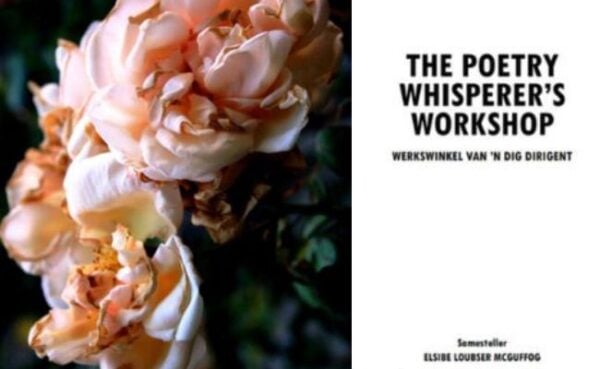
Photo of roses: Elsibé McGuffog
- This reader’s impression was written and sent to LitNet on the writer's own initiative.
The poetry whisperer’s workshop, compiled by Elsibe Loubser McGuffog and printed by Print on Demand Cape Town 2025
The poetry whisperer’s workshop is the takeaway from a project inspired by Alison Gwynne Evans, head of the Western Cape Branch of SACEE (the South African Council for English Education).
The compiler of this intriguing publication is Elsibe Loubser McGuffogg. Elsibe is known in educational and creative circles for her innovative approach to learning and unbridled involvement with and contribution to the written and visual arts. The sense of the person behind most of the writings in The poetry whisperer’s workshop underscores the notions that an artist is an artist by virtue of the way in which they engage with the world, and that teachers are born, not made.
The A4 format of the publication and glossy cover, with cover design by Peter Pitt, hint that what the reader is about to encounter is the product of something greater than the workshop from which it emanates: a celebration of poetry and its lasting relevance.
........
Central to the workshop is the idea that the future of poetry should be affirmed, even in times where AI is set to challenge all areas of human endeavour.
........
Central to the workshop is the idea that the future of poetry should be affirmed, even in times where AI is set to challenge all areas of human endeavour. “There is uncertainty about the future of poetry as well as education considering AI,” it is stated in the foreword. During the proceedings Nikiwa Ndobula, lecturer at the University of the Western Cape’s Education Department, asserted that poetry has lasting relevance in that it involves the poet’s own lived experience. Indeed, one must wonder whether some of the delightful and imagery-rich poetry by Elsibe and other poets in this collection could be matched by AI. To my mind there is a strong probability that it eventually will be. Ask then whether poems would have the same emotional effect on the reader if there was not a glimpse of the poet’s experience between the lines. In “Running Away from Home”, Mishé Williams makes memory and presence felt, and this helps readers relate this to any personal memories of running away from home.
We made fires from plastic bags in the night hours
My mother did not know where we were.
But what if the reader was aware that the same poem had been written by AI? How would readers respond to it then? Whatever the answer, The Poetry Whisperer’s Workshop draws the reader into topical questions and creates the need for us to explore them.
Cultural heritage, the writing of poetry as a means of expressing that heritage, and personal creative growth are really what underpin the raison d’être of this book. Elsibe’s poem “Krotoa, Eva of the Cape”, for example, is suggestive of the relationship between South African culture, education, language and poetry:
“Walking on the edge of the earth, becoming too clever,” he says
Where are her descendants now?
The poem suggests that her descendants are lost, “… under bridges with dreadlocks and graffiti”. I smile at the sweet irony of the poem, having recently visited my Alma Mater in Stellenbosch to find that the building where I started my journey as a language practitioner is now named “Krotoa”. In this book Krotoa is further celebrated by her likeness, sketched by Robin Williams. Several other artworks including compelling work by Peter Pitt reflect the richness of the imagery in the poems, even although they are not necessarily directly illustrative.
Elsibe’s visibility as the main poet in the offering echoes the title, The Poetry Whisperer’s Workshop, and applauds the idea of poetic pedagogy in which poems themselves are used as the medium for teaching the elements of its structure. Regarding pedagogy, Lukhanyo Govuza’s “Poem about Teaching” is focussed on the teaching of “little ones” and is rendered appropriately in the rhyming couplets often used in children’s literature to aid engagement and memorisation.
The outcome of the workshop is multilingual and includes original poems and translations into Afrikaans and isiXhosa. This would ideally serve as a gentle urging for teachers and workshop facilitators using this work as a reference to be mindful of the South African social scenario and the advantages of multilingualism. The multilingual approach further curates a feeling of interconnectedness between the languages and the participants in the workshop. There is an interconnectedness too in the fact that participants are not restricted to their specialist skills in their contributions. Graphic designer Muldene Dempers from Ginger Designs, in “Die buitestaander klop aan my deur”, gives format to her feelings in the design choices she makes in the final words, to her tormentor, written on a message board:
NEE!
NOOIT, OOIT WEER NIE!
GLAD NIE!
DIE OORWINNING SAL JOU NOOIT GEGUN WORD NIE.
The poems in this work represent themes of land, identity and language. The main poems themselves encourage the use of imagery and extended metaphor, and basic form, as in “Haikus for Breakfast” by Elsibe.
The Poetry Whisperer’s Workshop as reviewed is still in a naïve state; a simple and honest representation of work created during a workshop. The naïveté is intentional as suggested by the first names denoting the participants. With upscaling and attention to the elements of educational material, such as statement of objectives, intentional structuring, signposting and targeting, it could be the beginning of a series of important work. The stated aim of the original project is to get people writing.
The sustained use of poetry in the interest of self-awareness and the heightened consciousness of an inspired, creative and hopeful society is indeed an important aim. If AI is to take over this area of human endeavour, let it be our task to inform the algorithms in such a way that we can safely employ them to deepen our humanity.

Also read:
One pot cookbook for South Africans deur Louisa Holst: ’n resensie
Tietie en Nanna se huiskos deur Najma Abrahams en Azba Fanie: ’n resensie