

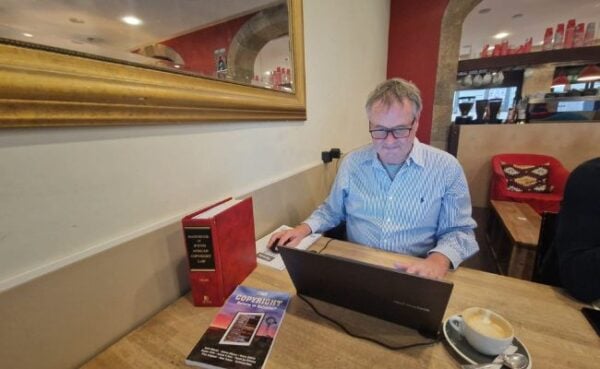
André Myburgh’s photo is provided and appears with permission (the photographer was Daniel Myburgh).
Translation into English of “Wysiging op wysiging van die Wysigingswetsontwerp op Outeursreg?” by André Myburgh (assisted by Deepl.com)
André Myburgh speaks with Naomi Meyer about the recent ruling of the Constitutional Court regarding the amendment of South Africa’s Copyright Act 98 of 1978.
André, I have spoken with Catrina Wessels a few times on LitNet about the so-called Copyright Amendment Bill (B13B-2017) (CAB) – the amendment to South Africa’s Copyright Act 98 of 1978 (https://www.litnet.co.za/ copyright-amendment-bill-referred-to-constitutional-court-an-interview-with-catrina-wessels /; https://www.litnet.co.za/kopiereg-billike-gebruik-en-kunsmatige-intelligensie/). Why is it in the news again now?
Yes, the Copyright Amendment Bill, which was introduced to Parliament almost ten years ago in 2017, is in the news again. This comes after the Constitutional Court’s ruling on 26 June 2026, in response to President Ramaphosa’s 2024 referral of the Copyright and Performers’ Protection Amendment Bills to the Court over his concerns about the constitutionality of certain new exceptions to the exclusive rights of copyright and performers’ rights.
Copyright exceptions define cases where works protected by copyright can be reproduced without permission and thus without compensation. The exceptions in the Bills include the controversial “fair use” clause, as well as expanded exceptions in favour of educational institutions, libraries, archives, museums and galleries, and an expanded exception for translations.
The main points of the ruling are:
- The Constitutional Court unequivocally, and for the first time, recognised that copyright, just like other intellectual property rights, is a property right protected against arbitrary expropriation by the Constitution, and that legislating an exception amounts to a deprivation of property.
- One set of the new exceptions in favour of educational institutions was found to constitute an unconstitutional arbitrary deprivation of property.
- The Court based its finding of unconstitutionality solely on the text of the president’s referral. The Court refused to hear complaints about the unconstitutionality of a multitude of other provisions, because they were not contained in the president’s referral.
- The remaining exceptions, including “fair use”, were interpreted and found by the Court to be constitutional “within the scope of the president’s referral”.
- The Court emphasised that its finding does not amount to a “mini-certification” of the provisions that were upheld, and confirmed that the constitutionality of those exceptions can still be challenged in the future if a factual situation were to arise that proves their unconstitutionality.
In its finding of the unconstitutionality of the exceptions in favour of educational institutions, the Court said, among other things, the following, which may at least put authors of educational works a little more at ease:
Education is a constitutional right, but it is the state that bears the duty to fund that right in public institutions, not private authors whose works are the product of legitimate commercial activity.
(The exception) cannot be justified as a mechanism for relieving the state of its obligations by conscripting private rights holders.
Aspects of the CAB were declared not to be unconstitutional, and other aspects were found to be partially unconstitutional. They did not answer some of the questions on which the president had asked the Constitutional Court for a ruling! Please would you break down the judgment so that our readers can understand what the Court said?
The remaining exceptions (ie, exceptions other than those for educational institutions) were not “declared not to be unconstitutional”, but “constitutional within the scope of the president’s referral”! That is a very unusual choice of words.
The Court’s reason for this is that they analysed those restrictions and, in their analysis, interpreted the exceptions very narrowly. This means that the exceptions are constitutional provided they are interpreted and respected following this narrow interpretation.
Because the Court based its findings on the text of the president’s referral, it rejected or did not even mention much of the evidence presented by the amici curiae (friends of the court). In its analysis of the “fair use” clause, for example, it interpreted the factor of “substitutional effect” as a narrowing of “fair use”, while there was evidence before the Court from an expert from the USA (where “fair use” originates) that “substitutional effect”, together with the absence of the inclusion of “the value of the copyrighted work”, would amount to an expansion of the exception. The factor “purpose different from that of the work affected” was not mentioned in the analysis at all.
Among the permitted purposes of “fair use” is “proper performance of public administration”. Again, evidence that this purpose does not appear in the original US “fair use” clause and is not permitted by case law there was not mentioned, and its scope was not analysed.
Another peculiarity of the South African “fair use” clause that the Court did not analyse, is the requirement that the source and the name of the author whose work is “used” must be cited if they appear on the “used work”. This requirement is not part of “fair use” in the USA and will have a narrowing effect on “fair use” in South Africa.
The Court’s analysis is therefore unconvincing, but its findings that the new exceptions should be interpreted narrowly and in the public interest create a guideline that will be binding on “uses” of copyright works without permission or compensation under these exceptions.
Among commentators’ unanswered questions is also how Parliament could have adopted these exceptions into law without an impact study. The Court accepted that the absence of an impact study could be considered in the context of the president’s concerns, but then the Court’s judgment did not address this omission in that context.
What happens now?
Due to the finding of unconstitutionality of one set of the exceptions, the president cannot sign the Bills. He must therefore return the Bills to Parliament so that Parliament can decide on the unconstitutional provisions. This means that the Bills will be presented to the Portfolio Committee for Trade, Industry and Competition for a fourth time (after 2017, 2020 and 2024).
The object of resubmitting the Bills would be for Parliament to replace the unconstitutional provisions with constitutional ones or to remove them, but it is also possible that the Bills could be rejected or withdrawn (which is what happened in 1999-2000 with the only other national bill that was found unconstitutional in a similar process). If Parliament adopts amended bills and the president has no objection to the constitutionality of the revised provisions, he must sign the Bills into law.
The Copyright Act of 1978 sounds old and certainly deserves attention, but it’s no longer the same piece of legislation that was enacted in 1978. A few amendments have already been made concerning technology, computer programs and indigenous rights (the last of these not yet in force after 12 years). We haven’t even begun to talk about copyright in relation to phrases like “computer-generated” and their implications, or the fact that there is no provision catering for artificial intelligence. But let’s talk about this case, which has just been before the Constitutional Court. It is mainly about property. But what does this have to do with copyright?
The ruling was the first from the Constitutional Court to recognise copyright unequivocally as a right of property that is protected against arbitrary deprivation.
It is true, yes, that the Copyright Act is outdated, and everyone agrees that it should have been modernised years ago. The current edition of this story has been running since 2009! Feel free to read chapters 1 and 28 of Copyright reform or reframe? (Juta, 2023). (The chapters in our book are deliberately mostly short and self-standing.) The Constitutional Court’s ruling changes nothing from what we wrote three years ago:
It is important to note that the Bills do not meet what are stated objectives: principally of benefiting authors and performers, and bringing our law up to date for the digital age.
In recent years, jurisdictions around the world have considered (legal remedies to combat online infringement) and numerous other topics that arise from recent technological developments, such as the "value gap" between income attributed to the streaming of musical works and sound recordings for profit and the remuneration received by copyright owners and performers, a private copy levy on digital as well as paper reproductions, the distribution of news media content by digital platforms, decompilation of object code in computer software, text and data mining and machine learning for artificial intelligence. None of these topics have been addressed in the Bills. Instead of bringing South Africa’s copyright legislation into the digital era, it would remain retarded by the Bills.
Online content piracy is a global problem that has escalated dramatically in recent years due to a rise in illicit streaming platforms and torrent sites, web hosting services that ignore copyright infringements perpetuated on their servers, and the anonymity behind which offenders are often shielded.
Operators of pirate sites and the servers on which infringing content is stored are often based in other countries to where the infringing content is made available to consumers. This situation poses great challenges to rights holders to enforce their rights of copyright. This situation was recognised by former president Zuma in a speech he made to performing artists and representatives from the cultural industry sector in 2009, when he said, “Piracy, like intellectual property theft, affects the income of many artists.” However, his awareness of the problems posed by piracy was not followed through by the introduction of remedies to combat piracy in the Bills.
(R)eform of the Copyright and Performers’ Protection Acts is long overdue. However, the current measures in promoting the Bills seem to ensure that such an end is not yet in sight.
The consequences of the Court’s decision are that uncertainty over the constitutionality of numerous provisions of the Bills will persist after their adoption and entry into force, and creators and owners of copyright works will have to turn to the courts time and again to protect the rights in their works.
- André Myburgh is a retired South African-qualified attorney and an honorary member of the South African Institute of Intellectual Property Law, residing in Switzerland. In his practice, he specialised in intellectual property law, specifically copyright, and he is the lead author of Copyright reform or reframe? (Juta, 2023), a comprehensive legal analysis of the Copyright and Performers’ Protection Amendment Bills.
Also read:
Wysiging op wysiging van die Wysigingswetsontwerp op Outeursreg?