

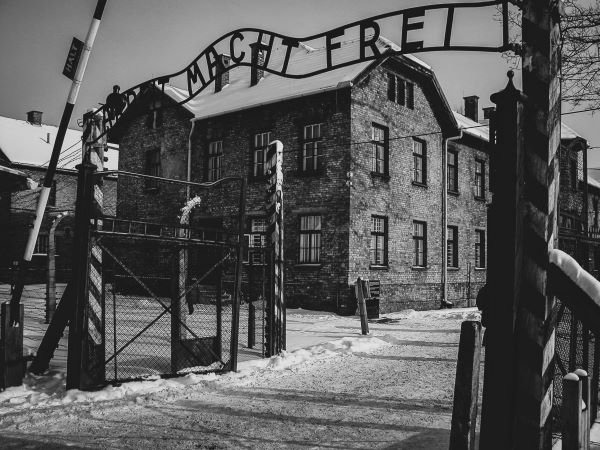
Photo: Frederick Wallace on Unsplash
“I warn you that you have not come to a sanatorium, but to a German concentration camp from which there is no way out, save the chimney!”
– Untersturmführer Ernst Grabner’s executioner at Auschwitz, Fritsch, greeting new arrivals
Last month, on Monday, 27 January, King Charles was photographed wiping away a tear on the 80th anniversary of the liberation of one of the most notorious of the German concentration camps, Auschwitz, in occupied Poland. At the same time, a rather shocking poll in the UK found that a disturbing number of younger Britons either had never heard of the destruction of human beings on a mass scale in the concentration camps during the Second World War, or were largely ignorant of the facts. There were similar findings in the US. In both cases, almost half of all young people were unable to name a single one of the Nazi concentration camps. And, in fact, many are unaware that the Nazis were in fact German, according to Times Radio (news broadcast, Wednesday, 29 January).
.......
As Russell notes in the introduction, at the lowest calculation some 12 million men, women and children were put to death by Hitler. “Not in battle, not in passion, but in the cold, deliberate attempt to destroy whole nations and races. Genocide conducted like some mass production industry – 12 million murders.”
........
One wonders how many young people in other countries, like South Africa, are aware of the staggering extent of the killings, often referred to as the Holocaust. The only other mass murders in recent history on a similar scale were those ordered by Stalin and Mao Tse-tung. Russia and China are still not fully transparent about what happened, and consequently do not mark the occasion with ceremonies of remembrance.
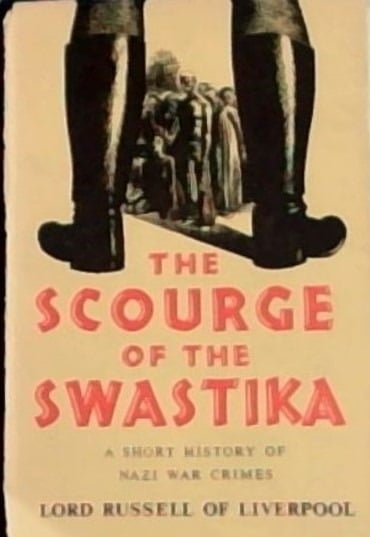
The scourge of the swastika: A short history of Nazi war crimes by Lord Russell of Liverpool
One of the most accurate – and appalling – books I have ever read about the German death camps was written by Lord Russell of Liverpool (The scourge of the swastika, published in 1954 by Corgi). Hundreds of thousands of copies were sold around the world. It is a terrible indictment of Germany, an allegedly civilised European country. As Russell notes in the introduction, at the lowest calculation some 12 million men, women and children were put to death by Hitler. “Not in battle, not in passion, but in the cold, deliberate attempt to destroy whole nations and races. Genocide conducted like some mass production industry – 12 million murders.”
Russell’s account is devoid of sensationalism and is absolute, irrevocable fact – scrupulously based on eye witness accounts, captured German documents and records of the Nuremberg war trials. He describes how, by the Presidential Emergency Decree of 28 February 1933, Hitler introduced Schutzhaft (protective custody) into the legal system of the German Third Reich. It was enough to show even the slightest sign of potential opposition to the new Hitler regime to be arrested and thrown into one of the new “concentration camps”. Thousands upon thousands of ordinary Germans were incarcerated without trial in these camps – many if not most never to be seen again. A veil of secrecy was thrown over the camps, and officially inspired rumours deepened the mystery and heightened the dread of what went on there. It was a deliberate ploy to keep the general population in line. In this way, Hitler’s Gestapo – whose task was to sniff out “enemies of the Party and the National State” – sent innocent Germans to the camps for “treatment”. The camps were run by the feared SS, the Sicherheistdienst. With the outbreak of war in 1939 and the invasion of Poland, the existing concentration camps in Germany, already holding thousands of prisoners, were expanded into occupied territories. Over time, these camps have become household names: Auschwitz, Belsen, Buchenwald, Flossenbürg, Mauthausen, Natzweiler, Neuengamme, Ravensbrück, Sachsenhausen, Dachau, Treblinka, Majdanek and Oranienburg.
........
[M]ass killings were conducted with the efficiency of a motor car assembly line in the gas chambers and ovens of Auschwitz, Dachau, Treblinka, Buchenwald, Mauthausen, Majdanek and Oranienburg.
........
Not all the camps were death camps, but mass killings were conducted with the efficiency of a motor car assembly line in the gas chambers and ovens of Auschwitz, Dachau, Treblinka, Buchenwald, Mauthausen, Majdanek and Oranienburg. Russell notes that some eight million of the total 12 million murdered in the war by Hitler’s SS were killed in these specific camps. Sir Hartley Shawcross, chief prosecutor for Britain at the war crimes trials, said that of the total 12 million murders, six million were Jews, according to the killers’ own figures – which means that two thirds of European Jewry was exterminated.
Millions were brought from the occupied territories to these camps, some deported as slave labour but no longer considered fit for work. Also, there were many Russian prisoners of war, and others were so-called Nacht und Nebel – night and fog – prisoners from Germany. After being worked into the ground, they were slaughtered by mass execution in the gas chambers. We could think of them as having simply “disappeared” – a phenomenon common in Argentina in the 1980s during the days of the Junta.
Auschwitz

Auschwitz, Poland (photo: Karsten Winegeart on Unsplash)
A couple of hundred kilometres from Warsaw, this “konzentrationlager” was enlarged and upgraded as a proper death camp in 1941, in tandem with Birkenau nearby, which was built for 100 000 Russian prisoners.
SS Hauptsturmführer Rudolf Hoss, who wrote a detailed report for his captors after the liberation of Auschwitz, described the process of mass murder after the four large crematoriums had been completed at the end of 1942. Once transports began to arrive from Belgium, France, Holland, Greece, Romania and other countries in occupied Europe, the trains drew up alongside a specially built ramp. Prisoners fit for work were taken to the work camps. The others were escorted to one of the new crematoriums.
........
Large numbers were involved: at one time, 10 000 people were passing through the gas chambers daily. Not less than 2,5 million people, by the commandant’s own calculation, were murdered in this way in Auschwitz, and another half million in other ways, which included shooting and medical experiments.
........
Large numbers were involved: at one time, 10 000 people were passing through the gas chambers daily. Not less than 2,5 million people, by the commandant’s own calculation, were murdered in this way in Auschwitz, and another half million in other ways, which included shooting and medical experiments. Lord Russell writes:
The victims were first conducted to a large dressing room adjoining the gas chamber. This room was fitted with benches and coat hooks, and the prisoners were told by interpreters that they were going to have a bath and be deloused, and to remember where they had hung their clothes. From there, they proceeded to another room which was fitted with showers to give verisimilitude to the instructions they had received from the interpreters.
The gas then emanated from the showerheads. After half an hour, the gas was turned off. Electric air conditioning units were switched on, and the bodies taken up to the cremating ovens by lift. Two thousand corpses were cremated in five cremating ovens, and the process took 12 hours.
Women, suspecting the worst, often hid their children under their clothes as they hung them up. But the SS were wise to this, and after a search any children found were put in the gas chambers along with their mothers.
During his time at the camp, Horst, nothing if not efficient, executed 70 000 Russian prisoners of war, usually by gas, but also by shooting and lethal injection, which was widely used. For example, on 6 July 1944, four British women who had been working clandestinely (they had been parachuted into France) to keep communications open between De Gaulle and the French resistance movement, having been arrested by the Germans, were murdered with injections of Evipan at the Natzweiler concentration camp in Alsace.
Lord Russell also highlights the atrocities committed during military campaigns, such as mass executions in Eastern Europe and the destruction of entire villages as acts of reprisal. Ukraine was a region of special interest for the SS, who massacred tens of thousands of Jews, usually by means of military-style firing squads.
Crimes against the Allies
Murders were not confined to civilians, however. Quite soon after the outbreak of the war, it became apparent that Hitler had no qualms about murdering Allied prisoners, in contempt of the Prisoner of War Convention of 1929, to which Germany was party. Lord Russell highlights numerous instances of captured British and other Allied soldiers being shot out of hand – too many to mention here. Suffice it to say that the Allied military tribunal, in their judgement, said that the shooting of unarmed prisoners of war was the general practice in some Waffen-SS divisions.
In conclusion, it is worth reflecting on the remarks by Shawcross in his opening speech at the Nuremberg trials of major German war criminals:
Apologists for defeated nations are sometimes able to play upon the sympathy and magnanimity of their victors, so that the true facts, never authoritatively recorded, become obscured and forgotten. One has only to recall the circumstances following upon (the First World War) to see the dangers to which, in the absence of any authoritative judicial pronouncement, a tolerant or credulous people is exposed. With the passage of time, the former tend to discount, perhaps because of their very horror, the stories of aggression and atrocity that may be handed down; and the latter, the credulous, misled perhaps by dishonest propagandists, come to believe that it was not they but their opponents who were guilty of that which they would themselves condemn … and so we believe that this Tribunal … will provide a contemporary touchstone and an impartial record to which future historians may turn for truth and future politicians for warning.
........
[I]n most cases, the causes and atrocities of the wars – Korea, Vietnam, numerous struggles for liberation across Africa and the Middle East, Latin America and a dozen other settings – have been brushed over or inadequately brought to light.
South Africa stands out as an exception, with its Truth and Reconciliation Commission. But the truth of the lessons of Auschwitz holds true for a world in conflict since 1945, and makes the 80th commemoration all the more important.
........
Indeed. These remarks could easily have had agency in so many conflict settings in the years since, but the tragedy is that they have been little heeded; in most cases, the causes and atrocities of the wars – Korea, Vietnam, numerous struggles for liberation across Africa and the Middle East, Latin America and a dozen other settings – have been brushed over or inadequately brought to light. South Africa stands out as an exception, with its Truth and Reconciliation Commission. But the truth of the lessons of Auschwitz holds true for a world in conflict since 1945, and makes the 80th commemoration all the more important.
As Lord Russell says, it is only when one recalls what was done in Germany between 1933 and 1939 that one can see in their true perspective the crimes committed during the war in Nazi-occupied Europe. The suppression of free speech, including the freedom of the press, the control of the judiciary, the confiscation of property, the restrictions on the right of peaceful assembly, the censorship of letters and telegrams, the monitoring of telephone conversations, the regimentation of labour, the denial of religious freedom: these are the bonds with which a tyrant binds his subjects, he says.
And if Hitler thought so little of his own countrymen, is it little wonder, adds Lord Russell, that he should have regarded as less than vermin, the peoples of the countries which his armies invaded? In our own highly monitored digital age, where very little is secret online and where even in the UK social media messages are intercepted and hacked by interested parties, the loss of freedoms enumerated by Lord Russell is a banging tocsin, a solid warning for all freedom-loving countries who value democracy and the rule of law.
Also read:
General De la Rey and his accidental part in Hitler’s downfall
D-Day, 6 June 1944: South Africans who made history during the invasion of France
Power politics in the Middle East: How the global North-South divide capitalises on trauma