

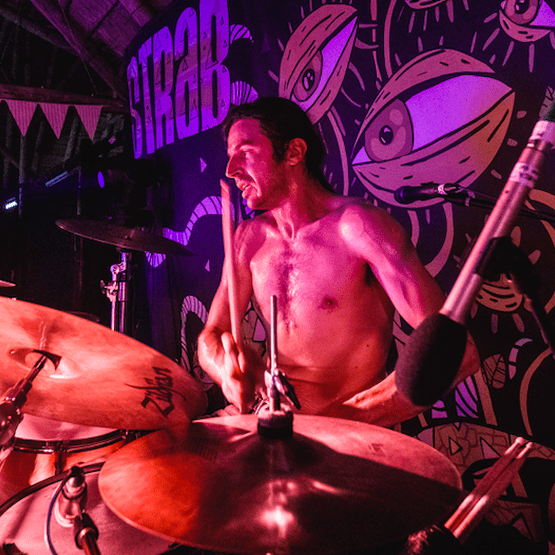
Jean Marais (photo: provided)
- Parts of the introduction, conclusion and “Kastige vryheid” section in this review were first published on No clean singing, a blog/zine/site for bespoken artire of hypogeal sonic artifice.
There’s something that Jean Marais probably could care less about, with regard to whether it was included in this article. He has a natural advantage and actually is a bit of an X-Man, seeing that his hearing is on the level of certain bloodsucking nocturnes. The only blood imbibed on this artist’s behalf would be what’s licked dripping from his fingers postpartum.
Artists, you see, whether X- or Y-chromosomed, know all too well that producing a piece of art is like both a birth and a death. There are labels one can tag onto a person of our subject’s disposition. Jean may be blind, but one thing I know for certain is that his sense of humour most certainly induced him to serenade Korn’s first single ironically with a shit-eating grin way back when it first dropped.
I’m also positive that he doesn’t find being called “that metal drummer” funny anymore, seeing that he’s not been playing metal for a long time. He used to play in crossover bands like Antipathy and Belhamel, but these days his interests lie more in exploring funk, rock, reggae, folk and especially African music.
.......
Drummers almost never ply their trade for just one project, and Jean is no different, but he made a choice long ago that music would be both muse and arbitrator of his reality.
.......
However, this label-averse writer would lean towards the more apt boxes of multi-instrumentalist musician, businessman, teacher, writer, thinker and visionary – a walking metronome. Drummers almost never ply their trade for just one project, and Jean is no different, but he made a choice long ago that music would be both muse and arbitrator of his reality.
What follows is a review of Jean Marais’s EP Khayatunes, conceived and produced during and post the lockdown, with an enlightening and refreshing discussion with the artist following the review.
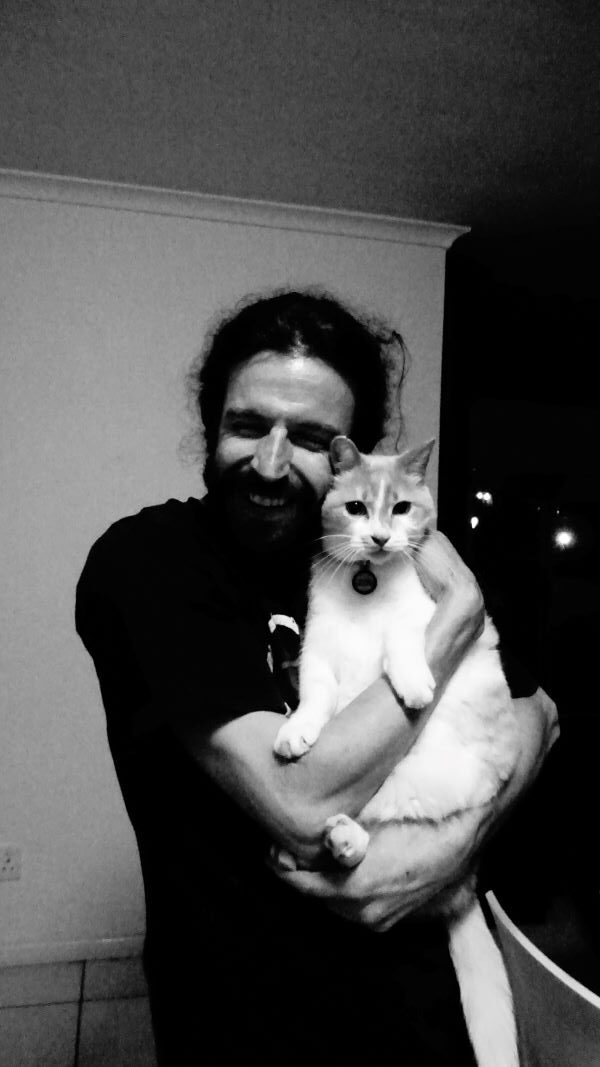
Jean Marais and Rooney (photo: provided)
Khayatunes is the debut release of Jean “Tunes” Marais. The “Tunes”, acting as his professional moniker, refers both to his life revolving around music and to his eponymous rehearsal and recording studio situated in Plankenbrug, Stellenbosch – though if one were to investigate a map, Tunes Studio clearly falls within the borders of Kayamandi. Most people with even a rudimentary knowledge of Xhosa should know that khaya means “home” and mnandi means “pleasant”. Therefore, the four tracks presented here encapsulate not just spatial-temporal relativism, but that warm embrace that only the comfort of home can bring, infused with the essence of the ancient magic of the universal language that is music. This is homage paid in the utmost sincerity.
Recorded intermittently from the summer of 2020 and into the autumn months of 2021, the collection known as Khayatunes came into being as four separate tracks, with a common DNA strain and concept chronicling the feel and sonic essence of the very setting in which they were recorded. It was a reflection of origin, and so, too, a consoling time capsule of – as well as a juxtaposition with – the uncertain times in which it was conceived for its remedial properties.
With the dropping of the letter “h”, kaya also means “wealthy, able, capable and strong” in Malay – a major tributary of language, cuisine and our cultural makeup as South Africans. In Antillean Creole, it means “marijuana”, and in Fijian it means “to answer or respond”. In Japanese and Chinese, it relates to the nutmeg or torreya tree, renowned in the former country for the quality of the sonance produced by the tap of a stone on its surface. (Jean’s primary choice of instrumentation is percussion, and he loves to say that hitting things for percussive effect is as vital to the soul as breathing.) This tree originated in the Jurassic period nearly 170 million years ago, and is therefore classified as a living fossil. Hearkening back a mere four years to be reminded of a little-known four-track EP is therefore inconsequential in comparison.
Coming back to its African namesake, the wood from the tree is employed in constructing furniture of fine quality as well as manufacturing Go boards. A game with seemingly simple rules, it is nearly insurmountably complex to newcomers, seeing that “the number of legal board positions in Go has been calculated to be approximately 2,1×10170, which is far greater than the number of atoms in the observable universe, estimated to be in the order of 1080”.
For a word that means “home”, khaya has a wide and varied history, interconnected even with a comprehensibly infinite number of connections. Shifting the tempo back to music, some people postulate that the number of possibilities in musical variation is practically infinite. And so, things that could seem small on the face of it could have whole universes lying just under the surface. You shouldn’t follow the Quechan etymology for kaya, though, where it means “tomorrow”, for you need to have listened to these four tracks yesterday already.
“The funk deck”
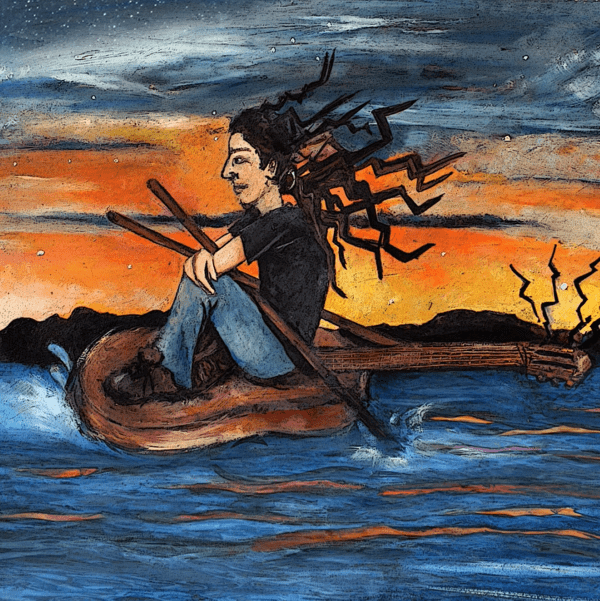
Cover art for “The funk deck” on Khayatunes by Zhandi Theunissen
The first thing that hits one about the sound, tone and general feel of “The funk deck” is that it is hard to place it, with it having been recorded during the lockdown. It was conceived and written in the first hard lockdown. “The funk deck” opens with fire crackling and steel string acoustics, a classical acoustic overture before the wafting envelopment of a happy gathering. The familiarity of a crowd is poignant in contrast with the island most people felt themselves stranded on during the lockdown. A doubling down, yet a flip of the coin, occurs as the full band departs from the semi-haunting melodies of the prelude into an island-style celebration.
The song is percussively driven forward, and while the percussion is never in the forefront of the story, the drums are quite upfront in the mix – a cruel spell to cast in such confining times, as an experiment to see how long one can keep still. There’s a lot on offer, but it isn’t necessarily hard to focus on just one instrumental part. The bridge has more space, with added emphasis on the keys and the bass, while the winds and other strings just provide accoutrements. This is lounge music for the attentive. Only in the final minute does the percussion climax in flurries of pheromonic, pentatonic phenomenology.
“Lachenalia”

Cover art for “Lachenalia” on Khayatunes by Zhandi Theunissen
Geographically set in the tranquillity of Betty’s Bay, Lachenalia Road is where the artist would visit his grandparents as a child. “Lachenalia” starts off temporally as a lazy Sunday, but then draws back straight into a sunny Saturday afternoon; the mini drum solo hiding in plain sight is set to prick up your percussive predilections. The song came to Marais as “a repetitive but bouncy guitar riff, using suspended E and B chords” on a walk down the road with his girlfriend on a hot summer’s day.
We’re greeted by the soft rhythmic buzzing of insects languishing in fynbos and drenched in summer sun, paired with the ripple of a mountain stream over the draw of a hand in need of cooling. (These were, in fact, beach sounds recorded on location in Betty’s Bay.) Nearly as bright as the accompanying art, the first rays of light break the false dawn. It has semblances of Klopse marching tunes, and if one were to walk into that painting and dig under the greenery, the soil would be undeniably African, the allegorical red ochre of laterite.
Hiding in plain sight, the drums give us a slow build-up to what should have been an inevitable solo at the 2:23 mark – not an obvious transition, but if the focus had been laid on the percussion here, it could have been. It fits the totality; however, it should be noted that the membranophonic additions for most of the track are way busier and more upbeat than one would usually envision with the chordophones on offer. Not one track on Khayatunes is under four minutes, yet when they’re done, I can’t help but think they are over too soon, that one more flurry begs ensuing. It’s not the amount of instrumentation on offer either, and it’s not the levels they’re recorded at. It’s the fact that each musician who took part in this project actually tore a bit of their soul free in the conjuring up of a majestical daemon (in the Saganic sense) such as this.
The track features Lee Thomson on trumpet, from the storied and dynamic ska-punk rock group Hog Hoggidy Hog, whom Jean first met at the age of 13 when he was playing the drums for both Fudge and Antipathy. Rudolf du Plessis was responsible for the 12-string guitar, with Mark Louis Ellis performing bass and a trace of electric guitar. Jean mentioned in one of his write-ups that he had a “fond memory of a Shadowclub CD and a Gretsch electric guitar which sparked a journey of many interesting experiences for Mark and (himself) making music together”.
“Inspiration level 3”

Cover art for “Inspiration level 3” on Khayatunes by Zhandi Theunissen
This is a smooth train-sition both as intro and coda, with a bold bass, a laze of sax and layered piano tracks trained in an ascension, led by the drums to a sublime synth-basted sax chorus, with the ever-present piano honky-tonking gleefully in the back. Probably the catchiest quarter, it has an electric solo which tastefully dances with the percussive attunements before stepping off the escarpment towards which this train has blindly yet inevitably rolled as quickly as it started, leaving your stomach knocking on the epiglottis. Just like the other sounds of life in the EP, the train was recorded by the artist and added for having been part of his living environment and, therefore, too regular a sound not to capture. Jean did a write-up of each song as they attained fledging, which he posted on his Facebook page. Failing emancipation from literary devices and being unable to pass up the opportunity to throw a gammon-appendaged stick into the spokes of irony for lacking inspiration, I felt it was apposite to have the artist introduce this track himself:
As it goes, life gets in the way of many things. However, “Inspiration level 3” (was) the third release from my song collective Khayatunes. The song originated in the first month or so of South Africa’s hard lockdown back in April 2020. I wrote the verse riff, but couldn’t complete the other parts of the song until December that year. I was on my way to Zeegunst – bags packed and instruments sorted – when our head of state announced yet another hard lockdown. Inevitably, my touring companions and I had to stay home, while those who made it to the venue in time could indulge in the festivities. Taking into account the trauma that 2020 caused, this was a very bitter one to swallow. Fortunately, I was in the company of my loving girlfriend, who is responsible for the beautiful artwork for my songs. Staying at home for the big days in December allowed for lots of time to strum away on the guitar, and, man, isn’t making music just the best therapy ever? I recorded the drums, acoustic guitar and a bit of percussion in February 2021 at Tunes Studio. Mark Ellis recorded the bass guitar and saxophone on the track. Riaan Nieuwenhuis, as a cornerstone member of the project, performed piano and keyboard on “Inspiration level 3”. The song pretty much consists of a verse and a chorus; that and the fact that this is instrumental music meant I needed a solo. A good friend and a fantastic guitarist, Stefan Steyn, agreed to perform the electric guitar solo at the end of the song. He ended the solo and the song on exactly the same note as the sample of the train driving past, which I used at the beginning and the end of the track. All the samples on Khayatunes were recorded with a Roland R05 recorder, and feature snippets of the soundtrack of my life. The song also features another dear friend of mine, Heinrich Wesson, who is responsible for the cabasa on the track. It was his debut as a percussionist and he did a magnificent job, even though guitar is his first instrument. I want to extend huge gratitude to everyone who contributed to making this a reality.
“Kastige vryheid”
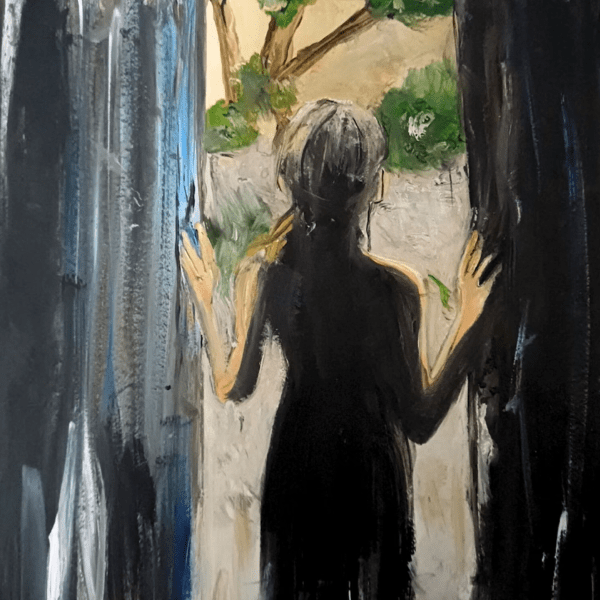
Cover art for “Kastige vryheid” on Khayatunes by Zhandi Theunissen
“Kastige vryheid” is a bit of a throwback to the times of the lockdown a few years ago, and was recorded as the final instalment of Khayatunes. Translated from Afrikaans, it means “alleged freedom”.
Even though it was the last song to be completed for the collection and was released quite a bit later, it was the first song I heard. All the instruments are vying playfully for space, and it is graciously granted. The guitar following the lead of the winds sounds so much like the wailing of a person lamenting the death of an era. “Kastige vryheid” is a swansong for a time. It’s not really saccharine, but there is brightness and light, just overtoned with a melancholy that only the sound of cicadas can really emulate and overture. It is nearly disjointedly offbeat between the drums and strings, until the sax and trumpet come in to act as the glue. This is the kind of stuff that should win Samas galore. This is the kind of music that can only cut the chaff of the most ignorant.
It is coupled with a surreally realist rendition of what seems like a female figure astride two trees that could act as curtains. In an accompanying artwork, Zhandi Theunissen took it a few levels up by creating a piece that really draws one in and which matches the music perfectly.
........
“We get to combine our ears and eyes, and that is magical. This song refers to the ever-present duality in life of being 'free' but paying a high price for that.” – Jean Marais
........
Supposed freedom – but “kastig” also has a root of being closeted, being free in confinement. Even in the great outside. Synths here bathe the composition in an atmosphere in which the piano and winds only – with a knowing earnestness of ease – inform us we’ve been before. The verse counterpoints a whimsy to the chorus’s nigh melancholic tones, yet it ends up being a means of catharsis. Taking a bit of a departure from the other songs from the EP, it has a definite wistful pensiveness present; however, it is good not just to take some upstart wrangler of words at face value, seeing that the artist himself had this to say about the track:
We get to combine our ears and eyes, and that is magical. This song refers to the ever-present duality in life of being “free” but paying a high price for that. I cannot help but think of Plato’s cave analogy. We are captivated by our circumstances, in which we basically just observe a reflection of reality. We are free to see only a certain perspective of reality. We are free because we are captivated, and we are captivated because we are free.
The first impression anyone will get from the final chord in the final coda is that it is over too quickly. River frogs and crickets of that particular crepuscular assonance bid us a temporary farewell.
The four tracks on Khayatunes are packed with many ideas, yet in a compressed neutron-star-spoonful finitude of just 17 minutes and 32 seconds; one cannot but think: there must be more? There is concentrated profligacy in composition, yet it all flows together smoothly, not a note misplaced or an empty space wasted.
Khayatunes was recorded and mixed by Mark Louis Ellis at Tunes Studio.
Mastered by Tim Lengfeld
Artwork by Zhandi Theunissen
Performers:
Jean “Tunes” Marais – drums, percussion and acoustic guitar
Mark Louis Ellis – saxophone, bass and electric guitar
Riaan Nieuwenhuis – piano and keyboard
Stefan Steyn – steel-string acoustic guitar, electric guitar solo (“Inspiration level 3”)
Heinrich “Wessleyan Sniper” Wesson – cabasa
Lee Thomson – trumpet and flugelhorn
Rudolf du Plessis – 12-string guitar
All the samples on Khayatunes were recorded with a Roland R05 recorder.
Interview with Jean Tunes Marais
Thanks for agreeing to this interview! It isn’t too hard to find information on who you play for and have worked with in the past, but could you give us a short bio of Jean Tunes Marais, the musician?
Thanks for the cool questions. I am a self-taught, freelance drummer and percussionist. At the age of 10, I was enrolled for classical guitar lessons, and although guitar took a back seat for the drum kit, I maintained the interest by occasionally jamming until 2020, when I wrote and recorded my first couple of songs. I started performing with a band called Fudge at the age of 12. For the largest part of my high school years, I performed and recorded with a progressive nu metal band named Antipathy. Working at the rehearsal studio connected me with a diverse group of musicians. In that manner, over the years I have both formed and joined quite a number of bands.
Currently, I work with Die Kaappunters, Jake Gunn, The Gambles, Riaan Nieuwenhuis, SNAFU and Skallabrak, among others.
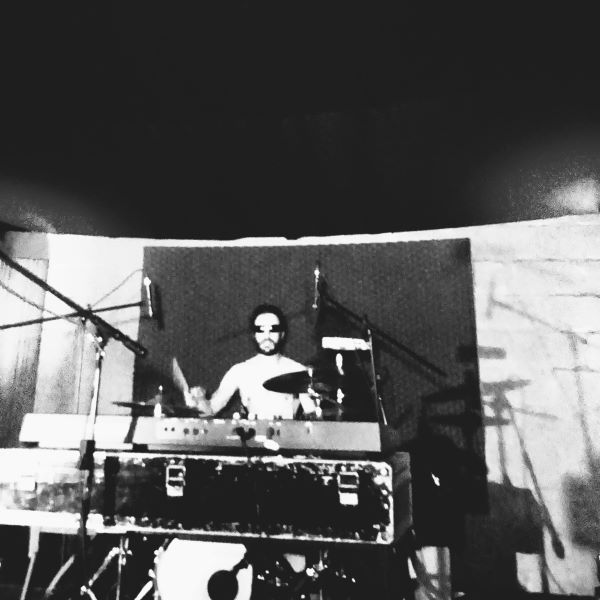
Jean Marais in studio (photo: provided)
Could you tell us a bit about Tunes Studio’s background, where it is now and the road forward?
Hartwich Holtzhausen and I opened Tunes Studio in 2010. Hartwich was a member of Alive Drum ’n’ Bass Trio, an electronic band which featured Christopher Steyn (Antipathy) on bass guitar and me on drums. Hartwich left Stellenbosch in 2012, which left me flying solo at that time. The idea to start a rehearsal studio stemmed mainly from my brother – Francois Marais with the band Belhamel – and me, when we were struggling to find a rehearsal space while at varsity.
The studio started in a small factory building in the industrial area of Stellenbosch. The shop consisted of a reception area, a small rehearsal room as well as a tiny kitchen and bathroom facility. Back in 2010, there was a lot of music happening in Stellenbosch fuelled by institutions like MK89. This allowed the studio to survive being just a rehearsal space. The music landscape was changing, and I started offering drum lessons at the studio as well.
In 2017, fellow bandmate and friend Mark Ellis assisted in starting up a recording facility as part of Tunes Studio. The studio is currently located at a premises which allows a big live room and a control room which are properly separated, two rehearsal rooms, and video facilities for shooting promotional content – something which I believe must be integrated into the existing services the studio has on offer.
........
In 2015, the idea came to me of releasing an album advocating change regarding a specific societal issue. I wanted to do an environmental album project, but a couple of logistical issues prevented the project from getting off the ground. A friend and fellow musician, Riku Lätti, told me that he felt I should rather shift the focus of the project to ethnic and cultural diversity.
........
You have worked with some great artists in the past in the production of Diversiteit (a criminally underrated album that went deeper under the radar than a nuclear sub). Could you tell us a bit about how that came together and what it meant for you and the musicians you worked with?
In 2015, the idea came to me of releasing an album advocating change regarding a specific societal issue. I wanted to do an environmental album project, but a couple of logistical issues prevented the project from getting off the ground. A friend and fellow musician, Riku Lätti, told me that he felt I should rather shift the focus of the project to ethnic and cultural diversity.
Since I started performing with Riku in 2016, he has introduced me to a substantial number of artists with whom I have been fortunate enough to perform and record. This meant that I had a network of artists whom I could approach with the idea of writing a song for Diversiteit. These artists include Jolyn Phillips, Frazer Barry, Churchil Naude, Bacchus Nel and Petronel Baard, among others. With Mark Ellis (bassist and recording as well as mixing engineer) at my side, we completed the project in early 2020.
On a personal level, this was a huge victory, as the concept of “race” has been developed by societal norms, and the recognition of the existence of such a concept is one of the world’s biggest problems. Let me clarify: now that the concept is ingrained in our behaviour and thoughts, it is of huge importance to recognise the existence of the concept; however, I feel that if humans had not attributed the concept of “race” to human skin complexion, the world might have had a lot less conflict.
Khayatunes is quite the forward-thinking project. When did it start forming in your mind?
When it dawned on me that I would have a lot more time on my hands because of the impact of the lockdown on my workload, I started playing more guitar. It progressed into writing some riffs and melodies, and I decided that I had to make good use of this opportunity the lockdown gave me – and that meant recording my first ever solo material. A famous quote states, “Man is what it consumes.” I am deeply aware of the influence one’s everyday soundtrack has on one’s thoughts, and hence I decided to incorporate the studio’s name and the area Kayamandi – in which the studio is situated – into the title.
Like a lot of art, we can reference time and space as contributors to the feel and aesthetic of the music produced in it. From the stories you wrote about the tracks and posted on your page, it seems that these two elements were instrumental – excuse the pun (sorry, the puns are just too easy) – in the formation of the tunes. Could you expand a bit on what place/space and temporal realities meant in the construction of the melodies that eventually came to be Khayatunes, and what you felt and went through during the time of writing and recording? (Apologies for the long and multifaceted question.)
I think that being isolated, versus operating within a group or team, has an enormous impact on art/music. Being isolated in the South African hard lockdown led to introspection for some, including me; and, therefore, the impact of introspective emotions on the music manifested in a way which conveyed more of the “self” through the music. If we analyse it through a more physical lens, one could conclude that music will have a totally different outcome when one is writing with a group of people, as opposed to when one is writing on one’s own. Although this is somewhat obvious, it is key to take it into account. On a metaphysical level, the spiritual and emotional component coupled with the physical writing process might unlock and/or draw on way deeper emotions of the “self”, than it would have if a group of people had been involved in writing the music.
........
Being isolated in the South African hard lockdown led to introspection for some, including me; and, therefore, the impact of introspective emotions on the music manifested in a way which conveyed more of the “self” through the music.
........
During the first lockdown period, I stayed at two different locations, the one being a flat complex and the other a commune house in suburbia. These two different locations helped me to form different textures and melodies, conveying different feelings and emotions in the music. The melodies I wrote in the flat complex, where I stayed with my girlfriend in the first phase of the lockdown, were romanticising this feeling of staying on one’s own island, which manifested into “The funk deck”. The second song I wrote, “Inspiration level 3”, definitely had a more ominous feel to it than the former, channelling the ever-growing feeling of sadness and worry as we were pulled further away from what we knew before the lockdown. “Lachenalia”, again, had a super-happy vibe to it, but with a strong undercurrent of melancholy, which conveyed the feeling of uncertainty. This happy vibe was brought forward by a holiday in Betty’s Bay, which came about when the lockdown restrictions were ever so slightly lifted. In other words, the silver lining was definite, but the melancholy still manifested the uncertainty. I think the fact that I visited Betty’s Bay, a town where I spent a large amount of my childhood with my grandparents, also helped to channel a light and happy feeling. “Kastige vryheid” was written when I kind of realised that this restricted lifestyle was probably not going to last forever, but then it dawned on me that going back to the “integrated” lifestyle had a lot less freedom than we thought it had. This paradigm was brought forward by the dividing nature of the lockdown, underlining the fault lines of capitalism coupled with the racial inequalities of society.
Was it difficult to write, record, produce, mix and master these four tracks during the lockdown?
It was pretty easy to find time to write music. It may be that some felt less inspired, due to the circumstances at the time, but I was curious and the thrill of exploring this new avenue inspired me. To write a riff or a melody with one instrument and then having to stack another instrument on top of your own creation, is a lot of fun.
The logistics of transport and booking recording sessions with the collaborators was a bit tricky. You just had to be ready when there was an ease of restrictions. Once again, it was cool to have more time than usual to experiment and rehearse the parts at home. The mixing and mastering phases were oftentimes remotely conducted.
Could you tell us a bit more about the recording process?
I recorded the more rhythm-based parts with a nylon-string acoustic as a guide track first. Drums were second in line. That was exciting, in the sense that I worked on some parts and/or songs for longer than others that were sort of more open for interpretation. Bass was next, and that was totally different for me, because Mark did it on his own after we had briefly discussed the role of the bass. He nailed it! I added some percussion, and Mark added little bits of electric guitar. It was the horn instruments after that, and then Riaan Nieuwenhuis did the final touch with both acoustic and digital piano. Having Riaan adding his flavour was significant in terms of not only loads of experience, but also unique directional input, as well as giving an optional nature to the production. Mark Ellis, Riaan and I were in studio when Riaan recorded the keys, and, having worked together on Riaan’s solo album Bleeding moon, we jelled in terms of direction on the Khayatunes project.
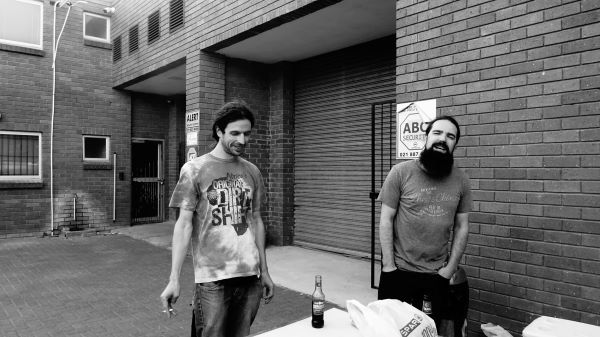
Jean and his brother Francois at Tunes Studio in Stellenbosch (photo: provided)
How was it working with Tim Lengfeld?
Tim is a great team player. We have worked together on a number of projects which were recorded at Tunes Studio, and then sent to Tim for mastering. His work flow and turnover time is slick. If you want to know more about him and his operation, I strongly urge you to check out an episode on Tunes Live Podcast with Tim Lengfeld.
Is there a track, section or contribution that you are most proud of?
The solo part in “Kastige vryheid” is a favourite of mine, due to the melancholy nature of the tone and melody of the trumpet. The chord arrangement of that section surprised me when I wrote it, as I learned new chords and came up with longer phrasing than I was used to.
You wrote in most of the main ideas of all the songs. What was the experience like to relay your ideas to the players of different instruments?
Vocally conveying ideas to fellow players is one of the most fun ways of musically expressing oneself. I specifically enjoyed working with sax, trumpet and bass guitar melody lines. When you have listened to a particular piece of music a lot, you start to imagine additional melodies in the music. If you can learn and convey those lines, the process of production creates some ideas which can then be added to the song by using an additional voice/instrument. I was fortunate to have had experienced musicians working on the tracks. It is astonishing how fast they transpose arrangements, practise a couple of times and then record them.
Working with Zhandi Theunissen, did you relay your ideas of the music, or were the songs recorded in full for her to hear the compositions before she worked on the paintings?
I think that when you are sort of forced to listen to a drummer teaching himself to play the guitar while writing songs, you probably don’t pay too much attention. Zhandi was present during quite a few Khayatunes writing sessions. We were visiting Betty’s Bay for a couple of days, when the signature riff for “Lachenalia” showed up at the door while I was strumming the guitar at the fire. Although Zhandi definitely drew influence from taking part in the writing process and paradigms surrounding the final recorded versions of these songs, conversations and short text descriptions also accompanied her drawings. The artwork for “Inspiration level 3” and “Kastige vryheid” originated from different phases of the recording – sometimes a mastered file, sometimes an unmixed file. With “The funk deck”, the idea for the artwork definitely developed together with the song. The artwork for “Lachenalia” being a sketch of a photo of the street sign also developed organically with the music.
Some legendary musicians provided their skills on the four tracks: Lee Thomson, Stefan Steyn and a more frequent collaborator – again, pun intended – Riaan Nieuwenhuis, not to mention the versatile Mark Louis Ellis and Heinrich Wesson. Did you always have these musicians in mind as contributors, or was it more a case of who was available at the time?
The idea was to get players on board who really wanted to participate in the Khayatunes project, and not to hire session musicians. Lee Thomson was the only musician who participated in a professional capacity; however, we have known each other for a long time, having shared stages multiple times back in the early 2000s. Riaan, Heinrich and Mark performed on Collaborator as well as Bleeding moon, and we share a well-established connection both on and off stage, so it was a no-brainer. I met Stefan in 2018, and from the start it was evident that we have a similar outlook on life and music. I could not miss the opportunity to include such a great guitarist and deep soul in the project.
You have another project in the offing – another four-track EP, if I’m not mistaken. Could you share anything about this new endeavour, or is it more secret than on which track Lee Thomson recorded the flugelhorn?
Ha ha, the flugelhorn was recorded as a textural layer among the many trumpet layers in “Lachenalia”. Yes, you are correct; Klutes Wil is also a four-song collection which incorporates my influences and my musical journey from 2021 to 2023. As a simple example, I started using two snare drums in my set-up, while performing with reggae group SNAFU, and so I used those exact same two snare drums on the Klutes Wil recordings. I also draw on North African rhythms, and that was brought about by my friendship with Algerian-born saxophonist Anis Moucer.
........
Oftentimes, the recording engineer will also assume the role of the producer, merely because most independent local artists don’t really have the budget to cover the costs of the recording studio as well as a producer’s fee. This leaves open the possibility that productions of different genres and styles, recorded by one particular studio, might start to sound like one another and thus hinder the authenticity of an artist.
........
Are you thinking about pressing the four tracks of Khayatunes onto an EP, to be released on Bandcamp or other streaming sites?
I definitely want to put the music on Bandcamp. I think that once I have finished my new project, Klutes Wil, I’ll release both song collections there. At this point in time, pressing physical copies is not on the horizon, but who knows what the future holds? With the content creation direction I am venturing in, having physical copies might serve the music well.
Recording can be an arduous process. What are some aspects of it that non-musos might not know about, and what can detract from the final product?
Oftentimes, the recording engineer will also assume the role of the producer, merely because most independent local artists don’t really have the budget to cover the costs of the recording studio as well as a producer’s fee. This leaves open the possibility that productions of different genres and styles, recorded by one particular studio, might start to sound like one another and thus hinder the authenticity of an artist. Looking at it from the studio’s perspective, it takes lots of time to experiment with different tones and sounds, and that might lead to the artist being unhappy about the rising studio bill. If a specific studio is responsible for the recording as well as the mixing of a project, that studio will make sure not to overcomplicate the mixing process. In some cases, that means sticking to the recording formula the engineer and the studio are familiar with. I guess that, to a certain extent, one could argue that the nature of humanity’s profit-driven society is to blame here.
What do you think are some of the biggest pitfalls for makers of original, alternative and even folk music in South Africa?
The large cultural exports of hegemonic economic powers like the USA, UK, etc make it difficult for artists to create music outside the classic Western framework being forced on the world by various forms of media. The influence of these cultural forces shapes the ideas, melodies and sounds of musicians across the world, and somewhat removes these artists from their local perspective. This can lead to a lack of originality in the music/art being produced. Oftentimes, people specifically want to relate to a shared experience, paradigm or cultural anecdote with the artist. In other words, if you are capturing and portraying the feelings of the average civilian in a true and accurate fashion, you are likely to win the favour of a larger portion of the society you are operating in.
I think it is also important to mention the interplay between creating something that you (the musician or the producer) want to deliver, and what you think your fans would want to hear. I mean, it is really hard to believe someone who is not believing himself.
........
The large cultural exports of hegemonic economic powers like the USA, UK, etc make it difficult for artists to create music outside the classic Western framework being forced on the world by various forms of media. The influence of these cultural forces shapes the ideas, melodies and sounds of musicians across the world, and somewhat removes these artists from their local perspective.
........
What have you been listening to lately, and what can you recommend to listeners who are seeking authentic South African or continental African tunes that don’t get enough airtime?
I have recently discovered Lungiswa Plaatjies’s music by chatting to local Uber drivers. I told one guy that I enjoy Thandiswa Mazwai, and he told me that the latter was most probably influenced by Lungiswa, who has apparently been in the music game much longer than Thandiswa.
I enjoy maskandi-influenced rhythms and melodies by artists such as Simphiwe Dana, Thandiswa Mazwai, Bongeziwe Mabandla, Tananas, Louis Mhlanga and Vusi Mahlasela. I also listen to quite a bit of jazz, like Shane Cooper, Kyle Shepherd and Nduduzo Makhathini, to name but a few.
Finally – coda – something I like to do in my interviews is to play a word game – you can opt out if you want. I present to you three words to ruminate, discuss or just expand on in any fashion you choose. The words are: inspiration, freedom and funk.
Inspiration lies in the soil, the people, the climate, etc, and thus there is a lot to choose from in order to be inspired. For some, inspiration is to put one foot before the other; for others, it means realigning and rediscovering the “self”.
Freedom can possibly mean to be far removed from your own bias, but also to be biased about your own development – I guess it depends on the point of departure.
Funk is another beautiful duality in terms of the word being used to describe something that you like, but sometimes also something you dislike. “I like the funky groove of this song.” “Something about that riff/song/melody sounds a little bit funky.” The best concepts for me are those that are not straightforward or clear-cut.
Thanks so much for your time and patience with this interview! Do you have any concluding remarks, shout-outs or final comments?
Many thanks and much gratitude to those who facilitated Khayatunes. Some of my close friends really invested a lot of their time into the project. Thank you for allowing me to put distance between myself and these compositions, and by doing so allowing me to tell my own tales with these creations.
Jeantunesmarais Instagram
Tunes Studio Instagram
Tunes Studio official website
Spotify
YouTube
Also read:
Die Kaappunters by die Toyota US Woordfees 2023: "Ons sing oor versoening," vertel Riku Lätti
Die kunste in die tyd van COVID-19: Riku Lätti se ope brief aan 2020
The "slammification" of the spoken word movement: Good or bad news for South African literature?