

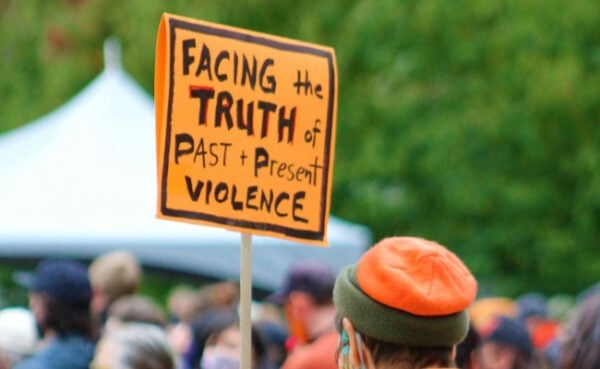
Foto deur Gabriel Dalton op Unsplash
...
Roets treats apartheid as though it were little more than an accumulation of private prejudices, rather than a comprehensive legal, political and economic system designed to dispossess, divide and impoverish the majority while concentrating land, capital and opportunity in white hands.
...
In an article published by Lex Libertas, “Jonathan Jansen turns ‘black grace’ into ‘swart gevaar’”, Ernst Roets takes issue with Jonathan Jansen’s earlier essay, “White crosses and black grace”, published on News24. Roets is right to insist that the families of murdered farmers have every right to mourn their dead, and that their grief should not be diminished or made conditional on the circumstances of their loss. But his argument against Jansen begins to unravel on contact with South African history.
Roets’s response rests on a selective reading of history that ultimately undermines the very case he is trying to make. He appears to regard reconciliation as a contract between moral equals, signed at the end of apartheid, under which everyone agreed to put the past behind them. He argues that black South Africans deserve no particular credit for not harming innocent white people, since refraining from violence is simply an elementary obligation of human decency. That is true as far as it goes. Nobody deserves a medal for not visiting violence upon another. But Jansen was not describing a favour owed to individual white citizens. He was drawing attention to the extraordinary restraint of an oppressed majority which, on attaining political power, might have pursued collective retribution but instead chose negotiation, compromise and the difficult work of building a common political future.
Roets treats apartheid as though it were little more than an accumulation of private prejudices, rather than a comprehensive legal, political and economic system designed to dispossess, divide and impoverish the majority while concentrating land, capital and opportunity in white hands. The transition to democracy did not happen because these injustices had been repaired, but through a negotiated settlement in which those who had suffered most were asked to accept political compromise without the immediate prospect of material restitution. To call this grace is neither to suggest that black South Africans are naturally more forgiving, nor to imply that white South Africans should live in perpetual fear of reprisal. It is to ask the beneficiaries of the settlement to acknowledge something of what it cost those who made it possible.
Roets’s invocation of Martin Luther King Jr’s famous aspiration that people should be judged by the content of their character rather than the colour of their skin is similarly disingenuous. He conflates inherited guilt with historical responsibility. No white South African born after 1994 should be made personally culpable for apartheid. But it does not follow that the consequences of apartheid disappeared with the arrival of a new constitutional order. Wealth, land, education and opportunity accumulate across generations; they do not become historically neutral because a constitution declares everyone equal. Nor was King’s dream an argument for historical amnesia. In Where do we go from here: Chaos or community? and through the Poor People’s Campaign, King insisted that civil rights without economic justice would remain profoundly incomplete. To borrow his language of equality while discarding his insistence on its material foundations is to retain the vocabulary of his politics while abandoning much of its substance.
...
There is a distinction between mourning the dead and recruiting them into an international narrative of white peril in a black-majority country.
...
The same selectivity informs Roets’s argument about farm murders. Jansen did not suggest that these deaths should not be commemorated. His question was about how they are represented, and to what political ends. Farm attacks are a serious and documented feature of South Africa’s wider crisis of violent crime, which cuts across race and class. But the claim of a white genocide is something altogether different that implies an organised campaign of racial extermination and requires evidence commensurate with so grave an allegation. The Institute for Security Studies, which Roets invokes in support of his argument, has not established such a case. Its research has instead drawn attention to the predominantly criminal motivations behind farm attacks. The display of 3 000 white crosses in Washington does not become politically neutral simply because its organisers describe it as a humanitarian gesture. There is a distinction between mourning the dead and recruiting them into an international narrative of white peril in a black-majority country.
Meanwhile, the farm workers, domestic workers and farm dwellers who inhabit the same landscape and are exposed to many of the same dangers, are excluded in the symbolism of the White Cross campaign. In May 2025, police minister Senzo Mchunu noted that African people have historically constituted a substantial proportion of farm attack victims, although official statistics do not consistently record the race of victims. This raises a question that Jansen was attempting to ask: Why do some deaths become an international cause célèbre, while others, occurring in comparable circumstances, pass almost unnoticed? This is not an invitation to establish a hierarchy of suffering or to suggest that one family’s grief is less deserving than another’s. It is a question about whose suffering is made visible, whose dead are remembered and whose lives are considered worthy of public mourning. Apartheid did not merely distribute land and opportunity unequally; it also established a hierarchy of human worth. We have not entirely escaped its moral imagination.
There is, moreover, a troubling irony in the language of the besieged minority to which Roets and others so readily appeal. The idea of black danger was not invented by contemporary political activists. It was one of the organising principles of white minority settlers from the start to justify their rule. Read copies of the Grahamstown Journal from the 19th century. It has been used for generations to justify segregation, militarisation and the suppression of black political aspiration. The spectre of the swart gevaar provided the ideological scaffolding for a political order that presented black liberation as an existential threat to white civilisation. Genuine fears of violence deserve to be heard and addressed. But we should be cautious of political campaigns that revive this older anxiety, give it a contemporary vocabulary and present it as a straightforward account of public safety.
Roets accuses Jansen of abandoning nonracialism, yet seems considerably less troubled by the mobilisation of racial identity within his own political constituency. A serious nonracialism requires two commitments held together: the rejection of racial essentialism and an honest reckoning with the structural inequalities that race has historically produced. It is not enough to insist that we should see one another as individuals while refusing to examine the unequal conditions under which those individuals live. Roets appears to want the first commitment without the second.
Nor do his references to surveys showing favourable interracial attitudes settle the matter. One can have warm feelings towards one’s white compatriots and still believe that land reform has been inadequate. One can reject racial hatred while remaining deeply dissatisfied with the distribution of wealth and opportunity. Personal goodwill and structural justice are not mutually exclusive propositions. Besides, without sufficient information about sample sizes, methodology and the wording of the questions, percentages alone tell us rather little about the depth or political implications of the attitudes being measured. A favourable opinion of one’s neighbour is not necessarily an endorsement of the economic order in which both happen to live.
The moral stakes are not especially difficult to identify. In a nonracial democracy, every person possesses inviolable dignity, and the common good cannot be secured through a peace that leaves some citizens permanently diminished. Reconciliation cannot become a one-way transfer of patience, in which the historically wronged are continually asked to exercise restraint for the comfort of those who benefited from the old order. Dignity honoured in political speeches but denied in the distribution of land, wealth and opportunity is a rather thin conception of dignity.
South Africa’s transition remains an extraordinary political achievement. But it also left much of the old economic order substantially intact. The black majority acquired political citizenship without anything approaching a commensurate share of the country’s accumulated resources. We consequently inhabit a democracy in which formal equality coexists with profound material inequality. Black South Africans did not negotiate this settlement simply to demonstrate their capacity for forgiveness. They were fighting for dignity, land, economic participation and the right to determine their own future. Many of those aspirations remain frustratingly unfulfilled.
Reconciliation ought, therefore, to be measured not by how often we congratulate ourselves on having avoided civil war, or by the kumbaya songs we sing together when the Amabhokobhoko win, but by how seriously we have addressed the conditions that made reconciliation necessary in the first place. With that measure, our record is considerably less reassuring. Grace should not be confused with forgetting, any more than reconciliation should be confused with absolution. Nor should grace become a permanent debt owed by the historically dispossessed, or an endless expectation where black South Africans must forgive, accommodate and exercise patience while the promises of liberation are indefinitely deferred.
...
There is something almost astonishing about the restraint by black people that has accompanied the disappointments of the democratic settlement.
...
There is something almost astonishing about the restraint by black people that has accompanied the disappointments of the democratic settlement. It is not a reason for complacency, still less an invitation to romanticise suffering. Black South Africans are entitled to anger, to betrayed memory and to material restitution. They are entitled to demand that the country honour the promises upon which its democracy was founded. Perhaps the real measure of the grace Jansen describes lies in the fact that, despite the failures and betrayals of the post-apartheid order, the majority has not yet brought down the pillars of this unfinished reconciliation. One is reminded of Samson in the temple, his hands against the supporting columns, bringing the whole edifice down upon himself and his enemies. The question Roets might consider is not why black South Africans should be praised for refraining from such destruction, but what kind of country we are building when we continue to question the value of their restraint and take it for granted.
See also:
Elders gesien: Moord is ’n gruwel, ongeag wie die slagoffer is