

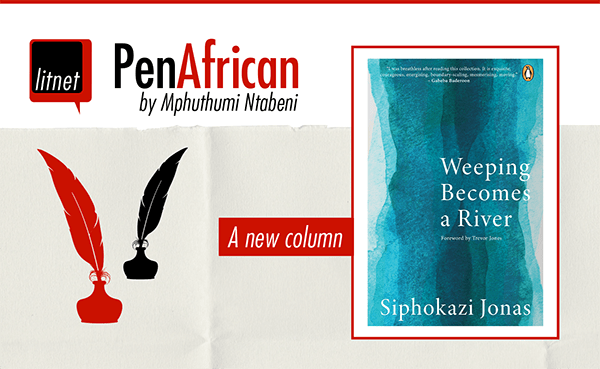
Book cover: Weeping becomes a river by Siphokazi Jonas (Penguin Random House SA, 2024)
- Mphuthumi Ntabeni writes a regular book column for LitNet.
Title: Weeping becomes a river
Author: Siphokazi Jonas
Publisher: Penguin Random House SA (September 2024)
ISBN: 9781776392087
In her debut collection, Siphokazi Jonas gives voice to a generation grappling with loss, language and belonging. Her poetry inhabits the fault lines between the personal and the historical, speaking to both the wounded present and the dead past.
It is not often that a volume of poetry captures the public imagination in South Africa. Yet, Siphokazi Jonas’s Weeping becomes a river has done just that. This is an unlikely and heartening success in a literary landscape where poetry is often treated as the private language of a select few. One wonders, inevitably, about the reasons behind this resonance.
For decades, black readers in particular have lamented the absence of their own lives, languages and textures of experience in the catalogues of South Africa’s major publishers. The familiar excuse is that publishing is business, not a moral enterprise, but this has done little to conceal the racialised logic beneath it. It is a known fact that our publishing market must cater to the tastes of a predominantly white readership. The result has been a cultural stalemate, a self-fulfilling prophecy of exclusion. Jonas’s collection, with its remarkable reach across audiences, quietly unsettles this paradigm.
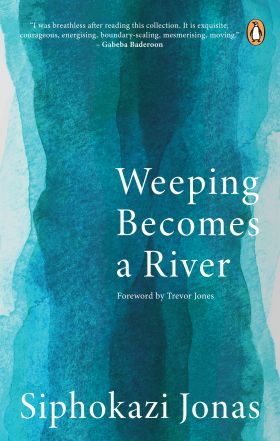
Book cover: Weeping becomes a river by Siphokazi Jonas (Penguin Random House SA, 2024)
Those I spoke to about her poetry often cited the quality of authenticity that speaks to their own lives in her poetry. Jonas’s voice, they said, “feels like ours” – rooted, immediate and recognisable. When I asked her whether the poems were deliberately autobiographical, she replied, “Absolutely, especially in this collection. It was less so in my earlier work, but something about the reckoning with loss during COVID led to more inward-looking work than before.”
That inward turn is what gives the collection its pulse. Jonas writes with a clarity and courage that invites intimacy rather than distance. She poses the questions that haunt the postcolonial self: who are we? From where do we come? What does it mean to belong? Her poems think and feel in the same breath, unafraid of tenderness or radicalised intellect.
The technical grace of her writing is unmistakable. Jonas’s command of rhythm and image feels effortless, as if her poems were meant to be spoken aloud, remembered by the ear before the mind has fully caught up. The lines move with the cadence of oral tradition, yet each word feels carefully placed, deliberate.
In one of the most striking passages, from the poem Inoculation, or to be bare at the point of connection, she writes candidly about her postcolonial, divided self:
English carried the roof of my mouth away, and I have been searching
for a gap in the fence around my mother tongue to find sanctuary.
Now, if I am to yield something “authentic”
(a proverb, an idiom, a vivid description of tradition)
I scavenge the dropped fruit fermenting at the base of Google’s omniscience.
Few contemporary poets have rendered the violence of linguistic dislocation with such precision. The irony here is both biting and tender: the poet scavenges for the language of her ancestors in the detritus of a post-everything digital empire.
........
Few contemporary poets have rendered the violence of linguistic dislocation with such precision. The irony here is both biting and tender: the poet scavenges for the language of her ancestors in the detritus of a post-everything digital empire.
........
Jonas’s work, however, does not remain confined to the personal. Her poems trace the delicate crossings between individual and collective memory, revealing how identity is never static but continually negotiated through history and inheritance. Asked which poem she feels closest to, she cited “A witch by any other name”, inspired by the derision that met calls to “decolonise science” during the Fees Must Fall protests.
“I wrestled,” she told me, “with which language denotes ‘backwardness’, and which ‘civilisation’. I sat with the word ‘witchcraft’ for a long time.” Her conclusion is as provocative as it is illuminating: “Colonisation is witchcraft.” Xhosa cosmology calls everything opposed to goodness witchcraft.
.......
“Colonisation is witchcraft.” Xhosa cosmology calls everything opposed to goodness witchcraft.
.......
It is characteristic of Jonas that she and her editor, poet Vangile Gantsho, chose to annotate this poem with footnotes in the style of colonial-era texts as a subtle reversal of the ethnographic gaze, turning the apparatus of scholarship into a tool of subversion.
Like WB Yeats before her, Jonas draws upon myth and folklore not as quaint embellishments, but as living sources of metaphysical truth. The influence of Xhosa oral storytelling runs deep in Jonas’s poetry. To begin a tale with the words “Kwahla, kwahlala kwanga ntsomi!” is, in the Xhosa imagination, a signal to collective attention, a summoning of ancestral knowledge. Her poems possess that same quality of invocation.
Figures like udyakalashe (the jackal) or igangqongqo (the ogre) appear not merely as symbols, but as moral presences, embodiments of lessons carried through generations.
What also distinguishes Weeping becomes a river is its courage to dwell in vulnerability. Composed during the isolation and grief of the pandemic, these poems ache with loss but refuse despair. In “What does not sink”, performed also at the 2021 State of the Nation Address, Jonas imagines the pandemic as Unogumbe, the deluge that reorders the world, and ends on a note of baptismal renewal:
When we salvage what is useful,
may we find ourselves baptised into something new:
new ways of mourning,
a people who have learned to breathe underwater,
reciting the names of those we have lost, and memories that never sink.
In that quiet invocation, Jonas gestures toward the moral function of art in a wounded society: to teach us how to live with memory, and how to breathe again after the flood.
.......
Weeping becomes a river is both a celebration and an inquiry, rooted in heritage yet alive to the contradictions of modern life. It is, above all, a book that lingers. One returns to its lines as to familiar hymns, each time finding them subtly changed by the shifting light of one’s own understanding.
.......
Weeping becomes a river is both a celebration and an inquiry, rooted in heritage yet alive to the contradictions of modern life. It is, above all, a book that lingers. One returns to its lines as to familiar hymns, each time finding them subtly changed by the shifting light of one’s own understanding. In a literary culture that too often forgets the spiritual work of language, Jonas’s debut stands as a reminder that poetry still has the power to speak to the soul of a nation.
Also read:
PenAfrican: Straddling borders, crafting nation: On Morafe by Khumisho Moguerane
PenAfrican: A reflection on Journey Kwantu by Vusumzi Ngxande
PenAfrican: In search of Nongqawuse by Treive Nicholas – a book review
PenAfrican: Sir Herbert Baker: a biography by John Stewart – a book review
The importance of oral history in southern African historiography