

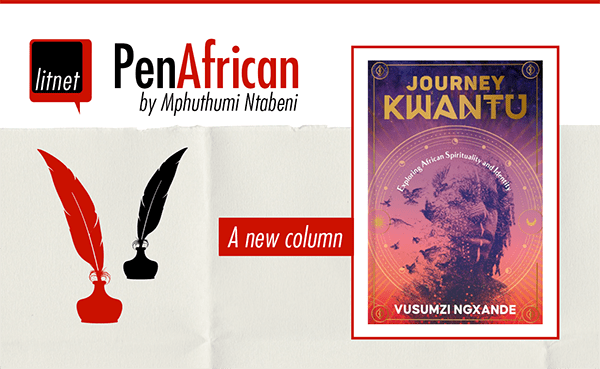
Book cover: Journey Kwantu. Exploring African spiritualty and identity by Vusumzi Ngxande
- Mphuthumi Ntabeni writes a regular book column for LitNet.
Title: Journey Kwantu. Exploring African spiritualty and identity
Author: Vusumzi Ngxande
Publisher: Jonathan Ball (2025)
ISBN: 9781776193134
It was with great anticipation that I opened the pages of Journey Kwantu by Vusumzi Ngxande, for my own literary aspiration is to illuminate and articulate the Xhosa worldview in all its depth. The book’s central affirmation that spirituality is the sanctification of matter profoundly resonates with me. This assertion is grounded in lived experience: as embodied spiritual beings, we act in the material world, and through those actions we inscribe the essence of our souls upon it, with an echo into eternity.
I was very pleased to see that the author of this book associates Ntu not as a mythic progenitor, like a “first man” or “ancestor”, but rather as the cosmic principle of life itself, akin to the concept of logos in Greek philosophy or qi in Chinese thought. Ntu is an ontological field in which all beings participate. It is often associated with the balance of the energy of humanity in the cosmos, the universal relationality and sacred unity of living things. In Xhosa and other Nguni traditions, Ntu may be implicitly referenced through idioms, rituals and the profound emphasis on ancestral connection and communal identity for living things. Some modern African philosophers have articulated Ntu as the central metaphysical category of African thought – encompassing muntu (person), kintu (thing), hantu (place/time) and kuntu (modality or manner).
.......
The book succeeds admirably in mapping the spiritual geography of our black lives, especially how our indigenous cosmology, shaped by centuries of ancestral wisdom, gradually morphed into what is now termed “religion” with the advent of Christian missionaries.
.......
The book succeeds admirably in mapping the spiritual geography of our black lives, especially how our indigenous cosmology, shaped by centuries of ancestral wisdom, gradually morphed into what is now termed “religion” with the advent of Christian missionaries. I will not engage here with the book’s treatment of the history of black southern African religion, not because it lacks merit, but because the scope of my reflections does not permit it. There are distinctions I would have liked to explore further – subtle but significant – but to do so hastily would be to do the subject an injustice. Such an engagement deserves its own dedicated space in another essay.
Ngxande writes: “The reason I started with a story of Nongqawuse and Nonthetha Nkwenkwe is that I wanted to demonstrate that, while all the chaos around us feels as though the world is ending, we actually have been here before. A people dealing with the ravages of a pandemic? Nongqawuse’s era had the lung disease. Nonthetha Nkwenkwe’s time endured the Spanish flu. We had Covid.” Like the author, I believe such moments in our history ignited desperate movements of religious millennialism. Indeed, the seed of the Great Xhosa Cattle Killing, commonly referred to in historical accounts as the “Nongqawuse incident”, was sown earlier, in the prophetic movement of Nxele, aka Makhanda, whose uprising culminated in the great tragedy of the Grahamstown War. Mgijima’s doomed congregation, which Ngxande also references, was yet another millennialist expression, this time from a sect of the Israelites. These movements were born of a people witnessing the slow erosion of land and identity. They reveal to us that there can be a perilous path of spiritual excess when belief becomes unmoored from wisdom and spirals into fundamentalism, the consequences of which are often catastrophic. The same superstitions that shaped the Grahamstown War bear chilling resemblance to those at Marikana, where miners, believing police bullets would turn to water, charged to their deaths. The book explores such lineages of misguided faith with thoughtful sobriety, never condemning outright, but inviting a deeper reflection.
........
Had the author turned his gaze toward the foundational theology of Christianity, namely Catholicism, he might have discovered that his own conception of the realm of the ancestors corresponds remarkably well with what Catholic doctrine calls purgatory.
........
Where the book errs, in my view, is in its narrow treatment of Christianity, seen almost exclusively through a Protestant lens. Had the author turned his gaze toward the foundational theology of Christianity, namely Catholicism, he might have discovered that his own conception of the realm of the ancestors corresponds remarkably well with what Catholic doctrine calls purgatory. This theological realm, where souls undergo purification before entering the beatific vision, mirrors the African understanding of ancestors who remain spiritually active, guiding and interceding for the living. It is, in essence, a communion across realms of the living and the dead.
Catholic tradition venerates saints not as deities but as holy exemplars, those who, having lived lives of profound virtue and fidelity to God, now dwell in the spiritual world and intercede for humanity. This resonates deeply with African spirituality, wherein ancestors are honoured for their wisdom and presence. In both worldviews, death is not an end but a metamorphosis of relationship. The Catholic notion of a “cloud of witnesses” (Hebrews 12:1) finds profound kinship with African cosmology, in which the physical and spiritual worlds remain in perpetual, reciprocal dialogue with the ancestors or saints.
I found the book’s apex in the chapter titled “The secret life of surnames: In my father’s house”. Here I encountered a wealth of fascinating insights about the evolution of names, among them that of the author himself. “Ngxande”, we are told, derives from ixanda, the Xhosa term for a rectangle. Traditionally, this referred to the visitor’s room in a Xhosa homestead. Drawing upon my architectural studies, I must respectfully diverge from the author on one point: while rectangular structures were not unknown in precolonial Africa, their widespread adoption and normalisation were markedly accelerated by European influence.
Indeed, many traditional African societies favoured circular dwellings: rondavels in southern Africa, tukuls in Ethiopia and Sudan, the beehive huts of the Zulu. These forms were well adapted to the climate and materials of their environments, offering both practical benefits and rich symbolic meaning. The circle embodied unity, continuity and harmony with the earth. It also aligned with communal living structures: hearths, meeting spaces and kraals that encouraged circular gathering. Rectangular shapes were sometimes used, especially for kraals and certain enclosures, but they were not the dominant domestic architecture.
European missionaries and colonial planners and administrators encouraged rectangular architecture for ideological and administrative reasons. It mirrored European land demarcation, building codes and notions of order. Over time, rectangular structures became institutionalised through churches, mission schools, urban planning and bureaucratic housing policies. Eventually, they were adopted even in rural homesteads. So, while the rectangle was not foreign to Africa, its elevation as the architectural standard and its association with “modernity” were indeed a product of colonial imposition.
......
Readers will not necessarily agree with every conclusion, and that is as it should be. Yet, this book is a crucial first stone in the isivivane1 of our spiritual reconstruction. ... Vusumzi – he who rebuilds the homestead – is indeed living out the legacy of his name, lifting high the horn of his ancestral home.
......
The heart of Journey Kwantu, however, lies in its next two chapters: “Culture versus spirituality: In the image of man” and “Into the ancestral realm”. These, I believe, are the book’s true thesis, compellingly argued and exquisitely rendered. For readers short on time, I suggest beginning here. It is in these pages that we encounter uvuthondaba – the searing core of the argument. Along with “Mother God: How the fall of matriarchies birthed patriarchy”, these chapters form the spine of the book’s philosophical vision. Here we learn how power, once centred in the hut (the feminine space), shifted with the symbolic weight of cattle toward the kraal (the masculine domain), ushering in a patriarchal system that eventually fertilised the capitalist structures now threatening to dissolve all that is rooted and communal.
Ngxande’s insights are grounded in thoughtful research and lived conviction. Readers will not necessarily agree with every conclusion, and that is as it should be. Yet, this book is a crucial first stone in the isivivane1 of our spiritual reconstruction. I sincerely hope that others will follow, whether in deep dialogue with Ngxande’s text or in offering alternative visions. In African culture, names are not given lightly; they are aspirational and prophetic. Vusumzi – he who rebuilds the homestead – is indeed living out the legacy of his name, lifting high the horn of his ancestral home. Ukwanda kwaliwa ngumthakathi!2
Notes
1 This is a cairn of traditional wisdom and direction.
2 Only the wicked oppose the expansion of goodness.
Also read:
PenAfrican: In search of Nongqawuse by Treive Nicholas – a book review