

- Mphuthumi Ntabeni writes a regular book column for LitNet.
I recently had the pleasure of attending Ibuyambo Book Festival at Langa Quarter, a business and agricultural hub of KwaLanga that is run by the Roman Catholic Church. Beyond books and fresh produce, handcrafted products and other art were also available for sale. This was my first time ever attending a book festival conducted in all the official languages of the Western Cape (English, Afrikaans and Xhosa, but mostly Xhosa). The main objectives of the Ibuyambo Book Festival are to revitalise, preserve and promote indigenous languages of the Western Cape. It made me extremely proud.
Abayaziyo intsusa nentsingiselo yegama elithi Buyambo baya kukhumbula ukuba lisukela ekubeni kusithiwa abaNguni babevela eMbo. Ngokwezi nkolelo kuthiwa uNtu lona yabe iyinkosi-mphathi wokuqala owazeka isizwe samaNguni. Abaziyo namanyange bathi lendawo yayikufutshane namachibi ekuthwa namhla ngalawa eGreat Lake region. Ubunyani balento bufumaneka kwinto yokuba maninzi amagma kwilwimi zala ngingqi nabeNguni aba sawasebenzisayo afana neli le nkomo. Ibuye ibhide lento kuba eligama “nkomo" liyasetyenziswa nakwilimi ezininzi zama KhoiSan. Andazi ke noba abeNguni bahle nalo ukuza apha emzantsi, okanye linyuke nama KhoiSan ukuya entla phambi kweteleki yabo bekhangela amadlelo.
As the name Ibuyambo spells out, the aim of the festival is to go back to our roots. Mbo is the mythological place of origin for the Nguni. It is believed that Ntu was the founding king of the place. Bantu refers to the people of Ntu. Buya means “come back”. Ibuyambo, therefore, is something that brings people back to their origins at Mbo.
........
I was fascinated to learn during the festival from Titage Toroga, a language activist of the Khoekhoe first nation, about the origins of many words we today assume are Xhosa but in actual fact have KhoiSan origins.
........
I was fascinated to learn during the festival from Titage Toroga, a language activist of the Khoekhoe first nation, about the origins of many words we today assume are Xhosa but in actual fact have KhoiSan origins. He read from his powerful Khoikhoi book of useful phrases and words. He says that the second ancestral gift, after our genes, is our languages. And that we should be vigilant in protecting them against powerful forces that threaten to silence them. At the festival, he also read to us from his book of Khoikhoi poetry.
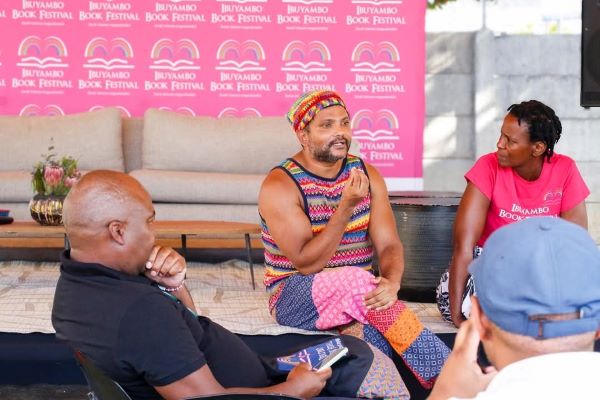
Mphuthumi Ntabeni, Phumla Makeleni and Titage Toroga in conversation (photo: provided)
The organiser of Ibuyambo Book Festival is Pumla Makeleni, an author, an indigenous language activist and an innovative force in the world of storytelling and social transformation. She is the author of Early rain that washes away chaff, a compelling novel that explores the themes of black young men’s propensity for violence, absent fatherhood and identity. Pumla is also the creator of an exciting short story collection, soon to be released, that promises to captivate and inspire readers with its bold, raw and deeply human narratives. She is also the founder of a transformative company dedicated to humanising township schools by reimagining how they look, feel and function. Her mission is to create spaces that inspire students, fostering an environment where education thrives in a setting of dignity and possibility. Now, she is also the founder of the Ibuyambo Book Festival, a cultural landmark that promises to celebrate the diversity of South African languages and storytelling traditions, while creating a platform for emerging voices in the literary world.
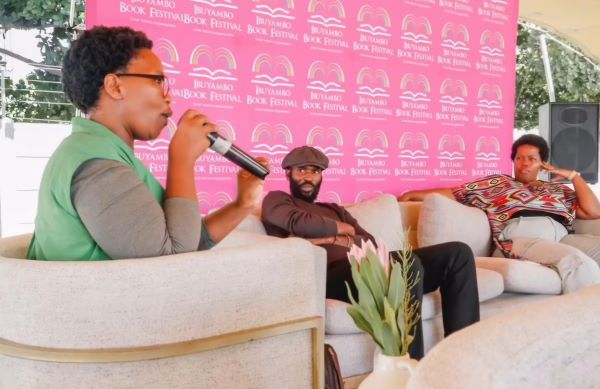
Nolubabalo Rani, Nkululeko Imange Dyantyi and Siphokazi Jonas (photo: Mphuthumi Ntabeni)
Among other prominent writers present at the two-day occasion were distinguished polyglots from the University of Cape Town, Dr Xolisa Guzula and Dr Athambile Masoka, whom I am proud to call homegirls. We all hail from the same area, under the mountain of Lukhanji. The book festival programme included the launch of their illustrious book, which is available in six of our country’s 12 official languages. The book is titled Together apart: The story of living in apartheid. The book is told in the ntsomi-like, simple language of omakhulu gogo storytelling found around the fire/TV of every home. It is also told through the life experience of those who lived during the height of the apartheid years, including sport and drama activists. It is non-judgemental, and neither is it prejudicial in tone. It is a collective of the effects of the apartheid system through several stories of heroines and heroes who contributed to fighting against this brutal system. Aimed mostly at children and young adults, it is obviously designed to plant the first seeds of popularising these stories for those who want more information to go and research for themselves. We had the privilege of listening to their journey in producing this unique project, which was funded by the National Lotto.
........
Siphokazi Jonas, whose recently published bilingual collection of poems, Weeping becomes a river, is taking the South African literary space by storm. Growing up in an Afrikaans dorpie made her adept in speaking three languages: Xhosa, Afrikaans and English. Her poems weave together experiences of alienation, belonging and the cultural differences of these discordant worlds.
........
Another prominent writer and storyteller was the poet Siphokazi Jonas, whose recently published bilingual collection of poems, Weeping becomes a river, is taking the South African literary space by storm. Growing up in an Afrikaans dorpie made her adept in speaking three languages: Xhosa, Afrikaans and English. Her poems weave together experiences of alienation, belonging and the cultural differences of these discordant worlds. The poems also migrate between forms: elegiac with melancholy, dancing with rhythm, rapping of urban social issues, celebratory traditional Xhosa songs, and ancient proverbial wisdom of intsomi. Some of her poems are deeply feminist, because “the body is marked territory from birth, and the scent of it never leaves”.
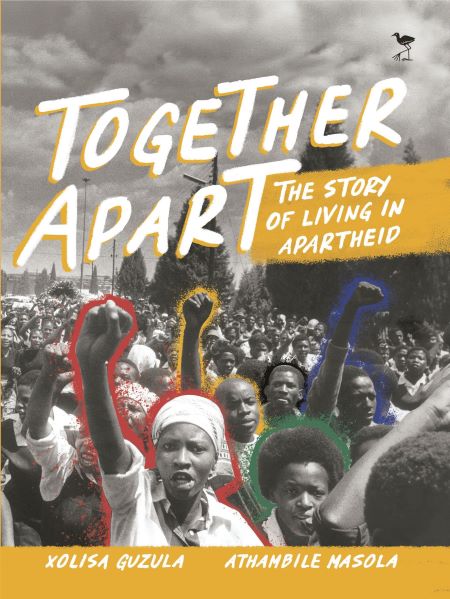
Together apart by Xolisa Guzula and Athambile Masola (Jacana Media, 2025)
In keeping with the motto of the festival, Zemk’ inkomo magwala ndini, Mr Fura Majola, a Xhosa lecturer at Stellenbosch University, gave us a reflection on the life and times of WB Rubusana. The main street of KwaLanga is named after Dr Rubusana. He also titled the book collection of essays by black writers of the 19th century, which he edited, with the Xhosa clarion call Zemk’ inkomo magwala ndini! (The cattle have been taken, you cowards!). The call was for black people to guard and protect the wealth of their inheritance. Majola’s talk explored the relevance of this call not only for Dr Rubusana’s era, but also for our age, which is facing its own challenges and neglect by our own indigenous cultures.
The neglect of indigenous languages was echoed by the representative from the Western Cape Libraries, Nomonde Ngqoba, who was accompanied by her colleagues Ayanda, Kwanele and Mbali. March is also a library month. She gave us an extremely pertinent workshop on the scarcity of books, especially nonfiction, written in indigenous languages, and urged writers to write their work in or have it translated into indigenous languages. This writer felt this clarion call deeply, as he has been thinking about translating his book, The broken river tent, into Xhosa for young adults. Luckily, he found a capable person in Mr Majola. The next step is to organise funding for the project.
Ibilunchthu mazangwa into ebikulomnyadala, ngakumbi kubathandi bencwandi nezacholo ezenziwa ngezendla zakwa Ntu. Sifunde lukhulu malunga ngendlela ngendlela esinokuthu sinakekele ngayo ilwimi zethu zesintu zingatshabalali, ngakumbi nedlela esingazigqithisela ngazo kwisizukulwana esilandela ukuze nabo bangaqhwaleli ekuzazini ukuba bango bani, besuka phi. Kuba kaloku isizwe esingayaziyo intsusa yaso sifana nje nomthi ongenagcambu, awukwazi ukondleka ncam, kwaye kwakufika izaqhwithi uyaphaphatheka uye endexe.
Popular children’s book storytellers, like Nolubabalo Rani, entertained grade R children with her storytelling skills in Xhosa, which were also very popular with young adult students. The crowning glory of the poetry session was Ms Nondwe Mpuma’s reading of her poem about Xhosa seasons and the meaning behind them. She educated us on the reason why Xhosa months are called what they are. You’ll have to order the book from Uhlanga Press if you want to have a taste of the cultural richness behind the poems. Another poem she read explained the reasons why certain words are regarded as taboo in the Xhosa culture. Several NGOs and NPOs, like Just Grace and the Mayine eAfrika Foundation, supported the festival in several ways. They brought school pupils from several schools around Langa township.
Maz’ enethole kubaququzeleli nabo bonke abathe bazimasa lomcimbi. Ukwanda kwaliwa ngumthakathi!
Also read:
Human Rights Day 2025: mind your language! About language rights and recent developments at UCT
PenAfrican: Call and response by Gothataone Moeng – a book review
BELAB and mother tongue education: an interview with Mphuthumi Ntabeni