

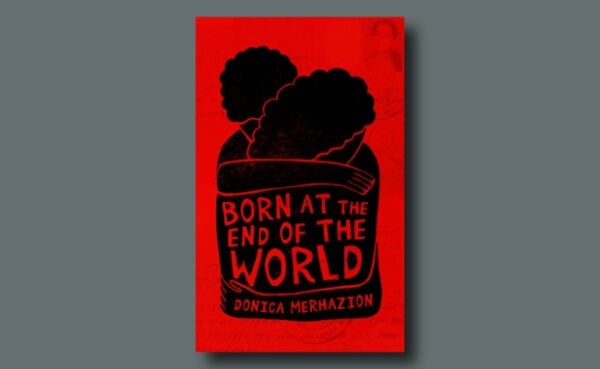
Title: Born at the end of the world
Author: Donica Merhazion
Publisher: Catalyst Press
ISBN: 9781960803337
Donica Merhazion’s debut historical novel, Born at the end of the world, opens with a 13-year-old girl, Elen, who has just been betrothed by her father. Across a dusty courtyard in Adwa, a bus is loading for the capital, Asmara. Her friend Birikti has pocketed eight birr, enough for two tickets. The eucalyptus trees that have always marked the edge of Elen’s world look crossable for the first time.
It is a modest scene, almost unremarkable in its details. Merhazion understands that a life can change direction in the space between one ordinary moment and the next. There is no grand declaration of independence, no stirring speech about a woman’s right to choose her future. There is a bus, a handful of money, a friend prepared to take a risk, and a girl who has begun to understand that obedience to family duty is not the same thing as loyalty to her own dreams. When Elen steps aboard, she crosses more than a physical distance. She begins the difficult business of becoming the author of her own life.
The scene also establishes the novel’s larger concern about the intimate unguided ways in which history enters ordinary lives. We often speak of historical events as though they occur at a calculated distance from the people who endure them. Wars acquire dates, revolutions acquire names, and political movements name their heroes and martyrs.
But for those living through the events, history arrives as a series of immediate need to answer practical questions. Where can one sleep without being discovered? Whom can one trust? Whose future are we preserving or destroying in looking after family needs? How does one preserve a family when the state has made family life dangerous? And what becomes of a child born into circumstances that no child should have to inherit?
*
Merhazion’s novel follows Elen and Girmai, two young Eritreans whose lives become entangled in the struggle for Eritrean independence from Ethiopian rule. The narrative stretches from the early 1960s to 1980, moving between Eritrea and Ethiopia before reaching a coda in Nairobi. Against this historical background the personal lives of her characters unfurl under the pressure of political violence, surveillance, imprisonment and exile. But the book is not simply a chronicle of a liberation struggle, but also a story about love, the compromises required to keep it alive, and the forms of courage that rarely announce themselves as courage.
The history matters, of course. Eritrea’s struggle for independence was a protracted conflict. The rise of the Derg, the Marxist-Leninist military government that ruled Ethiopia from 1974 to 1991, brought a new and particularly brutal chapter of repression. This Red Terror, most closely associated with the Derg’s campaign of political violence in 1976–78, became one of the defining atrocities of that period. For Eritreans, the wider conflict also involved the Ethiopian state’s military campaign against the independence movement. These histories overlap, but they are not interchangeable. Merhazion’s achievement lies in bringing the reader close to the people who had to navigate their consequences, rather than asking historical explanation to carry the emotional weight of the story. History matters here mostly as an aid to expound and explain personal experiences.
*
Structurally the novel alternates between Elen and Girmai, keeping them apart for nearly a hundred pages. This requires a considerable investment of patience on the reader’s part, but it serves a crucial purpose. By the time the two meet, we have some understanding of what each brings to the encounter. Elen has acquired a hard-won independence and an instinct for reading rooms, a quality that becomes essential in a world where a careless word can have consequences far beyond the moment in which it is spoken. Girmai, meanwhile, is a self-taught knitwear maker whose resourcefulness has already been tested by danger. He once hid from the Derg by sleeping in a well. This detail has an important metaphoric use where survival requires people to find shelter in places not meant to be inhabited. The image anticipates the larger predicament of people forced to live in the margins of their own country.
Girmai and Elen’s love develop under surveillance, which means that intimacy can never be entirely private. When a relationship is not a simply a matter between two people it becomes a liability, a possible source of information, and constant weakness that others might exploit. The lovers must learn to distinguish what can be said from what must remain unspoken. Merhazion showcases ways in which political terror alters the ordinary grammar of human relationships. Trust, which ought to offer shelter, becomes yet another potential risk; silence, which can look like indifference, becomes a form of protection.
This is one of the book’s quieter strengths. Merhazion does not need to turn every act of affection into a declaration of defiance. Love under such conditions is already political enough. To make plans together, to imagine a future, to remain attentive to another person’s needs when one’s own survival is uncertain, these are small significant acts in the book, but they’re also ways of refusing to let the machinery of violence dictate the entire meaning of a life.
*
The novel reaches its emotional centre in Elen’s arrest and interrogation. Here Merhazion confronts the difficulty of representing political violence without making suffering into a spectacle. She largely avoids both graphic excess and the sanitising language that can make brutality seem abstract. Instead, she takes us closer to Elen’s consciousness, allowing us to register the mental work involved in enduring what is happening to her. Fear is not merely a sensation, but a mental demand to stay awake, and a prod to the imagination to calculate what might happen next, what a captor knows, what an answer might reveal, and how much of the self can still be withheld for the sake of survival or loyalty.
Elen is three months pregnant when imprisoned, and the fate of her unborn child becomes one of the novel’s most pressing questions. The pregnancy changes the terms of survival. Elen is no longer struggling only for her own life; she is carrying a future that cannot yet speak for itself. The child becomes a measure of what violence threatens to destroy and of what human beings continue, often against all reason, to protect.
The child is eventually born in a prison cell. Her father, not knowing whether she has survived, chooses a name for her on a beach at Suakin: Hiyab, meaning “gift”. The name carries an almost unbearable tenderness. A gift is usually something given freely, received with gratitude, and associated with celebration. Here it is invoked in uncertainty, at a distance from the child herself, by a father who cannot know whether the world has allowed her to live. The word becomes an act of hope offered in the absence of evidence. It is a name spoken across the gap between what one fears and what one cannot afford to stop hoping for.
Elen’s resistance is equally compelling because Merhazion doesn’t dress it up as uncomplicated heroism. Elen runs a bar that doubles as an intelligence hub for the Eritrean People’s Liberation Front, while Derg officers drink at her counter, unaware of the work being conducted around them. The arrangement is both dangerous and ingenious. Her everyday occupation provides cover for an underground political life, and her ability to observe people without attracting attention becomes a form of intelligence.
We tend to remember liberation struggles through their spectacular moments of armed encounters, speeches, victories, defeats and the deaths of celebrated figures. But movements also depend on intelligence, people who keep secrets and pass on crucial information, who are able to recognise suspicious visitors, based on that intelligence, and pass information without drawing attention to themselves, or maintain the appearance of ordinary life when ordinary life can easily become death performance sometimes. Such work is difficult to memorialise precisely because it succeeds by remaining unseen.
Elen’s mother has taught her that quiet observation yields answers. It is a practical lesson, but it also offers a way of understanding Merhazion’s own method as a novelist. The book accumulates meaning through small details and repeated gestures rather than through grand pronouncements. The moral world is built from what people notice, what they remember, and what they manage to preserve.
Religion is part of this world, too. Elen’s Orthodox faith, and the rosary she carries through the worst nights, offer her a means of enduring uncertainty. Merhazion handles this aspect of her character with admirable delicacy. Faith is neither presented as a magical protection against suffering, nor dismissed as an irrational consolation. It is one of the resources available to a person who has been stripped of so many others. This authentic understanding of belief it doesn’t necessarily remove the danger but helps Elen remain optimistically herself within the challenges she faces.
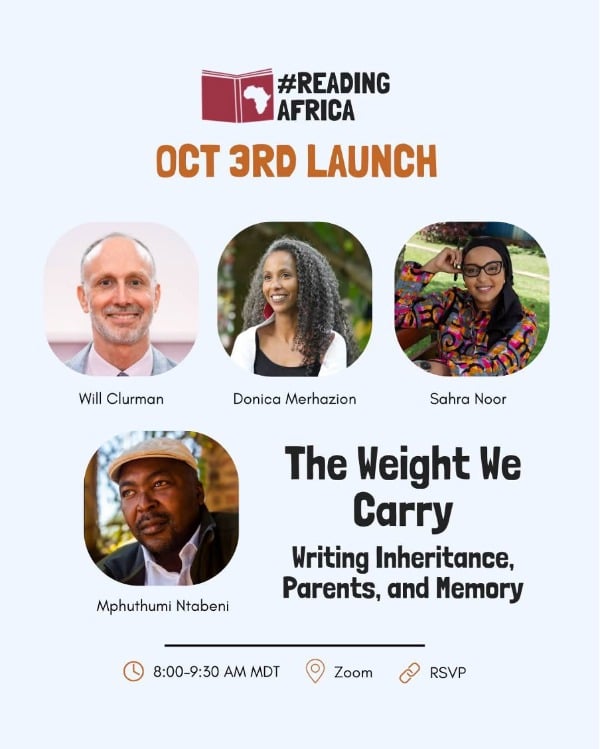
When I moderated their discussion panel “The weight we carry: writing inheritance, parents and memory” for Catalyst Press in anticipation of their popular #ReadinAfrica, 2–7 November, Merhazion said that the novel began as a children’s story, an attempt to pass on to her own children the sacrifices made by their grandparents. That origin helps explain the book’s deep concern with inheritance. What do children have a right to know about the lives that made their own possible? How does one explain a family’s suffering without allowing suffering to become the family’s only story? And what happens when the past, which parents have tried to contain or leave behind, returns through a child’s questions?
In this sense, Born at the end of the world belongs to a long African tradition in which oral family history becomes written literature. The movement from remembered experience to narrative is never simply a matter of transferring information. Someone must decide what can be told, which details deserve to survive, and how private memories might speak to a generation that did not experience the events themselves. The writer becomes both custodian and interpreter, preserving what might otherwise disappear while acknowledging that the act of preservation changes the material being preserved.
The author’s note on the book gives this concern a particularly moving dimension. Merhazion recalls being eight years old when classmates laughed at her after she announced that she had been born in prison. It is a small episode, but it reveals the social life of historical memory. What one family regards as a story of survival can become, in another setting, a source of embarrassment. A child may inherit an extraordinary history without yet possessing the language to explain it, much less defend it against ridicule. The novel is, in part, an answer to that childhood shame. It takes what might have been reduced to an uncomfortable fact and restores it to dignity with proper human dimensions. Now, a birth in prison is no longer an oddity to be laughed at, but part of a story about parents, family history, national political struggle, endurance and the stubborn continuation of life. Merhazion is not merely telling her children what happened before they were born, but is providing them with a doorway through to how to understand and narrate what that history means, or even defend the hour of their own inheritance.
*
Merhazion’s prose is sparse, clean and unshowy. She trusts the material without constantly pressing the reader to recognise its significance. At times, however, the restraint approaches understatement. In the prison chapters, for instance, I wanted more of the strange, oblique interiority that extreme duress can produce: the distortions of time, the mind’s sudden attachment to trivial objects, the irrational associations through which a person tries to remain in contact with a world beyond the cell. The novel is attentive to suffering, but there are moments when its emotional language seems more controlled than the experience it is describing.
The middle stretch, with its account of EPLF organisation and cell structures, can also feel more documentary than dramatic. The information is important, and it helps establish the political conditions under which the characters operate, but exposition occasionally slows the narrative. Historical fiction has a difficult balancing act to perform. It must give readers enough context to understand the stakes without allowing explanation to displace the people whose lives make those stakes matter. A little more compression in these sections might have sharpened the movement of the story.
Mercifully, and beautifully, the novel repeatedly finds its way back to the particular, and it is there that Merhazion is at her best. Consider the bucket placed too close to Elen’s sleeping spot, or the braids Abeba gives Hiyab before they leave prison. These details are first of all things that people must live with or do for one another. But they also reveal the persistence of ordinary needs within circumstances designed to strip people of dignity. A bucket, a place to sleep, a child’s hair being braided, such things belong to the humble vocabulary of care. Their presence reminds us that human life continues to demand tenderness even when tenderness has become difficult to practise.
The final hundred pages gather as a narrative of remarkable life force. The prose acquires a beautiful precision, linguistic flame as the story’s accumulated losses and hopes begin to speak to one another with greater urgency. By then, we understand that the struggle is not simply to survive the past but to carry its consequences into a future that will never be entirely free of them. Liberation may change the political circumstances in which people live, but it cannot automatically restore what has been taken, nor can it make the survivors’ memories conform to the cleaner story a nation might wish to tell about itself.
There is in the book a photograph of Maria at her baptism in 2012. She is wearing a dress sewn in prison from the cloth that once wrapped food. It is an extraordinary image, and perhaps the most eloquent statement of the novel’s purpose. The material has passed through different uses and different meanings. What once carried food into a place of confinement has been transformed into clothing for a child’s baptism, an occasion of welcome into a community of faith. The dress does not erase the prison from which it came. Its beauty depends, in part, on the history embedded in its making.
I found myself thinking of Joseph’s coat of many colours, not because the two garments carry precisely the same meaning, but because both suggest how an object can gather the stories of a family around itself. The dress is practical, intimate and historical all at once. It holds the memory of deprivation, the ingenuity of the woman who made it, and the life of the child who eventually wore it. This small thing is asked to carry a great deal, as children so often are.
Perhaps this is what Merhazion means by “a gift from the grave of history”. The past does not return to us intact, and it does not always arrive in a form which we know how to receive. Sometimes it comes as a family anecdote, a photograph, a name chosen on a distant beach, or a dress made from whatever material is available. Sometimes it comes with shame, or with questions for which our parents have never found adequate answers. The work of inheritance is to look again, to recover the lives concealed inside these fragments, and to give them a form that can be passed on.
Born at the end of the world is not without its unevenness. Its historical explanations sometimes outweigh its dramatic movement, and its restraint occasionally leaves emotional territory unexplored. But these are limitations within a work of genuine beauty, melancholic seriousness and humanity. Merhazion has written a novel that understands the difference between remembering suffering and making something meaningful from its memory. She honours her parents’ history without pretending that the act of telling it can settle every debt.
The dress in the photograph remains with me. It is evidence of what prison could not entirely take away, but also of what love can make from the remains of hardship. The novel performs a similar task. It gathers the scattered pieces of a family’s past and stitches them into a story that strangers can read, while leaving the fabric’s original marks visible. Through this story, Merhazion gives her children something more durable than a family legend. She gives them a history in which their beginnings are neither an embarrassment nor a burden to be concealed, but a difficult inheritance made bearable by the act of telling and love.
That is a gift from the grave of history, not the promise that the dead can be restored, or that the past can be made innocent, but the knowledge that their lives need not end with them. Someone can still bear witness. And someone, years later, can tell the story so that the next generation knows what it has been given, and at what cost.