

This reader’s impression was written and sent to LitNet on the writer’s own initiative.
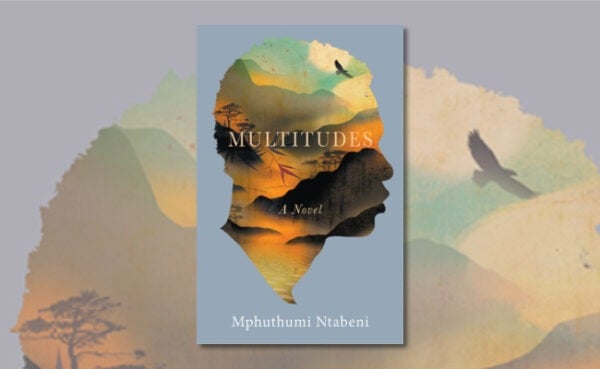
Multitudes
Mphuthumi Ntabeni
Kwela Books
ISBN 9780795711572
Phila Maseti is famous, but he does not exist. He is a fictional character, introduced by the author in his debut novel, The broken river tent, winner of the UJ Debut Prize in 2019. With reference to his modern-day connection with the late Nkosi Maqoma ka Ngqika (1798-1873), it was labelled “one of the most important books of the decade” by Tembeka Ngcukaitobi, lawyer and author of The land is ours (2018).
Fast-forward to 2026. Phila returns as the protagonist in Ntabeni’s third novel, Multitudes. He is now 51 years old, diagnosed with Crohn’s disease and grieving his Scottish wife, H.
Their undoing began quietly, as such things do. … She spoke of Skye and sheep herding and writing solitude in Shetland. (…) He spoke of the Eastern Cape, of the Bushman and Kariega riverbanks in the Zuurveld (22).
Initially, it was a mere physical separation; she returned to Glasgow with their two daughters, Ilita and Siya, but death altered the nature of the division. Phila found solace in his journals, where he was free to tame his ghosts by reducing them to writing, often in the format of letters to H:
I do not write because it will bring her back. I write because, in this strange borderland between her world and mine, words are the only planks I have to keep the bridge from collapsing (153).
The inward journey to the essence of himself as a product of his ancestors, his former selves and the soil from which he hailed, is both enriched and complicated by the journeys of others who cross his path. One such fellow traveller is his neighbour, Kyuri, once merely a voice on the phone asking him to receive a Takealot parcel, but thereafter the one who shares the emotional burden of witnessing a gruesome murder: “That’s how our affair began” (47). She represents a dual spiritual inheritance. Of Chinese and Japanese parentage, she has been shaped by Asian migrations and colonial history.
H remains a presence in Phila’s life. He shares his fears, hopes, dreams and grief, as recorded in his journals, with the reader, alternating between being a third-person narrator in the present and a first-person narrator when reflecting on his journal entries. H’s artistic nature is verbalised in a letter to Phila, corroborating his views on the narrative therapy provided by literature as art: “Perhaps that’s what art does at its simplest, making small spaces where the noise softens for a moment” (26).
The historical figure of Nkosi Dyani Tshatshu (1792-1868) becomes another fellow traveller, especially when Phila travels to Scotland to fetch his daughters after H’s death. Tshatshu, a prince, diplomat and interpreter, sought justice for his people to the third degree in a language not his own, and Phila likens his own journey to one embarked on by Tshatshu two centuries before:
It was to measure what Western civilization had promised against what it had taken, to listen for the old cries beneath the new hymns, and to answer the ancestral summons written in feather and flight (144).
The acceptance of a commission to write the biography of journalist Bloke Modisane brings Phila into confrontation with his own spiritual and literary restlessness. His unease with accepted norms, especially when manifesting as chains of limitations, is eloquently verbalised during a conversation with Kyuri:
The truth comes out better in fiction for me. … That is where my truth lives. Not in dissection, but in informed imagination breaking through the limiting boundaries of fact (201).
This is, of course, the very reason why Phila’s nature enabled him to experience the guidance as narrated in The broken river tent, and, with his being a middle-aged seeker of truth, his enlightenment is once again found in his ability to act as umlonzi, a bridge spirit. During ubuthongo bentlombe, the sleep of trance, he meets Princess Ntsusu, the warrior princess and firstborn of King Rharhabe (died 1792), and his royal wife, Queen Nojoli.
He becomes a rider on the wind horses his grandmother told him about – those carrying the mind across the thresholds of time – and is told by Ntsusu: “You are walking in the dream of history. … The past imagined the future that now dreams you” (57). She introduces him to the world as a setting occupied by both the Seen and the Unseen, where “the Seen were the dying, she called it the fading; and the Unseen were the living, the rising” (59).
This African view finds cultural links with the Gaelic Seelie and Unseelie courts, as explained by Scottish mythology regarding the fae. Neither are opposing concepts in the sense of good versus bad, but rather are like the yin to the yang or the night to the day. Analogous to the riding of the wind horses, Julian Goodare’s creation of the Scottish concept of swallow riders refers to those who ride swallows at night to join Seelie wights.
The history and memory retained by both the body and one’s surroundings constitute a returning theme. Phila experiences that which has been immortalised by Bessel van der Kolk’s The body keeps the score, in the very first chapter, titled “What the body knows before the mind”, during the simple act of awakening:
Something drew Phila out of sleep on the lounge couch. He lay still and listened to his own breathing before rising slowly. Years of such awakenings had settled into his neck and shoulders. He received the stiffness like the weather now, without protest (11).
The memory of the senses, as illustrated by Proust’s infamous anecdote regarding smell and taste, is included in Phila’s journals, as was done by Julian Barnes in Departure(s): “If Proust taught me anything, it was to eat the madeleine cake is to understand that memory is less a container than an atmosphere” (280). The concept is not foreign to Phila; his grandmother taught him the essence thereof: “Mountains and the land remember, Phila. They hold what rivers, in their love of speed, forget” (33).
This interconnectedness is applicable not only to cultures, countries and languages, but also to the multifaceted nature of the individual. Applied to the text, it is first and foremost reflected in Phila as protagonist, as illustrated by the title, bearing reference to the 1892 version of Walt Whitman’s Song of myself:
Do I contradict myself?
Very well then I contradict myself,
(I am large, I contain multitudes.) (Section 51)
Phila, with his determined yearning – “I needed to discover who I truly was, stripped of all the roles and disguises we wear in ordinary life” (163) – cannot escape the reality of his essence comprising the present as well as the past, humanity as well as nature, the individual as well as ancestors. Whitman acknowledges this truth:
My tongue, every atom of my blood, form’d
from this soil, this air,
Born here of parents born here from parents the
same, and their parents the same (Section 1)
And:
I am of old and young, of the foolish as much
as the wise,
Regardless of others, ever regardful of others,
maternal as well as paternal, a child as well as a man (Section 16)
The multitude of lives inherited from others, nature and the self are to be reconciled for wisdom and self-knowledge to manifest in Phila’s life. This journey, embracing all aspects of humanity, is the soul of the novel, breaking down the boundaries of differences usually perceived as obstacles, and illustrating that the yin gives to the yang and vice versa in an eternal cycle of death and rebirth:
The lives we fail to remember don’t disappear. They wait. They wait for us to become quiet enough, small enough, honest enough to hear them (206).
The parallels between Phila and the author are undeniable, but the latter has the last word, reminiscent of Phila’s words on the same subject:
It (the similarities) is an observation I neither confirm nor deny, preferring instead to leave the boundary between lived experience and imagination deliberately porous (Acknowledgements, 285).
The novel is a fictionalised version of several lived realities, and is therefore in conversation with a wide range of potential readers. Perhaps the most striking element thereof is the illumination of the delicate threads binding humans to each other, to their histories and to their surroundings. The inclusion of real historical figures and intertextual references add an evocative depth that will linger in the memory of this reader. Nonfiction teaches by means of facts; fiction, by means of imagination. Multitudes confirms this.