

America is on a roll, best summed up by Stephen Miller, a senior Trump advisor, just after Maduro’s exit from Venezuela, as he told CNN last week:
We live in a world, in the real world, that is governed by strength, that is governed by force, that is governed by power. These are the iron laws of the world since the beginning of time.
Ergo, there seem to be no rules or legal constraints any longer that govern the world of geopolitics. The only constraint, Trump told the New York Times, is his “own morality”.
For the past 80 years, ever since the Second World War, what is sometimes called the “rules-based system” or the “international system” has posited that the use of force by one state against another cannot be justified, unless in self-defence or allowed by the UN Security Council. This was the useful culmination of centuries of warfare, which saw countries and kingdoms scrambling to agree when, why or where it was not appropriate to go to war.
But in the past year, ever since Donald Trump became president of the USA, dozens of international trade, health, agricultural and environmental UN bodies – such as the World Trade Organization (WTO) – that came into being precisely to curate the rules-based system between underwriting member states, are basically being reduced to bleached coral. The USA has pulled back on membership and, more importantly, money. Just in the last week, some 66 such bodies have lost the Americans as members.
Nobody could ever accuse Donald Trump of being anything other than an energetic president. No sooner had he tackled Venezuela (a hotbed of drugs), than he set his sights on bringing Colombia, Cuba, Greenland and Mexico into the new “Donroe Doctrine” Western hemisphere orbit – a play on words on the original Monroe Doctrine, when former president Monroe declared that America would not allow European countries to make claims on Western hemisphere territory.
And now, Iran is in America’s sights, triggered by a massacre of innocents equal to Tiananmen Square, protesting against a cruel and incompetent regime. What is unusual about Iran is that it is not in America’s Western hemisphere. It’s beginning to look as if no country can avoid being embroiled in our new laissez-faire world. Almost any conflict, anywhere, can have knock-on effects.
South Africa is a good example. Pretoria has skin in the game when it comes to Iran. During the Second World War, Reza Shah Pahlavi of Iran lived under the protection of the South African government while war raged in his country. He lived in Johannesburg and died there in 1944.
The grateful Iranians kept close ties with South Africa in the years after the war, supplying Pretoria with oil during the apartheid sanctions era. After the change of regime in Tehran, the new Iranian government also kept in close touch with Pretoria, but this time with the Mandela government. So close are relations today, in fact, that both countries are currently conducting naval manoeuvres together with the Russian and Chinese navies, who have also been given the keys to the Simonstown naval base.
But Trump has now declared a 25% tariff hike on any allies of Iran, and Pretoria is decidedly at risk and running for cover, diplomatically speaking. Other allies of Iran are likewise ducking.
The result of all this off-piste activity, as Foreign Affairs1 suggests, is that in the short term, the world faces deep instability – following Trump’s lead, other countries could also feel free to ignore the rules-based system. There may be trouble ahead:
This is a recipe for unrelenting conflict, as states would be in doubt about what the rules are and therefore unsure of how to avoid provoking violence. Until a clear set of rules takes place, the world will be a profoundly dangerous place.
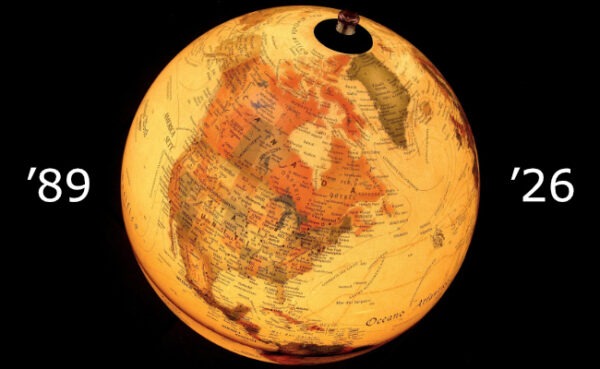
It looks like a fundamental resetting of global geopolitics. The year 2026, therefore, seems likely to become as important a year as 1989 was, in terms of setting the world on a new course, for better or worse.
Global GDP is set to grow by 2,6% this year and 2,7% next year, the World Bank has said. That compares with 2,8% in 2024 and 2,7% in 2025. This means that the world has defied the worst expectations of how output would plunge, after Donald Trump began unilaterally applying steep taxes on the imports of goods into the US last year, and using tariffs as a lever for diplomatic gain.
But the stats also compare poorly with past decades, indicating a world stuck in the slow lane. Annual growth is set to average 2,6% in the 2020s. This is even worse than the 2,7% average in the 1990s, which was driven by dramatic changes in the world economy, including the collapse of the USSR and the East Asian financial crisis.
1989
The year 1989 was a seismic year, notable for the fall of the Berlin Wall. I remember it well. It all happened very suddenly; in company with a gaggle of fellow interested scribes, I joined a charter plane and flew to Berlin Tegel Airport – now closed. Winter was already at hand, but the sun was out and the emotional atmosphere at the breach in the actual wall – a hideous concrete affair – was like nothing I’d ever experienced before. Lots of tears – and most of the folk creeping tentatively through the narrow breach carried rucksacks, believing this would be a temporary arrangement for freedom.
But instead, German reunification lay ahead – a pivotal inflection point, as they say, with far-reaching consequences for the world and for South Africa. The fall of the Berlin Wall signalled the end of the Cold War, the dissolution of the USSR (which ended the bipolar world), the emergence of America as the sole superpower and the end of most proxy wars.
With no USSR any longer at hand to support the ANC in its bid to overthrow apartheid, the communist threat diminished, and as a result the NP under President De Klerk felt able to negotiate itself out of power. He and Nelson Mandela oversaw the process leading to democratic elections in 1994.
The expansion of Nato into the former communist states followed, as, one by one – from Poland to Romania and Ukraine, across eastern Europe – they adopted democratic governance and market economies. The spread of free market capitalism became global, but was not always accompanied by democracy. China adopted capitalism but not political reform.
On the political front, communism as an ideological force threatening capitalism, became less of a threat. Instead, economic disparities, as well as ethnic and religious rivalries, became the dominant cause of conflict, and remain so to this day.
2026
Which brings us back to 2026, and a step change similar to that of 1989 in the new world order. Nato’s mission as primary defence against communism, has made way for broader security roles. Not all Nato members agree on the way to tackle the new threats, which are often ethnic, nationalistic or religious in origin. And so, it is becoming an open question whether Europe can really rely any longer on America pitching in alongside other European countries in respect of chapter five undertakings to defend any Nato member attacked by another.
Quite apart from the countries already mentioned (Cuba, et al), there is a brewing European crisis coming to a head, setting aside the Ukraine-Russian one for the moment. This has to do with Bosnia and the fragile Dayton Accords, which brought a kind of peace to the region. Now, however, for reasons too convoluted to go into here, the original peace agreement is being undermined. The Europeans need to come to the party and nip the problems in the bud, before the perception is allowed to take root that borders and agreements can be revised by force.
The main point is that it is exactly the sort of potential crisis that may explode, as the impression gains ground that the rules-based system under the UN and other bodies is impotent and toothless. It will also be an early test of where America under Donald Trump stands, when push comes to shove, and whether he will come to Europe’s aid under Nato rules.
Note
1) Foreign Affairs, 13 January 2026, Oona Hathaway and J Scott Shapiro
See also:
Suid-Afrika se vlootoefening met Iran ontketen diplomatieke storm
VSA se inval in Venezuela plaas Suid-Afrika se RNE onder druk
Die Johann Rossouw-gespreksreeks: Die VSA en Venezuela – wanorde of orde?
Kommentaar
Goeie insig.