

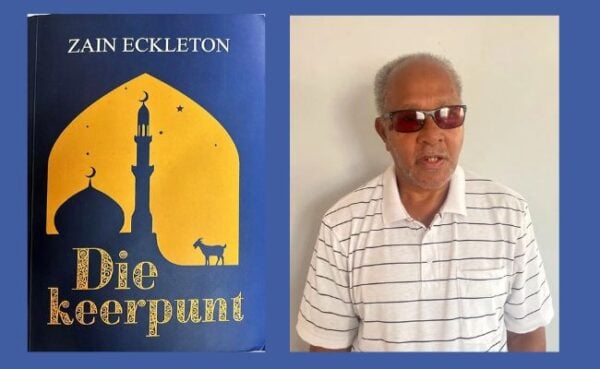
Zain Eckleton talks to Naomi Meyer about Zain’s book, Die keerpunt.
Zain, what is your background?
I am the eldest of three sons from a working-class family, born in Goodwood but raised in Elsies River. I am visually impaired from birth and am now basically blind, as I only have light perception, meaning that I can see a glimpse of daylight through an open door, but not what is showing up in the doorway. This is like the way I write: I vaguely see the light on the laptop’s screen, but I cannot see the letters. I use a screen reader that reads aloud what I type, and it goes back when I want to check if a word, sentence or paragraph is correct.
I am a single parent with two daughters. My wife passed away after 13 years of marriage. I retired in 2019 as a telecom operator for SAPS.
My first short story appeared in Huisgenoot in 1986. My first novel, Die rolbalspeler, was published by Kwela in 2011. I contributed short stories to various youth story collections aimed at the school market, published by Via Afrika. I had a radio play and other audio presentations for the on-air festival that aired on RSG. Die keerpunt is my latest publication.
Why did you write this book, and what was your inspiration?
To be a voice for those who suffer in silence emotionally at the hands of emotional abusers and don’t know how to speak out against it. And for those who can speak out but choose not to do so for fear of victimisation. I also wanted to speak to non-Muslims in general, whom I have found to be extremely ignorant and prejudiced with regard to Muslims and Islam. And to those who are harshly critical of the religion and its followers, based on what the West is saying and propagating, and what they hear about Muslim extremists, who are not actually acting according to Islamic teachings. The novel is set in the Cape and portrays, in part, the lifestyle of Muslims.
I have not come across enough Afrikaans novels about Muslims and their culture, but there are a number of non-Muslim novels that make reference to the religion using terms and phrases incorrectly. These even include a novel that won the Hertzog Prize long ago and a recent one that got onto the shortlist. They used terms like “Slams” and “iblies”, for example.
When I was in standard three or four, I read in a history book, in the chapter on the different religions, about the Mohammedane/Mohammedans. It said that Muslims worship Muhammad, and that Muhammad and Allah are the same. The truth is: Muhammad is a prophet and the messenger of Allah, who is God.
Why did you self-publish, and did you not send your book to a mainstream publisher? How did you experience the process?
I did submit the manuscript to my previous publisher. Unfortunately, they declined. I felt it was a story I wanted to tell and was too important to let go.
The process of self-publishing was very challenging and costly. First, I had to find a professional proofreader and editor working in the publishing space. Because of my lack of knowledge of the publishing industry, I went about it the wrong way: I first got the book out and distributed, instead of getting the marketing and publicity in place first. Although there had been deep thought about this initially and I had reached out to marketing individuals to guide me in this regard, I had got no response. Eventually, I was introduced to a publicist and a social media expert. And here we are, on our way.
Who is your ideal reader?
Readers who are open-minded enough to want to read about something they are unaware/ignorant of – Muslims and Islam. Readers who want to educate themselves and who want to learn more. And, of course, those who love a good love story. Because I write from the perspective of an author of colour, I hope that coloured readers will read the book, as it speaks of a world they know. It bothers me that coloured people, in general, don’t read Afrikaans novels. I understand this, since Afrikaans came to us from the perspective of the Afrikaners and was all about their world, which we cannot really identify with. We read Afrikaans books during our school years only because it was forced on us. But this is not a novel for coloured, white or black readers. It is a novel for readers.
Die keerpunt is aimed at the whole family, including teenagers, youth, adults and the elderly. The two main characters are 23 at the start of the story, their parents in their forties.
What are your thoughts about the South African literary scene, and would you consider sending your book to a publisher?
As far as Afrikaans fiction is concerned – speaking as a coloured male – there are not enough books that attract me. Most Afrikaans fiction is written by and from the perspective of white authors – even stories about coloured people and coloured issues.
Some Afrikaans fiction written by coloured authors also bothers me. There is the notion that publishers expect coloured authors to write in Kaaps, and some of these authors also insist that this is the only way they should write, with the understanding that there is only one form of Kaaps. That is far from the truth. There are various forms of Kaaps.
I know there is a Kaaps dictionary – on which I have not set eyes yet, because consulting a dictionary for me as a blind person is a nightmare – but there is no standard for Kaaps. Here, also, I don’t have a problem with authors who write in Kaaps. Of course they must. Where I need to, I do exactly that.
I also don’t have a problem with mainstream publishers. They are the experts. I salute the people behind the scenes getting the manuscript ready for print. Every manuscript should go through their hands. In fact, my new manuscript is currently at a publisher, to answer the question of whether I would consider sending my manuscript to a publisher again.
Where can our readers buy your book, and what is the cost?
The book is currently available at selected Exclusive Books outlets, Clarke’s Bookshop, The Book Lounge and Mzansi Books, on Loot and in other bookstores at R275.
Also read:
Saartjie Botha laat jou die wêreld anders sien – met Die rolbalspeler