

Title: An Uncomfortable Paradise: A History of Dispossession and Slavery in Simon’s Town
Author: Joline Young
ISBN: 9780796125392
Publisher: Nagspro Multi-Media
...
It began with the transformation of the Cape from a landscape of communal occupation, grazing and hunting, and living in general harmony with nature and animals, into one governed by European ideas of private ownership, fences, agricultural settlement and military authority – the so-called European civilisation.
...
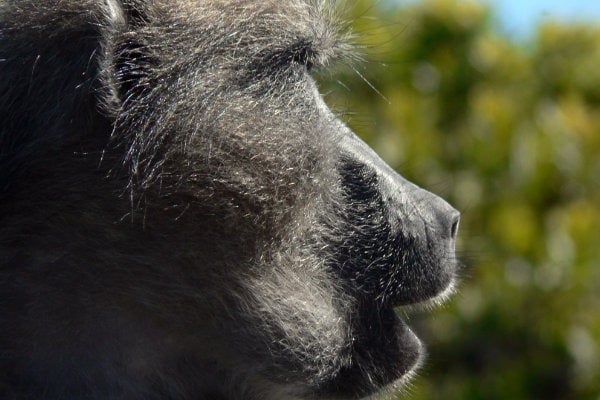
Those of us who live on the Peninsula have spent the better part of the past few months listening to Simon’s Town’s denizens, in particular, argue themselves hoarse over baboons. This month, the argument reached an apex point with the capture and relocation of the Waterfall troop, which began on 13 November. Forty-five baboons were moved to an enclosed wildlife centre in Kogelfontein, prompting an outcry from animal welfare groups and ordinary citizens. I understand the distress. Removing anyone from the natural habitat and home they have known since birth is bound to carry some measure of trauma, whichever way we look at it. Short of asking humans not to invade the natural habitat of animals, I find myself on the side of the decision to relocate the troop, albeit for somewhat different reasons from those usually advanced in the public debate.
The problem, as I see it, is that these baboons have been living in increasingly close proximity to human beings for too long. In the process, they have learned some of our less admirable habits, becoming adept at raiding kitchens, breaking into homes and rummaging through dustbins, and acquiring a liking for a diet of processed food that not only is harmful but bears little resemblance to what they would naturally forage for on the mountain. We have, in effect, created a relationship of unhealthy dependence, in which the animals associate human habitation with an easy source of food. This is neither good for the baboons nor sustainable for the people who live alongside them. I do not believe that allowing the situation to continue indefinitely is necessarily the more compassionate option. Hence I support those who think a properly managed relocation, with safeguards for the animals’ welfare, is the more responsible intervention.
That is, though, not really the intention of this piece. As someone who reads archives, I’ve also been struck by something else that remains largely unsaid beneath all this baboon noise. Nobody in this mountain suburb, or this council chamber, seems particularly interested in the history of removals in general that made Simon’s Town what it is today. The present argument, of course, is about the movement of a troop of baboons who have become a nuisance to the denizens. It seems so obvious to me that this should have automatically led to the scrutiny of the history of the founding of this village town, which also concerned the movement of entire communities from lands they had occupied for generations. Hence I have found myself going back to a book I read last year.
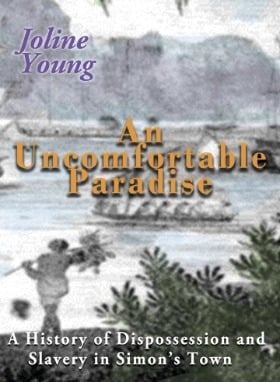 Joline Young opens her seminal book An uncomfortable paradise: A history of dispossession and slavery in Simon’s Town by admitting that the burden of slavery at the Cape did not end with emancipation. Its legacy travelled, she says, as a silent shame through the lives of later generations, in much the same way as the legacy of domination did – as something not spoken about, but considered better forgotten. I find that observation particularly useful for understanding what is currently happening in Simon’s Town, because it introduces us to the antecedents in our history that some would prefer to avoid.
To those of us who refuse to treat the history of the Peninsula as an isolated colonial episode are always cognisant of the fact that it did not begin with the arrival of Europeans, or with that of the enslaved people, or with the establishment of Simon’s Town as a town. It began with the transformation of the Cape from a landscape of communal occupation, grazing and hunting, and living in general harmony with nature and animals, into one governed by European ideas of private ownership, fences, agricultural settlement and military authority – the so-called European civilisation. This brought us technology and, unfortunately, other insalubrious consequences of the violation of natural laws, like artificial climate change, which was exacerbated by the introduction of foreign vegetation that led to uncontrollable mountain fires and so forth. It also introduced the cruel dislocation of both native animal and native human lives.
Before the arrival of the Europeans through the Dutch East India Company (DOC), the area was inhabited by indigenous people for millennia. This is why its history is an intersection of the lives of the Khoe and San, European sailors and settlers, enslaved people brought from elsewhere, West African migrant workers, Xhosa labourers from the Eastern Cape and Indian merchants. For those who might have missed this history, we remind them that the VOC’s arrival in 1652 was initially motivated by commercial considerations for its ships travelling between Europe and Asia, carrying and exchanging gold, silver, textiles, wine, ivory, spices and other goods. The Cape sat strategically along those maritime routes, which made for a prime refreshment station at Table Bay, intended to supply fresh fruit and vegetables to crews who frequently suffered from scurvy on their long voyages. Jan van Riebeeck arrived to establish this facility, not, at least officially, to create a permanent European settlement. But the original purpose did not survive for long. His reports to the Company about the landscape and its agricultural possibilities were so enthusiastic that they encouraged a more permanent occupation. By 1657, the VOC was offering land grants to employees who wished to farm. That is how what began as a commercial stopping point became a colonial settlement.
Young makes an especially revealing observation about Van Riebeeck’s relationship with the indigenous population. His journals record dealings with the Khoe chiefs, whom he entertained and with whom he negotiated for livestock at the same time as he was writing to his employers in the Netherlands, requesting permission to enslave them. The request was initially refused because the Company considered the Khoe too important as trading partners, and thus did not wish to antagonise them.
Young identifies a young Goringhaicona warrior, Doman, as having been abducted and taken to Batavia, as another reminder of the chilling double-handedness of the Europeans, whose performance of cordial relations on one side hid the calculation of intended violence and dislocation concealed beneath the apparently commercial beginnings of the settlement. Such encounters were not incidental to the colonial project. They formed part of the gradual dismantling of an indigenous society whose relationship with the land was fundamentally different from the one the Europeans intended to impose.
...
The transformation of the landscape from a hunter-gatherer and herder environment into an agricultural settlement was catastrophic for the indigenous population.
...
The transformation of the landscape from a hunter-gatherer and herder environment into an agricultural settlement was catastrophic for the indigenous population. The newcomers introduced fences, boundaries and private ownership into a society in which land was communally shared. Grazing grounds and access to water were restricted. People who had moved across the landscape according to established patterns of pastoralism and hunting found themselves confined by boundaries they had neither drawn nor consented to. The consequences were not merely economic; they destroyed an entire way of life.
The first Dutch-Khoe war broke out in 1659, led by Doman after his return from Batavia. Olfert Dapper’s account, which Young quotes, records a violent struggle over the occupation and ownership of the land. The Dutch claimed they were entitled to occupy it, and the indigenous inhabitants maintained that they had held it from time immemorial. After nearly a year of fighting, the Khoe lost the land and their movement was restricted to designated footpaths and controlled gates. The second war, in 1673, brought further dispossession. By 1676, the Company had organised an official commando against the Cochoqua Khoe of the Western Cape, and by 1699 their dispossessed status had also become firmly established.
One passage in Young’s account deserves particular attention. She reproduces the words attributed to the dying Khoe fighter Eykamma, who explained that the indigenous people had been driven from grazing grounds they had always possessed – land first made available to the newcomers as a refreshment station, only to be divided among settlers without their knowledge. Boundaries were erected, and access for natives to land and water was restricted. His final question, as recorded, was what the Europeans would have done had the same thing happened to them on their own lands. It is difficult to read that question without recognising its contemporary resonance.
...
I was reminded of it when I read that the present baboon debate has, in certain quarters, been reduced to the question of where one puts the fence.
...
I was reminded of it when I read that the present baboon debate has, in certain quarters, been reduced to the question of where one puts the fence. Professor Justin O’Riain, who favours removal, has argued that fencing should have entered the picture much earlier, while Dr David Gaynor has proposed an 8,3-kilometre baboon-proof fence above the town. These are serious people grappling with a genuine ecological and social problem. I do not pretend to try to settle their scientific disagreements. Indeed, I support the removal of the Waterfall troop because I believe the present arrangement has become untenable for humans and animals alike. But there is something peculiar in that we are back to arguing about a landscape in which the fence, the boundary and the designated enclosure remain such enduring instruments of control. The history of Simon’s Town reminds us that these are not neutral features of the landscape. They reflect decisions about access, ownership and belonging, and about whose ownership of the land is legal and who is permitted to prevail in the occupation of the land.
Young’s account complicates the familiar picture of European colonialism as the achievement of a confident and socially superior civilisation. Drawing on the research of Ashley Brenner, she reminds us that most Europeans who arrived at the Cape as VOC employees were not drawn from the upper strata of European society. Many came from German territories, some having been displaced by the Thirty Years’ War, which ended in 1648. They were people of considerable poverty, and some were coerced into Company service through deceitful recruitment. The sailors and soldiers who helped establish the colonial settlement were themselves often products of hardship and exploitation. Having suffered humiliation and deprivation within European society, they subsequently participated in the cruel domination of native people over whom they had acquired power. It is a familiar mechanism in the history of oppression, as seen now in how the Israeli state treats the Palestinians. The wound usually passes downwards, and those who have themselves been subjected to the cruelties of hierarchy sometimes become its most enthusiastic enforcers when given the opportunity. Frantz Fanon recognised the pattern: A system of cruel domination eventually teaches even its victims to regard domination as natural. And so it happened also in the history of our country, especially in Simon’s Town.
Simon van der Stel, the man who gave the bay its name, is a fitting emblem of these contradictions. His grandmother, Monica, was a formerly enslaved Indian woman from the Coromandel Coast, a heritage rarely acknowledged in the historical narratives promoted during colonial and apartheid era. Van der Stel became an important servant of the VOC and presided over a colonial order that entrenched European masculine authority. The town carries his name, but not the historical revelation about his bloodline. That small asymmetry is the whole matter in miniature regarding whose history becomes public memory and whose is allowed to disappear.
The history of enslavement in Simon’s Town is another part of this intersection. Young explains that the district’s history cannot be understood without considering both the people who were enslaved there and those whose lives intersected with theirs. Her research began with an oral history project undertaken among families forcibly removed during the apartheid period, and it sought to recover the human stories behind the anonymity of the historical record. Many of the people she encountered were descendants of those enslaved in Simon’s Town between 1725 and 1838. Others arrived after emancipation: West African migrant workers from 1838 onwards, Xhosa labourers who came to build the railway station in the 1890s, and Indian merchants who established businesses towards the end of the nineteenth century. Then came another chapter of dispossession. Under the Group Areas Act, families who had lived and worked in Simon’s Town for generations were removed. Young’s research began, in part, as an attempt to recover their memories before they disappeared into the silence of official history.
She begins the story of Simon’s Town with a woman named Susanna van Bengal, who, on 5 April 1725, stepped ashore at Simon’s Bay as one of five enslaved people bought by Anthonij Visser, and accompanied by his commando of armed Europeans. To the eye, the land looked empty, but it was not. Khoe watchers with poisoned arrows were there, and, as Young reminds us through the accounts of later travellers, so were the “very large monkeys” on the mountain. Before the first fence or house, then, the baboons were already part of the place, which is something the present quarrel too often forgets.
Susanna’s name, too, is a record of loss: She was born into a caste of barbers in India and named Polo, and her mother sold her at nine or ten because of poverty. She was renamed Amarenta, then Dafnie, then Susanna, and by the time she reached the Cape, she had changed owners’ hands at least four times. The same administrative colonial mindset that stripped Polo of her names later sorted her children into what it termed “bastards” and “bastard Hottentots”, and sorted the Khoe into “Hottentotten” and the San into “Boesman”. Young meticulously recalls the identity distress carried by the colonial census into the daily lives of later generations. Visser’s house became the shell of what is now Admiralty House, which the navy still owns. The colonial Dutch rules were such that a child’s fate hung on whether the white father married the black mother. This is why many Afrikaner families can trace their ancestral mothers to formerly enslaved black women. When Visser died in 1745, his death freed Susanna, which suggests she had borne his children. She, too, now appears in the records as a slave owner. I know of no entry in the registers that better captures the moral complexity of the Cape in that era.
Young also asks us to imagine the bay Susanna entered, with Khoe herders ushering cattle past a waterfall within earshot of the cascading water. The waterfall, she writes, was a sacred site for shamanic ceremonies, a place of healing. I cannot read this without remembering that the troop now removed is called the Waterfall troop. Whoever named it meant no irony, I am sure, but the name outpaces its time in surreptitiously tracing origins like a shoal of salmon swimming upstream to trace its birth waters and stones. The land always remembers. I offer this not as an argument against the relocation, but as a reminder that the ground under this dispute was a healing place long before it was a municipal problem, and will forever seek prevailing ways to return to its intended purposes, no matter how many relocations we impose.
What followed the Declaration of 1743, when Baron Von Imhoff made Simon’s Bay the VOC’s winter anchorage, was, in Young’s words, the death knell of the indigenous people. The West Dockyard storehouses, bakehouse, tavern and wagon road to Table Bay were all built by enslaved labour and washerwomen. Young points to letters about enslaved men hauling rocks down the mountainside in a place blazing in summer and wet and windy in winter, and about the public day of prayer of 1747, called because of the “great mortality” among the enslaved. The anxieties of the colonial mindset were about revenue rather than lives. The Tulbagh Code of 1754 shows how a society frightened of its own labour force tried to mitigate that fear by establishing discriminatory policies. The enslaved had to be indoors by ten at night or carry a lantern; could not ride, carry guns or gather near a church door; and could not sing, whistle or make any other sound at night. Naturally, later on, the apartheid regime perfected all that into racial laws.
Young’s most moving pages concern slave escapes: Seven people fled in 1758 in the Simon’s Town post-holder's own boat. In 1761, ten Madagascans escaped by sea, and in 1763, 22 Mozambicans, after a failed sea escape, fled inland. Whether they survived is not known, but they were never found. By 1775, she writes, Simon’s Town had gained the reputation of being the VOC outpost with the most daring escapes. Her explanation is that foreign-born people had known freedom and so were more ready to run, and Madagascans and Mozambicans, unlike Asians stranded on a different continent from their natal homes, were more likely to try. Those who remained were therefore disproportionately Asian, and this is why Islam took such deep root in the town.
The role of Christina Diemer’s farm, Imhoff’s Gift, includes Bugis, Malabarese, Bengalese, Balinese and Mozambicans. Among them was Ismail, said to be one of the two tuans buried in the kramat in Dolphin Street. Islam was banned until 1804, and yet names such as Ismail, Pagtra and Mandaar sit in the inventory as a glaring anomaly. Young describes the farm as an incubator of Islam. She cites an interview from 2009 with 91-year-old Aunty Kobie Manuel, who kept her ancestor Abdul Kariem’s kitaab; she notes that before the removals of the 1960s, at least 12 Muslim families in the Malay Quarter claimed descent from Ismail: the Ismails, Solomons, Manuels and Bakers. The enslaved schoolmaster Jan Smiesing kept health remedies in Tamil, and the Heritage Museum holds kitaabs in beautiful Arabic script. The conquerors, many of them illiterate men from the lowest ranks of Europe, ruled over people who could read and write in their own languages – how ironic.
An uncomfortable paradise is more than a history of slavery; it is an account of the successive human encounters through which a seemingly picturesque coastal town was made. The Malay Quarter, the mosque and the kramats are not picturesque leftovers, but evidence of what the town was built from. The families who carried that faith across three centuries were, in the 1960s, told to leave. The naval harbour, railway station, streets and commercial establishments were not just products of European planning, but were built upon layers of indigenous dispossession, coerced labour, enslavement, migration and racial exclusion. The physical beauty of the place can easily distract us from the human cost of its making.
The book also raises an uncomfortable question about belonging. The philosopher Alasdair MacIntyre taught us that practices carry histories, and we cannot properly understand a present argument without knowing the tradition in which it is conducted. A town is constituted by the people who have inhabited it, worked in it, built it and been driven out of it. Its identity cannot be reduced to those who currently possess its properties or enjoy its amenities, especially when the foundations are plagued with histories of injustice.
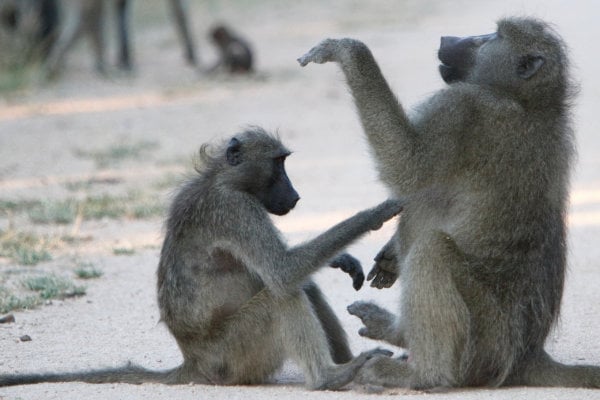
This is why I find the present baboon controversy so revealing. We have an extraordinary capacity to mobilise public feeling around the fate of animals, while showing much less enthusiasm for recovering the histories of the people who once occupied the same landscape. There are good reasons to protect wildlife, and I do not regard concern for the baboons as misplaced. But concern for one form of displacement should inspire us to remember, and to try reconcile with, our unjust past.
My modest proposal for those of us who live on this beautiful and uncomfortable peninsula would be to continue not only the debate about the baboons and acknowledging the practical necessity of addressing their increasingly destructive proximity to human habitation. I support the baboon relocation, provided it is undertaken with proper regard for their welfare and long-term survival. But let us hold alongside this another, perhaps more difficult conversation: Who lived in Simon’s Town before the naval base and the tourist guesthouses? Who built the town? Whose labour carried its items of trade? Who was enslaved, dispossessed and made to leave when belonging became a matter of race and mercantile property development? And then, let us find ways of paying some form of restitution to them. If the town can summon considerable moral energy in defence of a displaced troop of baboons, surely it can summon some of that energy to remember the people displaced before them.
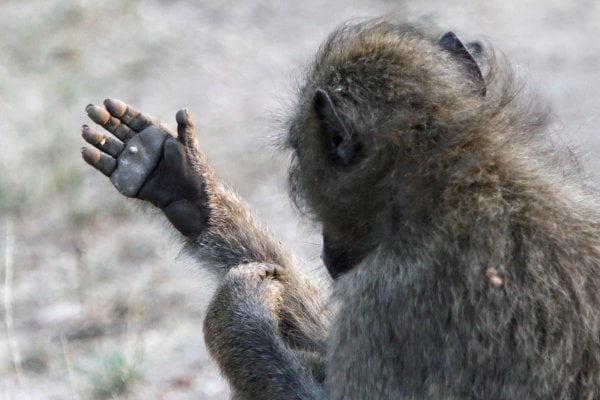
Whatever else the relocation to Kogelfontein teaches us, it should remind us that removals are never merely logistical exercises, but decisions about the relationship between inhabitants and the landscapes they occupy. And the silence that follows them, as Joline Young so perceptively reminds us, can have a much longer afterlife than the removal. And unattended silences, like untreated wounds, tend to fester.
- Baboon photographs by Izak de Vries
See also:
The limits of white innocence and the politics of black grace
The geography of power: Hollow land: Israel’s architecture of occupation by Eyal Weizman