

...
The occupation, he insists, is not merely administered through architecture and engineering, but is the architecture of conquest.
...
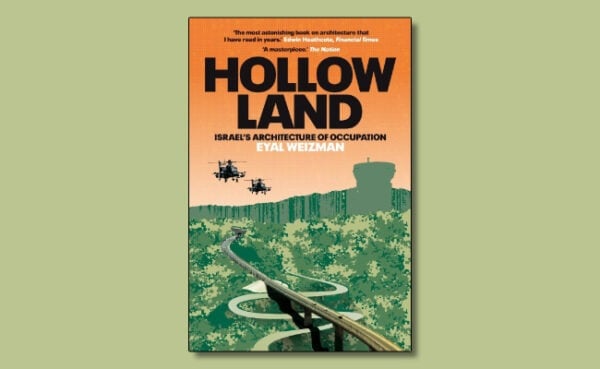
Eyal Weizman’s Hollow land: Israel’s architecture of occupation completely changed my understanding of Israeli occupation of Palestinian lands. It is one of the most original works written about the Israeli-Palestinian conflict not because it looks at the conflict through a unique lens, but because architecture ceases to be the passive scenery against which politics unfolds. It is the landscape itself that is giving evidence: Buildings, roads, checkpoints, tunnels, settlements, archaeological excavations, airspace and even the underground aquifers are not passive platforms but political actors.
Wars are usually narrated through diplomats, soldiers, politicians or victims. Geography is often treated as inert terrain over which history marches. Weizman inverts this relationship. He argues that history is literally built into the land – that political domination materialises as concrete, asphalt, zoning regulations, legal categories and military infrastructure. The occupation, he insists, is not merely administered through architecture and engineering, but is the architecture of conquest.
From the opening chapters, you can immediately see that this is not simply just another contribution to Middle Eastern studies, but equally a work of architectural theory, political philosophy, urban history, legal analysis and military geography. It draws from Michel Foucault as readily as it does from Ariel Sharon’s settlement plans. Edward Said appears alongside Israeli planning documents. Gilles Deleuze sits beside military engineers. Rather than producing an interdisciplinary study, Weizman dissolves the boundaries between disciplines altogether.
Readers expecting a chronological history of the occupation beginning in 1967 may initially find themselves disoriented. The book possesses almost no conventional narrative. Instead, it proceeds anatomically. Each chapter dissects one component of Israel’s “architecture of occupation”: Jerusalem, settlements, checkpoints, the separation wall, targeted assassinations, urban warfare and evacuation. Like an architect producing sectional drawings of a building, he cuts through the visible surfaces to expose the hidden structural systems beneath.
The title Hollow land itself announces the central intellectual conceit. Land, Weizman argues, is not simply a surface divided by borders. Modern occupation extends vertically. Sovereignty reaches downward into archaeology, groundwater and tunnels, and upward into drones, satellites and controlled airspace, making political authority volumetric rather than merely territorial.
...
This is why the Palestinian land resembles a multi-storey building whose floors belong to different owners.
...
This notion of “verticality” may initially sound abstract, but it quickly proves astonishingly concrete. The Oslo Accords, often imagined as dividing land horizontally between Israelis and Palestinians, actually divided sovereignty into layers. Palestinians received varying degrees of authority over patches of surface territory, while Israel retained extensive control over borders, airspace, electromagnetic frequencies, water resources and security. The result was not partition but stratification. This is why the Palestinian land resembles a multi-storey building whose floors belong to different owners.
It is this insight that distinguishes Weizman from nearly every previous writer on Palestine. Edward Said interpreted Palestine primarily through the language of dispossession, exile and Orientalism. Rashid Khalidi writes her national history. Benny Morris reconstructs military history through archival research. Ilan Pappé frames the conflict within settler colonialism. Weizman, instead, studies engineering drawings. His archive consists of planning applications, road systems, military manuals, zoning maps and government correspondence or diplomatic cables. Hence his protagonists are often architects rather than politicians. The effect is quietly revolutionary and a marvel to read. The book refuses to separate technical language from political consequence.
Consider the opening discussion of Migron, the West Bank outpost whose origins began away from political philosophy or military necessity. They began with something apparently mundane: a mobile phone antenna. A telecommunications mast justified new electrical connections, which justified security guards, whose presence justified the presence of families, which justified schools, synagogues and permanent settlement. You see how the Israeli settlers justify their occupation, from infrastructure development to land occupational sovereignty.
The anecdote functions almost like a parable. Normally, one imagines that governments build settlements first and infrastructure afterwards. Weizman reverses the sequence. Infrastructure built is itself a weapon of colonisation. A cell phone mast is transformed into geopolitical fact.
This ability to reveal enormous political consequences hidden within ordinary technical decisions recurs throughout the book. Roads are never merely roads. Bridges become instruments of segregation. Street lighting defines security perimeters. Stone cladding becomes historical narrative. Archaeology becomes territorial legislation. The politics of Israeli occupation are sedimented into matter.
The subtitle, Israel’s architecture of occupation, contains another subtle ambiguity. It can mean architecture built for occupation. Or it equally means that occupation possesses colonial architecture. Weizman deliberately embraces both meanings. Architecture functions simultaneously as physical construction and conceptual framework. Military commanders become architects because they organise territory. Lawyers become architects because legislation reshapes physical space. Urban planners become military strategists because zoning laws accomplish what armies cannot. This conceptual flexibility gives the book remarkable explanatory power. To avoid metaphoric excess, Weizman rescues himself through empirical precision. Every theoretical claim is anchored in maps, planning documents, engineering projects or military records. He rarely allows metaphor to float free from material evidence.
For readers outside the architectural discipline, the book’s conceptual density may initially prove intimidating. Weizman writes with extraordinary compression. A single paragraph might invoke Deleuze, Ottoman land law, biblical archaeology, Israeli military planning and urban morphology without pausing for explanatory transitions. This is exhilarating but demanding. The prose also possesses the density of theory rather than journalism. Unlike writers such as Thomas Friedman or David Grossman, Weizman assumes readers are willing to perform intellectual labour.
The reward is proportional. Each chapter leaves one seeing familiar images – the separation wall, settlements, checkpoints – with a fundamentally altered perception. One no longer sees isolated structures, but systems of oppression.
The new preface, added to the 2017 edition, performs another important function. It updates, after a decade, the original 2007 argument that witnessed expanding settlements, repeated wars in Gaza and the apparent collapse of the Oslo framework. Weizman argues that what began as occupation has hardened into a durable system of territorial separation that operates across multiple legal, physical and political layers, which he describes as “vertical apartheid”, extending his earlier concept of the “politics of verticality” into a broader theory of spatial domination.
This terminology is, of course, politically charged. Some readers will embrace it. Others will reject it. Whether one ultimately accepts Weizman’s characterisation or not, the argument deserves to be engaged with on its merits rather than dismissed because of its vocabulary. Throughout the book, he does not rely on rhetoric alone; he attempts to demonstrate, through architectural, legal and spatial evidence, how overlapping systems of movement, infrastructure, planning and jurisdiction produce unequal forms of mobility and citizenship. The strength of his case depends less on slogans than on the cumulative force of those examples.
...
Weizman writes from an openly declared moral and political position. He does not pretend neutrality. This reader admires him for that.
...
Weizman writes from an openly declared moral and political position. He does not pretend neutrality. This reader admires him for that. Indeed, he rejects the possibility that scholarship on Palestine can ever be politically neutral. There is intellectual honesty in this admission. Unlike many academic writers who conceal normative commitments beneath technical language, Weizman places his ethical commitments on the table from the outset. Nevertheless, this choice carries consequences.
The book devotes comparatively little attention to Israeli security arguments, except insofar as they are interpreted as ideological rationalisations for territorial expansion. Readers looking for a sustained engagement with Israeli strategic thinking on its own terms may find the treatment insufficient. That does not invalidate Weizman’s thesis, but it means the book is best read alongside works that foreground those perspectives, allowing the reader to judge where the competing interpretations diverge.
The greatest compliment one can pay the opening of Hollow land is that it permanently changes the reader’s habits of observation. After only the preface and introduction, it becomes difficult to see a road ever again simply as a route for transport, a wall simply as concrete, or a settlement simply as housing. One begins, instead, to ask architectural questions of politics and political questions of architecture. I hope this gives the government of the City of Cape Town something to ponder with their plans for building a wall on the N2 to protect commuters from the airport.
See also:
A hugely important book: A reader’s impression of The bitterness of olives by Andrew Brown