

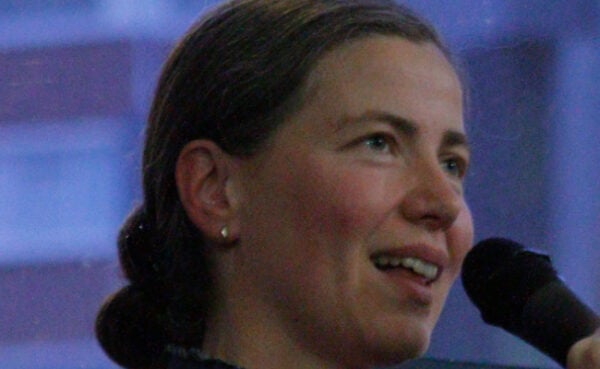
Stefaans Coetzee sent Karina M Szczurek a number of questions.
Karina, could you please introduce yourself in a few sentences for our readers?
Polish by birth, Austrian by citizenship and South African by heart, I am a reader, writer, editor and publisher based in Cape Town. I count myself extremely lucky, because I write and work with stories for a living. After my turbulent, migratory early life, South African stories brought me to this country. The old Victorian house I share now with Salieri, my beloved literary catssistant, has been my home for the past 20 years. I am gradually approaching my fiftieth birthday, but I am still learning how to be in this strange world, and loving the adventure.
What made you decide to start a short story workshop, which would result in anthologies?
As a writer, I’ve always found writing workshops incredibly inspiring. Over the years, I have been involved with a few major short story projects. Short Story Day Africa (SSDA) specifically has been pivotal in my thinking around the African short story, and it has been a joy to be involved with the project for well over a decade now. The project has been instrumental in shaping the literary careers of many writers and creatives, including my own as an author, editor and now publisher. I also learned a lot by being involved in the Flow Workshops that SSDA ran across the continent. This experience gave me the idea of creating an opportunity where, within a workshop environment, one could not only hone individual texts, but guide them towards a common publication – basically to workshop an anthology of stories within a small group of writers and a relatively short period of time.
Tiger and temperature – your themes are very diverse. How do you decide on them? And are you going to follow up with another T-title?
We decide within the group during the first meeting each year. The 2023 theme was inspired by a news story many will remember from that year: a tigress named Sheba escaped from a private farm in Gauteng and was eventually euthanised. The second theme was suggested by Karin Lijnes. It was one of a few ideas that circulated among the group, but when we voted, it turned out to be the favourite one. And this year, although the inevitable T-word that has been causing chaos and distress around the world this year was mentioned, a vote decided that our next anthology will be secret. The first three stories are already in, and I have a feeling this is going to be another fascinating collection.
What were some of the biggest challenges you faced in organising and running the workshop, and how did you overcome them?
The biggest challenge has been and remains that I am a one-woman show, so if I am ill or otherwise not able to work, everything becomes very difficult to manage. Last year, in particular, was brutal for me, with loss, grief, illness and other disasters haunting me throughout the year – there were moments where I could barely get out of bed. But what keeps me and Karavan Press going are the amazing writers I work with: it is their compassion, kindness and patience that makes everything possible in the end. Their support has been phenomenal.
Most writers are against AI, but you included a story from ChatGPT. (a) Why only in the first edition? And (b), are authors in danger with ChatGPT turning anyone with a computer into a writer?
We were all curious at first, and one of the writers, Kerry Hammerton, suggested that we experiment and see what ChatGPT could do with the prompts that we were also working with in the group. It was an interesting process, but we all felt that (at least this version of) ChatGPT could deliver only a competent story that felt bland and soulless. I haven’t read a single piece of creative writing yet that has made me feel threatened by ChatGPT. It might become more sophisticated and intriguing with time, but even if its output in the future is indistinguishable from stories created by human imagination and empathy, I will always want to continue reading and publishing stories that come from a human mind and heart. I always think of what Michiel Heyns once said at a literary festival: ChatGPT still does not comprehend the nuance of human ambiguity, and that is what makes us unique, as individuals and as creative beings.
What kind of impact do the workshop and anthology have on South African literature and writers?
I think they go a long way in creating a sense of community and make the solitary act of writing a little bit less daunting. Authors associated with Karavan Press and Karavan Stories are supportive of one another and the press in wonderful ways. I am deeply grateful for the network of personal and professional relationships surrounding the press and this project.
How do you see the role of short story workshops in promoting South African literature?
They offer writers opportunities to perfect their craft. They can be inspiring and allow one to discover other writers travelling on similar paths.
Will you one day think about an online workshop?
I have done a few online workshops in the past. In the first two years of Karavan Stories, we always had participants joining the in-person group via Skype. South African authors from as far away as South Korea and the Netherlands have participated in the project. However, I find in-person settings more rewarding and hope to stay offline as much as possible for the project.
What are some of the most memorable stories or writers that have emerged from the workshop?
I’ve truly loved working on all of the stories so far, but if I had to single out any, it would be the debut stories – a few of the participants had their first ever pieces of writing published in these anthologies, and three of them have gone on to complete full-length manuscripts (a poetry collection, a memoir and a novel) since then. One (short story collection) is nearly there. This is really exciting to see.
Has any writer who has been in one of your workshops made their debut afterwards?
One of them was published by Karavan Press last year: Self-portrait of a guava by Lucienne Argent. Another one is in the process of revision now and should be ready for publication soon. Two manuscripts have been submitted that I still have to read. And Karavan Press is acting as the local distributor for a debut novel by one other Karavan Stories participant: Joëlle Searle has published Odette in the US, and we are supporting her in her journey locally.
Who are some of your favourite South African short story writers?
There are soooo many, but I will name the first ten who come to mind: Nadine Gordimer, Niq Mhlongo, Lester Walbrugh, Diane Awerbuck, Alex Latimer, Ivan Vladislavić, Sifiso Mzobe, Karen Jennings, Damon Galgut and Mary Watson.
How do you see the future of South African short fiction?
The more we publish, the brighter it looks, so we are going to continue nurturing this wonderful genre.
Where can readers buy the collections?
Good bookshops will either have or be able to order copies, but Tiger is already out of print with only a few copies left in bookshops. The print runs are relatively small since it is an annual publication, but I know that libraries have copies, so readers can always access the anthologies there.
What advice would you give to aspiring short story writers?
The cliché advice I give all aspiring writers: read! And read some more. It shocks me how many people want to write and be published but do not read. And then: find your own rhythm and routine for writing. No matter what else you do, the easiest way to exercise your writing muscles is to keep a journal. Paper notebooks and writing by hand connect you to your creativity in ways a keyboard and a screen can’t. I do all creative writing on my computer, but most of my writing happens on paper in my diary.
See also:
It took the Booker to introduce South Africans to their own Karen Jennings
New from Karavan Press: In other stories edited by Kerry Hammerton
Short.Sharp.Stories anthology Fluid: interview with Andrew Robert Wilson, author of "Seahorse"