

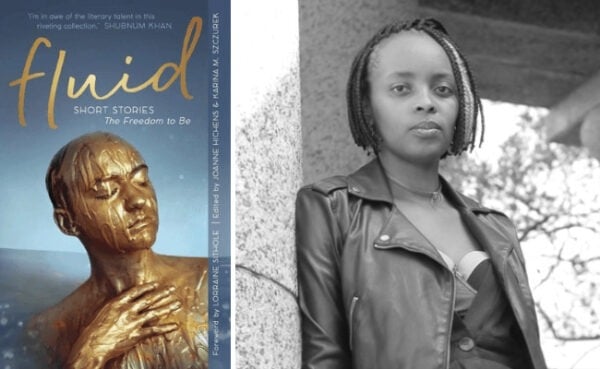
Fluid book cover: Karavan Press; Robyn Perros, photo: provided
Short.Sharp.Stories is a platform showcasing top and emerging South African fiction writers. The theme of this year’s anthology is Fluid – freedom to be. Fluid, this year’s Short.Sharp.Stories anthology, seeks to engage fictional expression around identity, culture and society.
Joanne Hichens conducts interviews with the respective short story writers.
Mini-interview with Mabel Mnensa, author of the short story “Jars for nights like this” in the 2023 Short.Sharp.Stories anthology, Fluid.
Mabel Mnensa is an avid reader, poet and writer who has just completed her master’s degree in creative writing from University College Dublin (2022) with distinction. Her published work ranges from children’s picture stories to prose that explores alternative worlds and realities. “Jozi’s calling”, a short story by Mabel, was published in the award-winning anthology Joburg noir. Coming from a long line of nomads, Mabel – true to her heritage – is currently in Dublin working on her debut novel, Undocumented secrets. Of her short story, she writes:
I wanted to explore the realities of a young black professional in Cape Town, trying to survive the spaces she finds herself in. Spaces that demand she leave parts of herself at the door. In a tale of two selves, can anyone win?
.....
You cannot leave parts of yourself at the door as you enter the places where you spend most of your time.
.....
JH: So, do you have a conclusion? (In a tale of two selves, can anyone win?) What is it like for you in real life, living in (different) “spaces”?
MM: Once one is segmented, I do not think it is possible for anyone to win. You cannot leave parts of yourself at the door as you enter the places where you spend most of your time, ie, work, and exist as a healthy, functioning being.
In my case, when beginning my career in Cape Town, there were too many parts of the “outside-work-Mabel” I felt I could not bring into the corporate space. It is not something that was overtly said, but something I saw in who succeeded and who seemed stuck in the places. Hungry to thrive, I brought forth a version I thought was easier to accept and eventually promote. I only realised the damage the segmentation was having on my mental health after experiencing too many moments shrouded in darkness. I laid my broken pieces at my psychologist’s door, and with her guidance I learned how to show up in spaces in a much healthier way.
JH: And how do you find it, as a young black woman, living in Dublin now? It is a world away from Jozi and Cape Town. For what reason did you go all the way to Dublin to complete a master’s degree?
MM: My parents moved to Dublin in the 2000s, and even though I insisted and managed to build my life in Cape Town, life had other plans. In 2021, I had to uproot myself from Cape Town after I lost my source of income due to sickness. As a result of lingering effects of my long Covid experience, it made sense to join my family in Dublin. It offered me a moment of respite, an opportunity to live with my family while focusing on my writing, something which I have tended to leave on the wayside in favour of climbing the corporate ladder.
I was initially wary of writing from Dublin, thinking that no one here would want to hear my stories; but I am learning that if you write from an authentic place, you will find readers who will relate to your story, regardless of where it is set. The years of therapy also really helped; I now find myself better rooted in the essence of who I am, which is crucial as I find myself working and creating in Dublin.
I have to admit, though, that despite the work done, I find that I am missing parts of myself. And this is beginning to become a focus of the stories I am working on. I am drawn to stories that explore the parts we lose when we migrate, whether it be across continents, countries, cities or social classes. The unnamed protagonist in Jars for nights like this is essentially a migrant, alone in a white Cape Town. If she does not find better coping mechanisms and reliable alternative realities, she will soon lose too much of herself and not be able to function.
.....
I have to admit, though, that despite the work done, I find that I am missing parts of myself.
.....
JH: What “alternative worlds and realities” are you particularly interested in exploring through your writing?
MM: Currently, I am interested in exploring the trauma and PTSD many live with, focusing mainly on stories of black women, and looking at worlds and realities where they would thrive. With the dark history, experience and present that many of us black women have had to endure, at times I think it is only by magic that we are able to function and even flourish. It is this subtle type of magic, spirituality or supernatural that I want to explore. In Jars for nights like this, running away into a supernatural space is posited as a possibility. I guess I am exploring which spaces – physical or perhaps supernatural – we can escape to where we will be able to be wholly as we are.
JH: Getting specifically to your story: a tight, precise literary piece and the tackling of mental health issues and alcoholism certainly tie in with exploring alternative realities?
MM: Yes, it is all linked. For the Jars for nights like this protagonist, the state of intoxication offers an alternative reality. It is the state in which she is not overly concerned about perceptions or expectations, and all the parts of her that she feels compelled to suppress during her work day come out to play. I, of course, do not have the answers, but by the end she is hopefully closer to finding a way to a healthier state of being.
JH: In your short story, you refer to jars of sea water, with a nod to the “jars” in the title. What is the significance of this?
MM: You know how when many Joburgers come to Cape Town or any coastal place, the people back home ask them to come back with bottles of water from the sea? The jars are a nod to that, the idea of being able to capture a moment, a memory, an energy within a jar that you can go back to. Also, I am thinking of jars with brains and foetuses floating in Formalin in science labs. This again makes me think of preserving memories.
It is also a nod to Mxolisi Nyezwa’s powerful poem, “Sea”.
JH: When it comes more generally to the short story form, what are the advantages? And do you feel there is a space for short story writing in the South African, indeed the global, literary scene?
MM: Globally, there is a rise in short stories; this can be seen in the journals coming out and anthologies being published.
I am sure the cynical would attribute this rise to reduced attention spans. I agree with Nicholas Royle’s argument that “a good short story requires you to concentrate and it’s the most amazing example of the story coming together between writer and reader. There’s this great intimacy.” It is this intimacy I would like to tap into.
Since most of my stories focus on PTSD, the short story format suits them best; the stories serve as snapshots of a certain experience of the characters. The format allows us to explore these snapshots in a detailed way that the longer format does not necessarily afford us. And I believe stories should be as long or as short as they need to be.
.....
Since most of my stories focus on PTSD, the short story format suits them best; the stories serve as snapshots of a certain experience of the characters.
.....
JH: After your experience as a master’s student in Ireland (and congratulations, you were awarded a distinction!), what tip would you offer an emerging writer?
MM: It probably will sound like a cliché, but the best thing to do is to find work and writers you like. See what it is about the writing and style that works for you. Experiment with different styles until you find your own style. And most importantly, find your rhythm and write, write often, write even if the inspiration or creativity is not there.
Also read:
Short.Sharp.Stories anthology Fluid: interview with Robyn Perros, author of "The window display"