

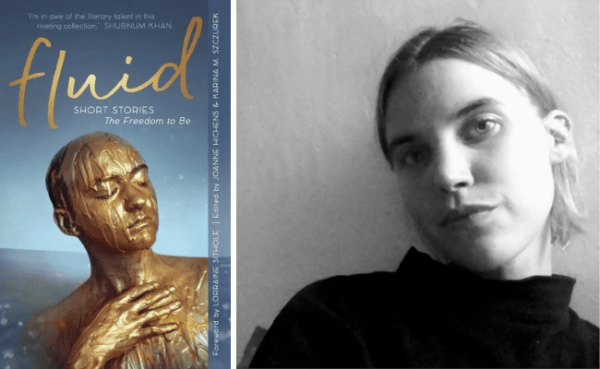
Fluid book cover: Karavan Press; Robyn Perros, photo: provided
Short.Sharp.Stories is a platform showcasing top and emerging South African fiction writers. The theme of this year’s anthology is Fluid – freedom to be. Fluid, this year’s Short.Sharp.Stories anthology, seeks to engage fictional expression around identity, culture and society.
Joanne Hichens conducts interviews with the respective short story writers.
Below is a mini-interview between Joanne Hichens and Robyn Perros, author of the short story “The window display” in the 2023 Short.Sharp.Stories anthology, Fluid.
Robyn Perros is a South African writer, researcher and multimedia artist. She holds a Master of Arts in Creative Writing from Rhodes University, where she is currently a PhD student and part-time instructor in the School of Journalism and Media Studies. Her work has been exhibited/presented/published in multiple spaces, such as the KZNSA Gallery, Theotherroom, the Open Plan Studio, “The symposium for artistic research in analog photography” (Helsinki Darkroom Association, 2022), the “Institutions and death” conference (University of Bath, 2022), Isele Magazine, Decolonial Passage, Mahala, Zigzag, Ja and Ons klyntji, among others. Her research looks at online death practices in South Africa. She lives in Makhanda. You can follow her on Tumblr. She writes of her story, “The window display”:
I explore my complex unease with the way in which capitalism plus consumerism intersect with memories, particularly in the age of social media. Unlikable women. The shameful characters we keep “embalmed” within our own psyches and bodies. The consumable ones we prefer to present to / package for the world. Displaced resentment/bitchiness for both. Displaced grief. The strange feeling of life and death growing increasingly synonymous with a trip to the mall. The dark comedy/frivolity of it all.
JH: Your story could be described as dystopian or sci-fi. I found your story almost mesmeric and very powerful. Your protagonist, Lan, breaks free from her stifled life as a mannequin. Perhaps I should leave an enigmatic character well alone, but could you decipher for us a little more of her role?
RP: There is a lot of incentive to be liked online, and I think this has only fuelled my fascination with unlikable people. Particularly unlikable women. Lan, in “real life”, would be a bit unlikable, I think. She’s unambitious, insecure, jealous, unwilling to change, complacent in the face of a burning planet, and sickly obsessed with her looks. In the story, Lan is a mannequin who possesses many undesirable human qualities, yet her status as human is still questionable. I’m not sure who or what Lan is exactly, but maybe she is a comment on the constant questioning of the authenticity or “humanness” of people (including our own selves, certainly myself) and how capitalism/consumerism and social media only obscure this further. Perhaps she represents a digital trace, or the selves we’d rather were disposed of. I’m not sure.
.....
Capitalism/consumerism is so embedded in my life, mind and body that it would be difficult for me not to write it into my stories.
.....
JH: Your completely interwoven comment on capitalism and consumerism is integral to this story. How did you achieve this so seamlessly?
RP: Capitalism/consumerism is so embedded in my life, mind and body that it would be difficult for me not to write it into my stories. I’m interested in this idea, though, of companies like Facebook owning representations of our memories and essentially “selling” them back to us under the guise of gifts. Whether or not that comes through in the story is debatable, though. I quite like the form and style of my stories in representing the themes they’re dealing with, and so I became quite conscious of writing “The window display” in a way that it, too, was “consumable”.
JH: You write a lot from your dream life. Can you tell us a bit more about how stories or scenes come to you?
RP: In “The window display”, there is a scene where Lan enters a kind of sci-fi graveyard located in a shopping mall. This scene came from a dream, and in a practical sense, the writing of the story began there, with that scene. I – like many other people who write, I think – often seem to be collecting invisible things. Throughout the day, my body gathers details from everyday life that may or may not make it into my writing. All this is to say that I believe I’m doing the same thing when I sleep/dream, too. I’ve kept a dream journal for about eight years now, and not only does it provide some comic relief, but it reminds me to listen to my subconscious, to nonsensical things – that nothing and no one is impossible. It’s this quality of dreams that I tend to approach my writing with, I think.
.....
Throughout the day, my body gathers details from everyday life that may or may not make it into my writing. All this is to say that I believe I’m doing the same thing when I sleep/dream, too.
.....
JH: Talking more about your life in general, part of your work is to research online death practices in Africa. Can you tell us more about your fascination with these practices and how this influences your fiction?
RP: Most people with a Facebook account, for example, have experienced a personal death-related incident on this platform. It’s these stories, among many other things, that motivate my research. Broadly speaking, though, I’m fascinated by the existential dimensions of digital life, and how with death our notions of (im)mortality and personhood are challenged by this. I’m interested in how the online dead continue to contribute to the algorithmic ecosystem, and how this might relate to concepts of a spirit realm in the South African context. Another aspect of this field I find interesting is the “transcendence industry” (grief bots, automated farewell messaging, and tech start-ups like Eterni.me, etc). But beyond my intellectual fascination, the more I look into death in general, rather than look away from it, the less I seem to fear living. I think a lot of my fiction is formed from the subconscious residue of my research – an outlet for expressing and informing this knowledge imaginatively and, more importantly, humorously.
JH: On another note altogether, you have recently been longlisted for The Island Prize. Congratulations! Could you tell us more about what this means to you, and indeed being included in an anthology like this one?
Thank you. It is an honour to be longlisted for The Island Prize. When you’ve been toiling in the dark with the voices in your head for so long, it is nice to have one’s madness affirmed in some way, whatever the outcome of the actual prize might be. Having “The window display” in the S.S.S anthology, alongside other local writers I admire, is exciting, daunting, an honour. I’m really looking forward to reading the other stories.
JH: As a writer and an academic, would you like to share your thoughts on the state of South African literature? Where are we headed?
RP: There are so many angles from which one can look at the South African literary scene, that it’s a tough question for me to answer succinctly. But I have huge love and respect for independent publications, zines and smaller literary magazines in South Africa – and all countries, really: publications like Chimurenga, New Contrast, JALADA, Isele, Ons Klyntji and Ja, projects like Nature is Louder, and many others. I think these platforms are just as important as the bigger publishing houses. They allow for less filtering and more risks, play, collaboration and experimentation, and can be a foot in the door for newer writers, like they have been for me.
But many of these platforms are labours of love, and although this is their potency, it can be unsustainable and limit their ability to thrive. But who has access to even these independent publications, not to mention book shops, book launches, libraries, etc, is also a challenge in South Africa, I think. I think that the individuals, groups and organisations (like the Black Power Station library here in Makhanda and the Denis Hurley Centre’s Street Lit project in Durban) who are bringing out relevant books and resources, and who are creating book clubs and writing groups and micro book economies, in spaces where these things aren’t as accessible, are crucial to strengthening the South African literary scene outside of the more elite spaces that occupy it.
I love it when writing enters and disrupts the public space, too. I like to pick up and read things like Jehovah’s Witness pamphlets on my walks to campus, questionable flyers that get handed to me, handwritten signage, graffiti, etc. I often wonder how these forms of the written word might be included in what we think of as the state of South African literature, too.
.....
I like to pick up and read things like Jehovah’s Witness pamphlets on my walks to campus, questionable flyers that get handed to me, handwritten signage, graffiti, etc. I often wonder how these forms of the written word might be included in what we think of as the state of South African literature, too.
.....
JH: What does South Africa provide that other countries don’t? Or does it come down to: I was born here and live here, so I write about here?
RP: I think South Africa provides me with the opportunity to confront my own hypocrisy on a daily, sometimes hourly, basis. When I have the courage to see and let myself be seen, that is. I often want to look away from all that is broken here, and often still do, but there is something that makes looking away in South Africa particularly haunting, I find. If you look away with your eyes, does it mean you look away with your mind, your heart, etc? Living in South Africa seems to bring out the extremes in me. Extreme best, extreme worst, extreme mediocrity. The chaos and contradictions that come with the inner and outer extremities here are something I think I’m trying to learn how to hold through writing, reading, teaching and art.
JH: Lastly, from your experience as a writer and an academic, what is your secret to writing? I am perpetually looking for the secret!
Writing – or how I write, rather – is something I’m still figuring out. Probably because it’s equally as mysterious as it is mundane. I don’t write every day. I write when I’m obsessed with something, and when I am, I’m disciplined with seeing that idea through. Before the typing even begins, though, a lot of the writing happens in my head. While I’m doing other things like walking, swimming, washing dishes, staring at a wall, I’m moulding images, details, people, conversations together into stories. It’s like when I sit down to write, I’m just assembling the body for an already-made ghost to clamber into. But the process does differ from piece to piece. A big part of all my writing, though, is the rewriting. I will have draft after draft saved all over my laptop and emailed to my three different Gmail accounts 100 times. It’s a shitshow, really.
I think my best writing comes when I have the courage to write from the shittier parts of myself. I had a dream the other night that my partner, who is also an artist, was giving me advice. In the dream, he kept shouting, “Write from your black holes, Robyn! Write from your black holes!” I woke up and told him, and we laughed, and so I guess maybe a “secret” is trying to write from one’s own secrets, one’s own blind spots, one’s own black holes – whatever black holes mean to you, LOL. Another secret is the Rhodes University Creative Writing master’s programme. It changed my life.
Also read:
Short.Sharp.Stories anthology Fluid: interview with Nedine Moonsamy, author of "The jump"
Short.Sharp.Stories anthology Fluid: interview with Anna Hug, author of "Fynbos"
Short.Sharp.Stories anthology Fluid: interview with David Medalie, author of "Milly takes a husband"