

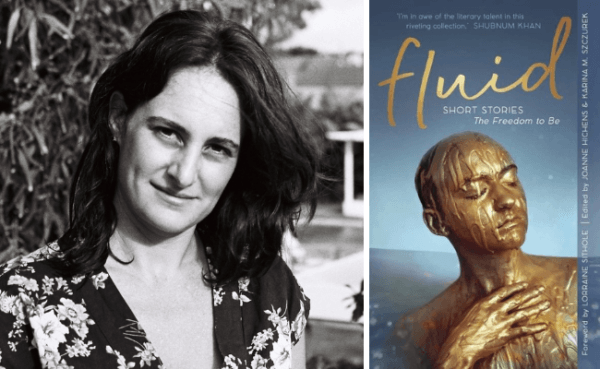
Diane Awerbuck, photo: Justin Youens; Fluid book cover: Karavan Press
Short.Sharp.Stories is a platform showcasing top and emerging South African fiction writers. The theme of this year’s anthology is Fluid – freedom to be. Fluid, this year’s Short.Sharp.Stories anthology, seeks to engage fictional expression around identity, culture and society.
Joanne Hichens conducts interviews with the respective short story writers.
Below is a mini-interview between Joanne Hichens and Diane Awerbuck, author of the short story “The ones that got away” in the 2023 Short.Sharp.Stories anthology, Fluid.
Diane Awerbuck is a teacher, writer and reviewer. Her first novel, Gardening at night, was awarded the Commonwealth Best First Book (Africa and the Caribbean). Her prize-winning short stories are collected in Cabin fever. Her thriller, Home remedies, is set in Fish Hoek. Awerbuck’s doctorate deals with how people write about trauma. Most recently, South and North are her prescient pandemic-thriller series, co-written with Alex Latimer, as Frank Owen. She is also working on another short story collection, titled Inside your body there are flowers. Diane writes of her story, “The ones that got away”:
We all have those roads-in-the-yellow-wood dudes – the unready loves who left us, or we left. Sometimes, in the small, shuddery hours, they come back. I think about them; I’m glad I knew them. Life is long. If you’re lucky.
JH: You are indeed a consummate short story writer. What draws you to the form?
DA: Sheer laziness. Novels are the most terrifying of the forms, apart from screenplays (which are basically the haiku of the fiction world, and which is why the good ones are hardly ever written by just one person). Short stories are what I write to limber up while I’m gathering the courage to step over the threshold of the haunted house: I know I’ll be there longer than overnight.
But then I find that the story is actually a wunderkamer, and I want to tour the room properly instead of the kitchen and bathroom – and forget the attic or cellar! – before Bluebeard returns from his business trip. I always think I can expand an idea or situation, or come back to it, or save it for later. All lies, of course.
JH: You’ve written all sorts of forms – academic, thriller, literary. Do you have a preference?
DA: I like all the forms and their expectations, their rigour. Genre writing is the hardest (that goes double for krimis). No one reads your treatise on trauma. Everyone thinks they’re a poet.
It takes a while to learn the structures, but the learning should feel like fun. I’ve learned what not to do, too, publicly and shamefully. So it goes.
JH: Your language is completely precise. Do you spend hours getting it right – writing and rewriting? (Or do you take dictation from God, like Edna O’Brien self-reportedly did?)
DA: A woman I used to teach with, once said that people mistake English’s wide range of meanings for fuzziness. She told me that there is always one word that is exactly right, like an arrow hitting the bullseye. I argued then, but now I’m not so sure.
...
Writing is an aptitude. Sometimes you have more time and inclination for it, and sometimes you have children.
...
JH: Has it become easier over the years?
DA: Writing is an aptitude. Sometimes you have more time and inclination for it, and sometimes you have children.
JH: Do you access your dreams for story sparks? Or your memories? Or is it the waking unease that releases story? I love that phrase, “the small, shuddery hours”, in which your protagonist has shown himself to you.
DA: This story had been sitting for some time, but it was reinvigorated the other day when Mister Yellow Road sent me a cryptic message on social media. It settled something.
Generally, it’s always so odd to me that Westerners are in denial about the metaphysical, but will pay vast sums to find perfection, or God, or meaning, or love (these are all the same thing). We are more than the sum of our squishy parts.
JH: You once described fiction writers as magpies. What did you mean by that?
DA: We steal; we hoard; we like the sounds of our own voices.
JH: Getting to your story: set on the banks of a river, “The ones that got away” is packed with visceral detail – of the braai, the fishing, the teens in the dark; it brought back moments for me of illicit love. It has a sense of pathos and longing to it, and magic, or inevitability, as two teenagers seem to stumble towards a sensual encounter. Would you consider your story to be characterised by magical realism?
DA: We all experience longing and magic, but we aren’t always good at knowing when they’re happening to us. Longing and magic don’t go away because we get older or more disappointed with our circumstances and selves. (Middle-aged love is so devastating because this time round, you know exactly what’s at stake! Old-aged love is going to knock your thrombosis socks clean off!)
This story is elegiac, I hope, but not nostalgic or whimsical, and neither is writing about these ideas that go beyond the body. I’m going for perverse magical-realist. Whimsy, for me, is about tone rather than content: I’ll always choose Trueblood over Twilight. Whimsy is coy, pretentious and fundamentally flimsy – a special effect. You can’t trust whimsy.
...
We all experience longing and magic, but we aren’t always good at knowing when they’re happening to us.
...
JH: It’s a beautiful read. Thank you. And we are looking forward to more of your stories, as you have a new collection coming out, titled, Inside your body there are flowers. What a wonderful title. Would you like to share a little of what we can expect?
DA: I seem to put out a collection every decade or so.
The archaeology of aging is so interesting – what people think they are allowed to do; what they actually can do. I wanted to write plain poetry about transformation and resistance.
“Inside your body there are flowers” is a quote from the mystic Kabir. I’ve been thinking about that quote for 25 years. For me, it opens up a whole lot of themes, and in this collection they’re to do with disease, survival, sex, identity. But love. Love is the animating thing.
JH: After years of honing your craft, what tip would you offer not only an emerging writer, but an established writer? Maybe you have two tips!
DA: Don’t do it.
But also: if you want to, you will.
Also read
Short.Sharp.Stories anthology Fluid: interview with Anna Hug, author of "Fynbos"
Short.Sharp.Stories anthology Fluid: interview with Nedine Moonsamy, author of "The jump"
Short.Sharp.Stories anthology Fluid: interview with David Medalie, author of "Milly takes a husband"
Short.Sharp.Stories anthology Fluid: interview with Robyn Perros, author of "The window display"
Kommentaar
Thanks, Diane, for a lively interview!
Joanne, you're a Catherine wheel of a woman. Thank you for all your energy and hard work and spark.