

This reader’s impression was written and sent to LitNet on the writer's own initiative.
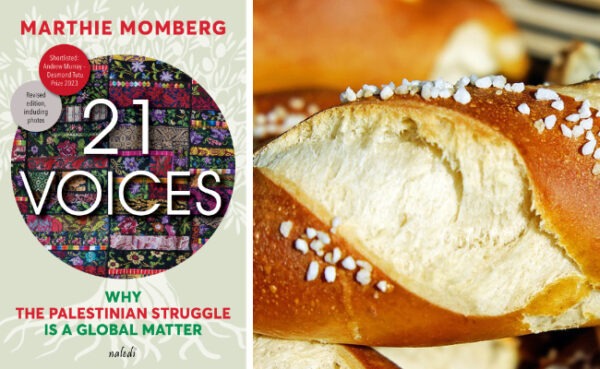
Title: 21 voices: Why the Palestinian struggle is a global matter
Author: Marthie Momberg
Publisher: Naledi
Available in print and as an ebook
Breyten Breytenbach wrote:
if you were to gaze on the gazetted faces of the dead
you’d remember gossamer mothers in gas chambers
and know: this is not the way
to recover your identity
The above is a portion of Oorblyfsel/Voice over, written by Breytenbach in conversation with renowned Palestinian poet Mahmoud Darwish. Breytenbach was a great South African poet who died on 24 November 2024. His letter in 21 Voices: Why the Palestinian struggle is a global matter is a call to humanity.
*
This is not “just a book”. This is an invitation to sit with others (many of whom are what we’d call “others” – those whom we too often misunderstand and fear) and dine together, to dip our hands into the same pot, as it were. To tear great strips of bread to share with the one alongside. To converse. To listen. Also, in a sense, to rebel against all that seeks to hold us apart – by coming together.
In this book, Marthie hosts an intimate “dinner” with 21 long-time transnational activists for Palestine, inviting South Africans and Jewish Israelis to tell of their journeys. It’s a diverse gathering across ethnicities, backgrounds and faiths. Yet all are bound by a common thread: they feel, think and act for Palestinian liberation because they recognise a humanity that should be shared – equally – with all of humankind.
Join me for a moment of eavesdropping around this “dinner conversation”, won’t you?
- “I am a human being only to the extent that I refuse to let the pain of other people that I’ve witnessed, die,” says Siraj, a South African Muslim.
- Maira (a South African who converted from Hinduism to Islam) agrees, saying that “if one part of the world is in pain the whole world should feel it”.
- Rachel (a South African who associates with being both Jewish and a humanist) thoughtfully says: “No single human can ever, ever in principle be my enemy. Even the one who says I’m their enemy.” Particularly, not the one who others say is our enemy.
Fear – and the need to create an enemy through subtle and ongoing indoctrination – is raised by many of the interviewees as the disturbing truth beneath what too many call “the Israeli-Palestinian conflict”.
- Naomi (a Jewish Israeli who is not religious) is firm on this: “I don’t think there are any fundamental differences between people. I think the issue has a lot to do with ignorance and with the control of power, and also fear.”
- Rachel, whose father lost his entire family in Auschwitz, speaks of her ingrained cultural fears bred in both her orthodox Zionist Jewish school and her veldskool (schools that taught white learners defensive skills during apartheid), and her then-perception that “as Jewish people who had faced extermination, we have the right to everywhere in the land, that it’s all ours. It was very simple, really.”
- Mpho, a South African Christian who experienced apartheid as one of the oppressed, clearly sees the similarities in Palestine and the use of religion to justify dispossession and violence today: “You’ve got to have a justice that treats people equally …. God is global – God is not South African.”
While apartheid in South Africa may have been banished, “apartheid” – separateness – is seeking to stretch its hideous tendrils around the globe. We seem to be retreating into spaces too small, surrounding ourselves with those who are seemingly similar. Marthie’s book offers another way “to recover your identity”. Beyond the personal and geopolitical understandings, this book offers insight into the global implications of ignoring the humanity of Palestinian people and their plight.
Marthie doesn’t interrogate herself with any less scrutiny. She offers her journey from a “safe and simple (life), (where) God was on our side” to her “submission to inaction”, despite her awakening to the double standards of apartheid. In her self-reflection, she speaks of her inappropriate silence at the time: she felt powerless, and an alternative society seemed unimaginable. She was “yet to discover the liberation of listening to (her) conscience”. It was after a personal tragedy that she found herself confronted with what lay within herself. She enrolled in further studies that took her to Berlin, where she was awakened to the similarities between World War II Germany and South Africa’s apartheid rule, finding that “ideology in the service of religion can override compassion and disrupt and destroy lives”. But it was back in her hometown of Stellenbosch that she was confronted by the words of Professor Yakof Rabkin: “There is a profound difference between Judaism and Zionism,” he said. “Judaism is a religion, while Zionism is an ideology that promotes colonialism and racism under the guise of religion.”
For Marthie – a God-fearing, white Afrikaner woman – this was her Damascus epiphany. “I felt implicated, and considered myself an oppressor by proxy,” she confesses. To be “exposed to grassroots reality”, Marthie found herself in rural West Bank, Palestine, in 2011, as a part of a group of trained ecumenical accompaniers who offered a nonviolent protective presence to the local community, who were being terrorised by illegal Israeli settlers. What followed was the logging of multiple daily human rights violations on her dusty keyboard. Marthie witnessed what she called “collective punishment” by militarised oppressors of the Palestinians who dared remain on their ancient family land.
Dispelling the myth of Zionism as equated to Jewishness is clearly unpacked in this book – thoroughly (Marthie is a researcher and academic, after all), sensitively and without personal judgement. Confronting decades of misinformation, which holds sway by currying the fear of carefully cultivated enemies, is a crucial part of it.
While the “dinner guests” in 21 Voices: Why the Palestinian struggle is a global matter are speaking from interviews captured nine years ago, today their words are more relevant than ever. Indeed, Jewish South African Levi’s words feel grotesquely prophetic when heard today:
To have a majority, literally, you need to get rid of the Palestinians. We cannot contemplate them returning, and so we’re going to be in a situation of war, occupation, shooting stone-throwing kids and going into Palestinians’ houses just to terrorise them, even if they have done nothing. But we need to provoke them and do things to prevent unity amongst them. If they fire rockets in counter-provocation, we go in there with might without distinguishing between combatants and civilians. I mean, you get yourself into supporting that type of carnage by keeping quiet.
Marthie Momberg is not “keeping quiet”. In this revised and updated version – which answers pressing questions post-October 7th – she continues to call us to change. In the 21 friends around her “dinner table” she finds a “search for the liberation of the self and other, for a freedom that engenders a generosity of spirit – one in which people can invite the ‘other’ into their homes to share coffee; to talk about life, death, and dreams”.
The tragic irony of hindsight shows us just how prophetic these 21 voices – and our great South African poet – truly were. Today we find ourselves witnesses to what our world’s greatest humanitarian agencies and international courts call nothing less than genocide. We can no longer afford to ignore the pain of others. Or not to be moved to action. For humanity’s sake. This book is an invitation, a doorway.
In Breyten Breytenbach’s words, continued from above:
which only goes to show
that since the outset of stellar configurations
there’s been a door to life in the dark out there
The 2024 revised and updated version of 21 Voices: Why the Palestinian struggle is a global matter is published by Naledi. The first print in 2023 was shortlisted for the Andrew Murray – Desmond Tutu Prize. The book includes photographs, maps, tables, detailed explanations of key terms, and an index.
See also:
Hope, belief: A reader’s impression of 21 Voices by Marthie Momberg
21 Voices deur Marthie Momberg en die Palestynse stryd: Wat kan jý doen? | Naledi-dag 2023
So nodig soos kamele: ’n lesersindruk van Marthie Momberg se 21 Voices from Israel and South Africa
A hugely important book: A reader’s impression of The bitterness of olives by Andrew Brown