

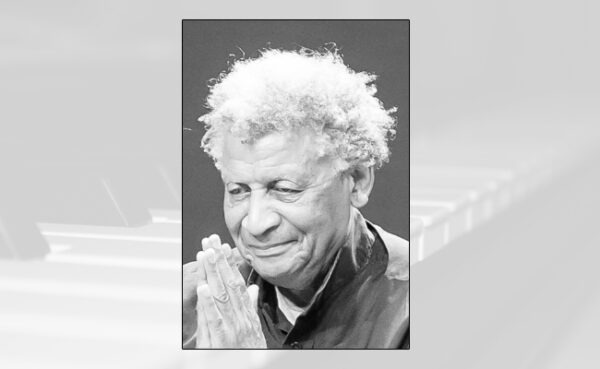
Abdullah Ibrahim: By Tore Sætre - Own work, CC BY-SA 4.0 (Via WikiMedia)
...
He then expressed his own compositional philosophy with characteristic directness: “I write about the things that I know.”
...
I had the great privilege of interviewing Abdullah Ibrahim on two occasions. One of those conversations, recorded in February 2013, remains available online.
Returning to that recording after his passing, I am struck by the economy of his answers. Ibrahim did not explain his achievement through the conventional language of ambition, fame or professional success. He returned, instead, to first principles: knowledge, identity, discipline, cultural memory and the responsibility of an artist to develop an honest voice.
When I asked how he had continued to find inspiration as a pianist and composer over such an extensive career, he recalled advice given to him by an English teacher when he was young: “When you write, write about the things that you know.”
He then expressed his own compositional philosophy with characteristic directness: “I write about the things that I know.”
The answer was brief. Its meaning encompassed a lifetime.
What Abdullah Ibrahim knew was Cape Town.
He knew it not merely as the geographical starting point of an international career, but as a convergence of sound, faith, language, displacement and cultural memory. Cape Town remained the ground beneath his music even when he was thousands of kilometres away. Its churches, communities and remembered voices entered his compositions.
Born in Cape Town on 9 October 1934 and baptised Adolph Johannes Brand, Ibrahim encountered music through his family. His grandmother played the piano in the local African Methodist Episcopal Church, while his mother led the choir. Traditional African and Khoisan songs, Christian hymns, gospel music and spirituals formed part of his earliest musical experience.
Beyond the church, he absorbed American jazz, township jive, Cape Malay musical traditions and European classical music. Cape Town was a port city in which people and musical ideas from different parts of the world encountered one another and assumed new forms.
The sacred and the secular were not entirely separate. Neither were the African and the international, or the traditional and the modern.
Ibrahim’s musical vocabulary emerged from this environment. It was not assembled later as a calculated exercise in cultural fusion. These traditions were already present in the world in which he grew up. He listened to them, studied them and eventually developed a musical language that was recognisably his own.
Cape Town was therefore more than a recurring subject in his compositions. It was part of the language in which he composed.
He began piano lessons at seven and made his professional debut at 15. As Dollar Brand, he immersed himself in the work of Duke Ellington, Thelonious Monk and other major figures in American jazz. Yet this engagement did not cause him to abandon his own musical inheritance. It helped him to recognise what was distinctly his. That became one of the most revealing themes of our conversation.
When we discussed what might enable South African musicians to reach an international audience, Ibrahim did not suggest that they imitate whatever happened to be commercially dominant elsewhere. He observed that musicians in different parts of the world were increasingly playing similar rhythms and reproducing similar formulas.
Against this tendency towards uniformity he emphasised the importance of identifying and developing an individual artistic voice.
He suggested that an artist entering the global arena had to bring to it a distinctive voice and spirit – something that could not be supplied by anybody else.
This was more than professional advice. It expressed the governing principle of his own career.
Ibrahim did not become internationally important by disguising where he came from. He became internationally important because he learned to express it with unmistakable clarity. His international reach did not depend on making his music less distinctly South African.
That principle was already evident in the Jazz Epistles.
Formed in 1959, the ensemble brought Ibrahim together with alto saxophonist Kippie Moeketsi, trumpeter Hugh Masekela, trombonist Jonas Gwangwa, bassist Johnny Gertze and drummer Makaya Ntshoko. The group recorded the landmark Jazz Epistle, Verse 1, widely regarded as the first full-length jazz album by black South African musicians.
Its importance extended beyond that historical distinction. The Jazz Epistles demonstrated that South African musicians were not distant imitators of American modern jazz. They were participating in and extending its language through experiences, rhythms and melodic ideas formed in South Africa.
They entered an international musical conversation without surrendering their identities.
Apartheid, however, attempted to regulate far more than political rights and physical movement. It sought to determine where people could live, who could perform together, which audiences could gather and whose cultural work would receive institutional recognition.
Jazz contradicted that project. Improvisation depends on listening. An ensemble requires individual voices to meet and respond to one another. Each musician retains a distinct identity, but no musician creates the collective music alone. In a country governed through enforced separation, the integrated jazz ensemble embodied another way of relating.
Following the Sharpeville massacre of 1960, repression intensified. Clubs were closed, musicians were harassed and the conditions necessary for an open, developing jazz culture became increasingly difficult to sustain.
In 1962 Ibrahim and the vocalist Sathima Bea Benjamin left South Africa for Zurich. There, Benjamin persuaded Duke Ellington to listen to the Dollar Brand Trio. Ellington recognised the quality and distinctiveness of the music, and the encounter led to a recording session in Paris. The resulting album, Duke Ellington Presents the Dollar Brand Trio, helped open the way to European festivals and international recognition.
Such moments are often described through the language of discovery. But Ibrahim had not been waiting, unformed, for an international authority to give him an identity.
Ellington recognised a musical voice that had already been shaped by years of listening, composing and performing.
The encounter opened doors. It did not create the artist who walked through them.
Ibrahim and Benjamin moved to New York in 1965. Ibrahim appeared at the Newport Jazz Festival and Carnegie Hall, later substituted as leader of the Duke Ellington Orchestra, and worked among musicians who were transforming modern jazz.
Yet New York did not turn him into an American pianist. Participation in the international jazz world appears, instead, to have reinforced the principle he articulated in our conversation decades later: An artist’s contribution lies not in resembling everybody else, but in bringing something into the room that could not have arrived through anybody else.
This did not mean closing oneself off from influence. Ibrahim listened widely and studied deeply. His music was never culturally sealed. But meaningful exchange requires each participant to have something of substance to exchange.
Without an individual voice, internationalism can become uniformity. With one, music rooted in a particular place can speak far beyond it.
Our conversation also moved from artistic identity to the conditions under which musicians are expected to work.
I asked Ibrahim why South Africa, despite producing some of the most creative people in the world, had not always developed the depth of artistic appreciation and professional infrastructure found in certain other countries.
His answer did not romanticise the artist’s struggle. He spoke about the failure of South African promoters to recognise what he described as his “international fee”. A performance, in other words, is not merely the physical activity visible on a stage. It is the result of years of study, composition, rehearsal, cultural knowledge, experience and sacrifice.
When that labour is not properly remunerated, he suggested, artists are forced to devote too much of their time and energy to survival.
The observation remains painfully relevant. Musicians are frequently praised as cultural ambassadors and sources of national pride. while working within systems that do not adequately compensate them, protect their intellectual property or support the long-term development of their craft.
We celebrate the finished song, but often overlook the conditions that allow the songwriter to continue writing. We applaud the performance, but not always the years of labour that made it possible.
Ibrahim’s response added an essential qualification to the language of artistic vocation. Artists must develop and protect their voices, but the society receiving their work must also learn to value it.
Culture cannot be sustained indefinitely by sacrifice alone.
This question of value was connected to another important concern in the interview: the preservation of African musical knowledge.
When I asked how his approach to composition and the piano had changed as he matured, Ibrahim referred to the large body of African musical heritage that had never been adequately documented or published.
He belonged to a generation that had experienced how black South African cultural work could be suppressed, neglected or prevented from entering the formal record. Compositions that were never recorded, published or successfully passed on remained vulnerable to disappearance.
This does not diminish the importance of oral transmission, through which African musical knowledge has been preserved and renewed over generations. It does, however, emphasise the importance of supporting the people and communities responsible for carrying that knowledge forward.
Ibrahim became one of those carriers.
His work carried more than individual melodies. It carried church cadences, township rhythms, dance band traditions, Cape musical forms and the memories of communities whose creativity had not always been adequately recognised or documented.
Music cannot replace a historical document, photograph or written testimony. But it can preserve dimensions of experience that conventional archives do not always contain: emotional atmosphere, communal rhythm, spiritual orientation, humour, grief and the feeling of belonging to a place.
Ibrahim’s compositions do not merely describe history. They allow us to hear something of how history was lived.
Nowhere is this more evident than in “Mannenberg – is where it’s happening”.
Recorded in Cape Town in 1974, the composition took its title from one of the areas shaped by apartheid’s programme of forced removal. Ibrahim’s memorable piano theme, the communal pulse of the recording and Basil Coetzee’s commanding saxophone voice created music in which listeners recognised something of themselves.
Its political force did not depend on an explicit manifesto.
Apartheid had attempted to classify communities as marginal, removable and culturally inferior. “Mannenberg” placed the life and sound of the Cape Flats at the centre. It carried sorrow without reducing people to their suffering. It contained defiance, but also warmth, movement and collective vitality.
It made audible what the political system had attempted to marginalise.
The composition became closely associated with resistance to apartheid because political struggle was not separate from ordinary human life. Liberation was not only a matter of changing laws. It also involved recovering dignity, memory and the ability of a community to recognise itself.
To hear one’s experience expressed with dignity can itself be an act of resistance.
Ibrahim returned to Cape Town in 1968, converted to Islam and adopted the name Abdullah Ibrahim. He undertook the pilgrimage to Mecca in 1970. His spiritual practice became closely connected to the discipline of his music.
His playing could be rhythmically forceful, but its authority did not depend on filling every available space. A phrase was allowed to settle. A melody could be repeated until it acquired the quality of meditation. Silence became an active part of the music.
This brought our interview to the subject of artistic maturity. “It takes thirty years to learn what to play, and another thirty years to learn what not to play.” He then observed, with characteristic dryness, that he had arrived at the second thirty.
The remark was humorous, but it revealed something fundamental about his later artistry.
Young musicians often equate ability with addition: more notes, more speed, greater complexity and more visible demonstrations of technical command. Maturity asks a different question: What is essential? Learning what not to play does not mean becoming less capable. It means becoming less dependent on displaying one’s capability. The silence has been earned. A simple melodic line carries authority because the musician understands the many alternatives he has chosen not to use.
This quality became increasingly prominent in Ibrahim’s later performances. His technical knowledge did not disappear; it became concentrated. The result was not simplicity born of limitation, but simplicity reached through mastery.
His lifelong engagement with martial arts complemented this discipline. Both practices demanded concentration, control, balance and economy. In each, freedom was achieved not through the absence of preparation, but through preparation so deeply absorbed that it no longer needed to announce itself.
Ibrahim’s music returned repeatedly to home, water, mountains, children, journeys, prayer and ancestry. These were not merely decorative titles. They formed a spiritual and geographical vocabulary through which he continued to understand his life.
Exile gave that vocabulary additional intensity.
When home is physically distant, memory can become both refuge and responsibility. Ibrahim carried Cape Town into European and American concert halls, not as a historical curiosity, but as a living musical presence.
International audiences may not have understood every local reference. They may not have recognised each church harmony, dance rhythm, remembered street or political shadow.
But they could recognise longing, displacement, dignity, spiritual searching and return.
Ibrahim’s international reach was not achieved by making his music culturally anonymous. It arose from the clarity with which he expressed a particular experience.
The more honestly he wrote about what he knew, the more widely the music could be understood.
When Nelson Mandela was released from prison in 1990 he invited Ibrahim to return to South Africa. Four years later, Ibrahim performed at Mandela’s presidential inauguration.
The moment carried enormous historical significance. A musician whose work had developed under racial restriction, and whose career had been driven into exile, returned to perform at the inauguration of South Africa’s first democratically elected president.
Yet Ibrahim’s legacy cannot be reduced to political symbolism. He was not a great composer simply because his music became associated with liberation. Its political significance was inseparable from its artistic strength. He wrote melodies of exceptional clarity and developed a relationship between African musical memory and modern jazz that could not be mistaken for anybody else’s work.
His music endured because it was never merely topical. It engaged with history while reaching towards enduring human questions: how people preserve dignity, how memory survives displacement and how an individual voice can remain open to the world without being dissolved by it.
Abdullah Ibrahim died in Germany on 15 June 2026, aged 91, following a short illness.
His final public concert in South Africa had taken place at the Cape Town International Jazz Festival in March 2026.
There is a profound sense of symmetry in that final South African appearance.
His career had extended across continents and more than seven decades. Yet his final public concert in this country took place in the city whose sounds had first taught him what he knew.
Listening again to our conversation, I hear a philosophy of artistic life expressed without ornament:
Write about what you know.
Develop a voice that is genuinely your own.
Recognise the intellectual and economic value of creative work. Preserve what has not been adequately documented.
And, after learning what to play, devote yourself to discovering what may be left unsaid.
These were not abstract instructions. Abdullah Ibrahim’s career had demonstrated each of them.
He wrote from Cape Town without writing only for Cape Town. He entered the world without becoming placeless. He absorbed international influences without surrendering his identity. And he demonstrated that the deeply local does not have to ask permission to become universal.
The world did not embrace Abdullah Ibrahim despite where he came from. It embraced him because he carried where he came from so completely.
His music travelled farther than most lives ever will, but it never forgot the sound of home.
See also:
Wat hy geken het, wat hy saamgedra het: Abdullah Ibrahim en die musiek van sy tuiste