

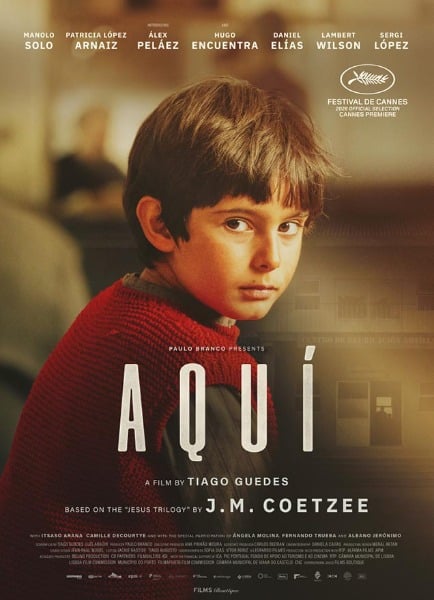
Aquí from director Tiago Guedes will soon have only three screenings in South Africa, as part of the European Film Festival. It is a huge movie, and I would urge serious movie buffs to grab a seat while they are still available. (Click here for information on how to book. )
Aquí represents Portugal and France at the 13th European Film Festival in South Africa.
A Spanish movie based on JM Coetzee’s vision of a Spanish-speaking world
Director Tiago Guedes and Luís Araújo are credited for writing the screenplay, which is firmly based on JM Coetzee’s novels The childhood of Jesus (2013), The schooldays of Jesus (2016) and The death of Jesus (2019). Collectively, these have become known as the “Jesus trilogy”. Please note that one does not need to know the novels to enjoy the movie, but for those of us who have read Coetzee, there is a beautiful sense of homecoming when watching Aquí.
In The childhood of Jesus, and in Aquí, we learn that Simón, an older man, and David, a young boy, arrive by boat in a new, unnamed country where they initially spend time in a transit camp to learn Spanish. The citizens of the new country are strongly encouraged to lay aside their old lives and to forget their previous languages. This way, each of them starts fresh, and everyone speaks the same language to cooperate better.
Coetzee, of course, tells his story in English. Tiago Guedes took it upon himself to allow us the pleasure of experiencing Coetzee’s story in Spanish. Aquí is a treat.
What Aquí is about (without spoilers, I promise)
We meet Simón and David while they are walking in hot sunlight. At first, we just hear them. Then we see their shadows. Eventually, we see them. Finally, they stop at a refugee centre.
Simón and David are not their original names. They have been issued these names at the transit camp.
We learn that David has lost his parents, as well as the letter which contained details of his parents. Simón is presently looking after David, but he cannot wait to hand the boy back to his mother.
The new arrivals experience the various frustrations of a civil service that lacks urgency. David is thirsty. The system cannot help him. Yet, while the socialist state apparatus lacks humanity, there are always people willing to help.
Simón and David meet Inés, a young woman. Simón convinces her to look after David – he promises to be around to help.
David goes to school, but he does not enjoy the rigid regimes. He rebels. When the authorities want to send him to an institution 50 kilometres from the city where Simón and Inés live, the two decide to take drastic action: They pack their bags and move on again. Once David finds a school where he can flourish, our story takes a new turn, and new challenges await.
I am not to say more. Book your tickets and experience the rest first-hand.
Aquí – what does it mean?
Not all of us attended Spanish classes in a transit camp, so I am keen to point out that Tiago Guedes chose a clever title for his enormous epic. Aquí simply means “Here” or “You are here”. Remember that when watching the movie.
Here, wherever here is, people arrive by boat. Here, people speak Spanish. Here, everybody receives an allowance. Here, people get a house. Here, people wear old-fashioned clothes. Here, people have laid aside their old selves and have become new citizens of this unknown country.
“Here” represents the world; there is no other world anymore. Here, people are encouraged not to fight one another or the system.
George Orwell’s 1984 sketches a society where everyone (who belongs to the Party) is taken care of, but everyone is also closely monitored. Coetzee and Guedes toy with a much gentler society, where the citizens remind one another that here is best. Do not question.
Aquí. You are here. Accept it.
So, where is here? It does not matter. Here is where the inhabitants have been given a new life.
Is this perhaps a new socialist state? Is this perhaps heaven? In Greek mythology, people who die cross the river Lethe in a boat. It is the river of forgetting. On the other shore, they can step off and start anew. See also Simón’s explanation of a crossing into a new dispensation when a horse dies. (This same conversation is echoed much later in the movie, but go and experience that for yourself!) JM Coetzee most certainly understood that his readers would wonder about the Lethe, which may have been crossed, and Tiago Guedes clearly toys with the same idea of a river crossing when we see the harbour in which Simón finds a job: It is a river-based harbour.
Three epochs, one epic
Tiago Guedes and Luís Araújo’s screen adaptation of Coetzee’s novel is a masterclass in changing one art form into another. I understand The childhood of Jesus to be a political allegory, with the explicit references to the biblical Jesus’s time of refuge becoming a plea for understanding. No prizes for understanding a critique of Western education in The schooldays of Jesus. The death of Jesus then becomes a beautiful allegory for explaining the transformation of a child into a teenager. David rebels; he joins his own tribe. Look out for the scene where he releases two birds from the cage.
Guedes has managed to take three novels, fast-track the narrative and say to the viewer: Aquí. Spend these three hours and 24 minutes with me.
Like Coetzee, Guedes knows that the viewer brings intertextual references along; we have not crossed the Lethe. Guedes, like Coetzee, encourages our intertextual references, but at the same time he has managed to create an epic that can hold its own.
David, the boy against the system
JM Coetzee used the titles of his novels explicitly to activate biblical references in an otherwise secular story. Simón (or Simon) was the man who was forced to bear Jesus’s cross for a while. David was the young boy who took on a giant. Remember this when watching the movie.
David struggles to accept that aquí, or being here, automatically means accepting what others say. David sees things differently. He is blunt; he refuses to play the game of fitting in.
David may well be on the autistic spectrum. My “diagnosis” is part of my intertextual baggage. Others may disagree, but if the viewer were to enter the movie with an understanding that David rebels by being blatantly truthful in a society that is tolerant of not speaking out, well, then please enjoy the story and bring your own understanding to this complex character.
Don Quixote as a fellow traveller
Don Quixote is a constant companion in the journey of Simón and David. Guedes cleverly introduces the book much earlier than Coetzee does. Look out for it and listen to David’s interpretation of the story. It says a lot about him.
Actors
Álex Peláez plays the younger David, and Hugo Encuentra the older boy. To my knowledge, Aquí is the first major movie break for both boys. They handle these challenging roles extremely well. Manolo Solo plays Simón, and Patricia López Arnaiz is Inés.
Morality handled by Coetzee and Guedes
Coetzee did not interfere with the screenwriting, but he did avail himself to be questioned. It is telling that Guedes explicitly acknowledges both Coetzee and Dorothy Driver in the credits.
Interestingly, and maybe thankfully, Guedes spends a lot less time on Simón’s obsession with sex. It is a good thing, as Simón in the movie is slightly gentler and easier to understand than in Coetzee’s version of him. Inés, too: In the first Coetzee novel, there are serious doubts about her handling of David when she starts taking care of the boy.
Those who do know Coetzee’s work understand that he constantly questions his reader’s take on morality. Guedes understands that, too. Right towards the end of Aquí, when a rebellious, teenaged David wants to move away from Simón and Inés, their moral behaviour is questioned. In Coetzee’s novels, both characters carry a heavier burden than in Guedes’s movie, but this does not in any way detract from the way Guedes presents his story. Again, Guedes allows those of us who bring intertextual baggage to use it, but for those who arrive fresh to the story, his screen version is a masterful retelling of Coetzee’s books.
One small note: Viewers will meet a man called Dimitri, who embodies both good and evil, and who holds both morality and a lack thereof in himself. Director Tiago Guedes chose to cast someone in that role that looks a lot like himself. I even thought it was Guedes playing the role, but I was wrong – Dimitri is played by Daniel Eliás. I mention this because, like Coetzee, Guedes understands Dimitri to question everyone’s understanding of right and wrong.
Experience it if you can
Sadly, Aquí will not be streamed during the European Film Festival. The following three screenings will be the only chance to see this wonderful epic.
Book to see Aquí
There are two screenings of Aquí in Cape Town and one in Johannesburg.
- Cape Town: Tuesday, 22 September 2026, at the UWC CHR Iyatsiba Lab, 2:00 pm (RSVP here)
This partnership between the European Film Festival South Africa and Iyatsiba Lab provides for free community screenings that extend the festival beyond traditional cinema spaces, creating an opportunity for audiences to come together, experience stories from across Europe, and connect through the universal language of film. While these screenings are free, spaces are limited and every booking matters.
Address: 66 Greatmore Street, Woodstock, Cape Town (entrance on Regent Street)
The screening will be followed by a panel discussion exploring questions around postcoloniality and collective amnesia in film, aesthetic education and the idea of metaphysical exile.
- Cape Town: Thursday, 24 September 2026, at the Labia, 12:15 pm (cost: R90)
- Johannesburg: Thursday, 24 September 2026, at The Bioscope, 2:00 pm (cost: R94,50)