

...
The book understands that historical memory is not only about the great events that determine the fate of nations, nor about the kings whose names survive in official records. It is also about the people who prepared their meals, carried their water, watched them sleep and eventually watched them die.
...
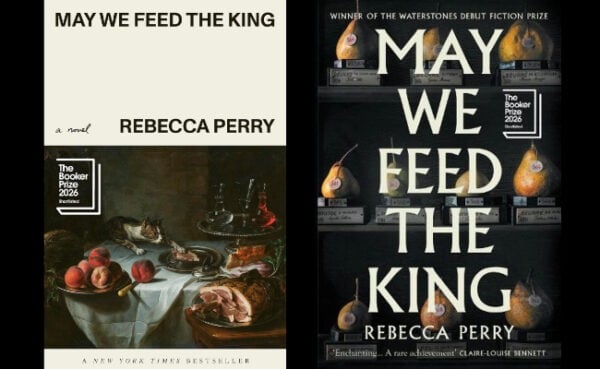
The punters of the Booker Prize 2026 are convinced the winner will be either Marlon James’s The disappearance or Douglas Stuart’s John of John. Either would be a worthy winner. But in my humble opinion, the book that deserves the prize, for its imaginative originality, its fresh tone and its extraordinary ability to make historical fiction speak urgently to the present, is Rebecca Perry’s debut novel, May we feed the king.
If you think, from the title, that the book is about food and the feeding of a king, you are right. Food is its organising principle, but the book is about much more. Among other things, it is about how history is manufactured to serve power; the burdens of unsolicited power and the intrusiveness of destiny; the messy human life concealed behind the objects we leave behind; and the impossibility of ever recovering our lives through memory.
The book begins with a woman who has spent 22 years as a historical curator, recreating domestic and culinary scenes in medieval buildings. Her speciality is the arrangement of objects: replica food, crockery, furniture, clothing and the small domestic traces that suggest that somebody has only just left the room. Her guiding principle is that a scene must appear as if its inhabitants have stepped out for a moment and might return at any time. Otherwise, she says, it is merely an arrangement of objects. The scene is dead.
The narrator has been commissioned to create six installations in a historic palace celebrating its 750th anniversary. She is given access to its extraordinary archives, which include centuries of royal accounts, recipes, letters, medical records and descriptions of court life. What begins as a professional assignment gradually becomes something far more intimate, because she is also emerging from a personal catastrophe. Perry lets us approach its precise nature through its effects rather than through explanation. The narrator’s appetite, like that of the kings she must enact, has diminished; her domestic life has become strange; the ordinary rituals of living have lost their former meaning. She is, in a sense, another person who has left a room and not yet found her way back.
Perry does not rush towards an explanation. She lets the narrator’s condition settle into our consciousness through seemingly careless details: the empty chair at the dinner table, the difficulty of buying food, the sudden silence of a house in the evening. The narrator describes how her work has sustained her when other people have run out of things to say. This observation captures something essential about grief, the fact that the work of living must continue long before we have recovered any convincing reason for doing it.
The palace, with its layers of historical memory, offers her an unexpected refuge, because its rooms are also full of absent people, people who left behind their absence rather than a void. They can be approached through the objects they touched, the food they ate, the letters they wrote and the arrangements of their domestic lives. For the unnamed narrator, historical reconstruction is not simply a matter of getting the furniture right. It is an imaginative act that restores the pressure of human presence to a space, the impossible task of breathing a living spirit into museum exhibits.
Perry is especially good on the peculiar relationship between authenticity and illusion. The narrator’s discussions of replica food are often wonderfully funny, occasionally obsessive and always revealing. She knows the shortcomings of individual plastic vegetables, the difference between a convincing and an unconvincing chicken leg, and the precise circumstances in which a replica egg can be more convincing than the real thing. Yet these apparently eccentric professional observations gradually acquire a deeper significance. What makes something real? Is it the material from which it is made, or the life we are able to imagine around it?
She also reminds us of the importance of all the senses to memory, through the narrator’s declaration that scent gives a room its depth. Soundscapes, she argues, can be artificial, but fresh herbs introduce something the eye cannot provide. Scent offers a passage into memory, an almost involuntary means of recovering a lost world. I often experience this when I return to the places of my youth: They give up their history through smell before anything else. Perry’s prose works in much the same way. Her attention to texture, temperature, colour and smell makes the past feel like a physical environment.
The second movement of the book introduces a parallel narrative, set in the same palace several centuries earlier. We meet a young attendant whose duties include looking after a dying king. The king is relatively young and married, and has spent much of his reign in a state of physical and political withdrawal. His illness, in particular his loss of appetite, becomes a spectacle around which the entire court organises itself. Physicians, holy men, servants, courtiers and ambitious advisers wait for the inevitable, each with their own anxieties and calculations.
Perry does not give us a conventional historical novel, with an authoritative narrator explaining the political circumstances or supplying a reassuring chronology. There is none of that epic Hilary Mantel business on the life of Cromwell. Instead, she constructs her world through fragments, observations, overheard conversations, meals, rumours and domestic incidents. The effect is cinematic. We see people entering and leaving rooms, hear conversations through doors, and watch the small gestures through which power makes itself felt.
The dying king is an enigma. Perry refuses to make him either a saint or a conventional tyrant; his humanity emerges through his appetites, and his lack thereof, through his discomfort and through his relationships with others. Even his death is rendered with extraordinary economy. The young attendant expects some recognisable moment of departure, but death arrives almost imperceptibly, without disturbing even the curtains. The beautiful sparseness of the telling exposes the inadequacy of the elaborate rituals that surround death, especially royal death. For all the machinery of power that comes with monarchy, a human being still dies quietly in a bed after facing bodily humiliating needs, leaving others to fuss around him.
The succession introduces another, equally compelling character: the new king, the third brother, who has spent his life assuming he would never inherit the throne. For him, as for Claudius in Robert Graves’s I, Claudius, elevation is not a triumph but a catastrophe he never expected. He discovers that kingship means surrendering almost every ordinary freedom. His movements are controlled, his conversations monitored and his correspondence scrutinised; his private life becomes the property of the court, and especially of his reluctant advisers.
Perry’s treatment of power here is subtle and often funny. The new king’s advisers are interested in him only for his capacity to perform the functions of monarchy, and his personal quirks irritate them. They want heirs, military decisions, political alliances and the familiar public gestures of royal authority. His reluctance to embrace the business of ruling is regarded almost as a constitutional malfunction.
Perry exposes the relationship between political power and the body. The king must eat, sleep, have sexual relations, produce an heir and show the appropriate appetite for violence. Even his most intimate bodily functions become matters of administrative concern. The court’s obsession with the queen’s menstruation and the couple’s sex life is rendered in a deliberately grotesque and darkly comic way. The monarchy has reduced the human body to an instrument of state continuity. To recover his authority, the king must behead the queen’s lover, who has made him a cuckold. The king couldn’t care less, which the court interprets as a sign of weakness.
The book’s most interesting insight is that power is a kind of prison for its possessor and an instrument of oppression for everyone else. The new king has authority over thousands of lives, but very little control over his own. When he is asked to sign decrees authorising executions, he begins to understand the bloodshed that has always accompanied the institution he has inherited. His brother, whom he remembers as a gentle and almost otherworldly figure, had nevertheless presided over the machinery of violence. The new king is therefore trying to find a way of remaining human in a position that requires the suppression of his humanity.
This is where the book acquires a fresh political dimension. Perry is not merely interested in the private psychology of monarchs. She is examining the elaborate arrangements by which power protects itself: the courtiers who sustain it, the advisers who manipulate it, and the ordinary people whose lives are subordinated to its demands. The court is a world of performance, where everyone is watching everyone else and even kindness is a political manoeuvre.
The young attendant provides a necessary counterpoint. He is close enough to power to observe its absurdities, but far enough removed to retain a measure of independence. His relationship with the new king develops through a series of encounters that are both tender and uneasy. The king finds in him something he cannot find among his advisers: the possibility of candid, honest, ordinary conversation. It is also through the attendant that Perry explores the peculiar intimacy of service. To tend to someone is to know their habits, their vulnerabilities and their physical needs, to encounter the person beneath the office. This is, of course, why no man is the proverbial hero to his valet. The attendant’s experience of the dying king becomes an education in mortality, and it changes his understanding of the new one.
The novel’s treatment of the relationship between these two men is deliberately restrained. Perry is more interested in the emotional and social consequences of their proximity than in offering easy explanations for it. Through it, she gives us an intimate and affecting exploration of loneliness, trust and the unequal distribution of sacrificial service.
The title, May we feed the king, acquires several meanings as the book progresses. At first, it seems to belong to the practical vocabulary of royal service: the attendants and cooks who must keep a dying monarch alive even when his body can no longer accept food. But feeding evolves into an image of care, of obligation, of the human desire to sustain what is disappearing. The question of preservation runs through the entire book: how we preserve a life, what survives of a person once the body is gone, and what an archive can tell us about an individual life behind the historical facts.
The narrator discovers that the historical record is often an inadequate representation of the people it purports to describe. The king she eventually chooses to recreate has been reduced in the palace ledger to a deeply unflattering figure, his reign surrounded by contradictory accounts and retrospective judgements. She is distressed by this reduction. A life, she understands, cannot be adequately represented by a collection of official verdicts. Her response is not to claim that she can recover the historical truth in its entirety. Rather, she tries to restore the possibility of human complexity by looking for unique, incidental details: a particular food, a request made to the gardener, a commission to an embroiderer, the small preferences that might reveal something of an otherwise inaccessible personality. Perry is not suggesting that imagination can replace historical evidence. She is exploring what imagination can do when the evidence is incomplete, and how responsible historical reconstruction requires an awareness of the limits of what we know.
The third section, which begins with the question, “How do we know anything about history?”, brings these concerns into the open. The narrator addresses an audience at the palace and discusses the sources through which we construct our understanding of the past: letters, diaries, records, stories and songs. Her talk is particularly interesting because it brings the book’s two narrative strands into conversation. The curator’s work and the historical narrative are revealed as versions of the same undertaking. Both involve an attempt to make absent lives present without pretending that absence can be entirely overcome.
Official records preserve the affairs of the powerful, but even those records are incomplete and unreliable. The lives of servants, women and ordinary people survive in more oblique ways, often through the smallest traces. The narrator’s attention to domestic objects is therefore not merely an aesthetic preference, but a way of looking for the human lives that conventional history tends to overlook.
The final historical movement is particularly effective in this respect. Years have passed, and the young attendant has become an old man. His daughter watches him approach death, increasingly detached from his present circumstances like the first king he attended. He begins to speak of the king he once served, a figure whose existence has become an unspoken family history. His daughter has grown up sensing that something happened at court which altered the course of her parents’ lives, but she has never been told the full story. Now, as her father nears death, the past returns with startling force. He believes he must go to the king, because the king has summoned him. The final exchange between father and daughter is deeply affecting. Asked whether he has seen his king, he answers that he has, and that the king has gone into another life.
In this moment, the book’s concerns with memory, mortality and historical reconstruction come together. The attendant’s life has been shaped by an encounter he could never fully explain to his family. His daughter inherits the emotional consequences of a history she has not been permitted to know. In this sense, the book is also about inheritance, not as the simple transmission of property or titles, but as the mysterious way the past inhabits the lives of those who come after us.
One of the pleasures of Perry’s writing, beyond her beautiful, non-lyrical poetic prose, is her refusal to over-explain. Her prose is observant, controlled and occasionally mischievously playful. She has a wonderful eye for the absurdities of professional life, particularly the institutional anxiety that surrounds creative work. The palace administrators want their anniversary installations completed on schedule, while the narrator becomes increasingly absorbed in the historical material. They worry about deadlines, budgets and visitor experience. She worries about the precise arrangement of a piece of fruit that nobody may ever notice. The contrast is funny, but it also reveals an important tension between art and its institutional purposes. The palace wants history to be accessible, attractive and commercially useful. The curator wants to create something that might communicate a more elusive sense of human presence.
That tension reaches its conclusion in the epilogue. The palace is dissatisfied with aspects of her work, particularly the time she spent on research and some of the obscure details the public might never notice. The narrator, however, knows that the installation has succeeded. She recalls the archivist’s response to the finished king’s chambers: the movement of the archivist’s eyes from the fruit bowl to the cloak, the fireplace and the apple. These responses matter more to her than the administrators’ approval. She has created something that speaks to those capable of seeing it.
I also admire Perry’s structural ambition. May we feed the king moves between periods and narrative perspectives without settling comfortably into any one literary category. It is part historical fiction, part literary essay, part psychological study and part meditation on the practice of creative historical reconstruction. Its three movements are not simply different chapters of a story, but different ways of approaching the same problem: how to make sense of lives that are no longer accessible to us.
*
There are moments when the fragmentary method makes the narrative feel deliberately elusive. Some of the historical vignettes could perhaps have been more tightly connected, and the relationship between the narrator’s personal recovery and the king’s story occasionally asks considerable patience of the reader. But this is also the source of the book’s distinctive character. Perry trusts accumulation rather than conventional plotting. Individual fragments acquire their meaning through their proximity to others, much as the objects in the narrator’s installations create the impression of a life when considered together.
The book understands that historical memory is not only about the great events that determine the fate of nations, nor about the kings whose names survive in official records. It is also about the people who prepared their meals, carried their water, watched them sleep and eventually watched them die. Their lives may not have made it into the chronicles, but they were there, and their presence mattered.
Perry’s book also offers a quietly persuasive argument for the importance of imagination in historical writing. The past is not a country we can visit simply by consulting its documents. Archives give us evidence, but evidence alone cannot restore the emotional texture of a life. That requires an act of imaginative attention, one that acknowledges the difference between what we know and what we can only suppose.
I was particularly struck by the way the book treats grief as a form of historical consciousness. The narrator’s encounter with the palace is not an escape from her own life, as some might suppose, but a means of returning to it. By learning to attend to the lives of the dead, she slowly recovers the capacity to take part in the lives of the living. Her work becomes a way of keeping faith with what has disappeared without allowing disappearance to have the final word.
This is a difficult balance to achieve. Sentimentality often makes the past too comfortable, and historical detachment makes it too remote. Perry avoids both. Her prose is emotionally restrained, but there is considerable feeling beneath its surface.
Rebecca Perry has written a book about the afterlife of ordinary things, and about the extraordinary amount of human existence that can be contained in an apparently insignificant object. Its great subject is not really the king, nor even the palace, but the persistence of human presence in the face of time. It reminds us that every life leaves traces, although not everyone knows how to read them. That is what good literature does. It teaches us to look again at the things we thought we already understood.