

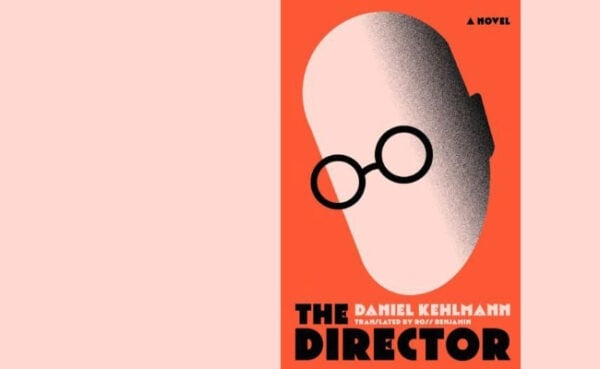
The director by Daniel Kehlmann, translated by Ross Benjamin, is the book most thought would win the International Booker Prize 2026. But the judges thought otherwise. They voted for Tiawan Travelogue by Taiwanese author Yáng Shuāng-zǐ, translated into English by Lin King. This historic win marks the first time an original Mandarin Chinese book has won the prestigious international prize. I have not yet read the book, so for now you’re getting the review of the one I wrongly predicted to be the possible winner. As you’ll see from my review I am actually delighted I was wrong!
...
This is an important topic that has been covered almost ad nauseam, which is probably why, to me, the book felt curiously pre-digested in its execution. I finished it with a faint sense of déjà vu.
...
Ostensibly, The director is about the moral, aesthetic and historical crises of twentieth century cinema. This is an important topic that has been covered almost ad nauseam, which is probably why, to me, the book felt curiously pre-digested in its execution. I finished it with a faint sense of déjà vu. It took some time for me to identify my unease about the book, because it’s obviously written with much intelligence. Its insights, to me, arrived already dulled by repetition. So, much in it has been said before; only now, it is said with sharper wit and retrospective wisdom.
To say the book is banal is not to deny its craft. Daniel Kehlmann remains a writer of technical assurance. The prose is controlled, the structure is deliberate, and the shifts in perspective are handled with a professionalism that never falters. But this very fluency becomes part of the problem. The novel reads too smoothly, too knowingly, as if it has already neutralised the shocks it seeks to represent. It is a book that anticipates its own seriousness so completely that it forgets to risk anything. Something about it reminded me of JM Coetzee at his most aesthetically evasive self – the chilly authority, the carefully managed distance, the sense of a mind always foreclosing the critique of its decelerations before it speaks them.
At its core, the novel stages the life and moral ambiguities of the filmmaker GW Pabst, moving between exile, artistic compromise and the shadow of fascism. These are, in principle, rich materials. The twentieth century has not exhausted them; it cannot. Kehlmann approaches them through a series of the familiar coordinates of a compromised artist – the seductions of Hollywood, the moral stain of having worked under Nazism and softly appeasing it, and the instability of memory in old age. There is very little that is uniquely discoverable in these themes. The best Kehlmann could do was to depict them in creative reiteration.
The opening section – set in a television studio with the disoriented Franz Wilzek – promises something more formally adventurous: a meditation on memory, decay and the unreliability of narrative itself. The scene is sharp, even unsettling. The old director, dragged into a live broadcast he barely understands, performs the past as anecdote while fragments of suppressed history begin to intrude. There is genuine tension here, a sense that memory might fracture into something dangerous. Wilzek catches a glimpse of himself on a monitor and loses his thread entirely; the image of his own face, split across screen and room, doubles him into helplessness. The moment when he insists that the lost film was never shot – “It wasn’t shot! It isn’t true, goddamnit; it doesn’t exist!” – while simultaneously remembering it frame by frame, is the novel’s most disturbing and intriguing scene. Yet even this promising instability disappointingly resolves into a recognisable pattern of the buried Nazi past and the implication of complicity.
...
Pabst’s encounters with American producers are rendered with satirical precision – the empty praise, the linguistic misunderstandings, the bureaucratic absurdity of studio logic. The two Warner men, Jake and Bob, circle Pabst in an endless loop of hollow enthusiasm, trapping him with compliments to flatter him into affirmation of their planned project. There is genuine comedic pressure in the scenes.
...
The denials, the suppressed recollections, the eventual suggestion of guilt – these are deployed with competence but without surprise. The novel gestures toward the uncanny, toward epistemological doubt, but ultimately retreats into a moral clarity that feels predetermined. The Hollywood sections exemplify this tendency. Pabst’s encounters with American producers are rendered with satirical precision – the empty praise, the linguistic misunderstandings, the bureaucratic absurdity of studio logic. The two Warner men, Jake and Bob, circle Pabst in an endless loop of hollow enthusiasm, trapping him with compliments to flatter him into affirmation of their planned project. There is genuine comedic pressure in the scenes. Yet the satire eventually lands exactly where one expects it to as an exposure of Hollywood shallowness and the philistine nature of most of its executives, with a tinge of the misunderstood European artist. These are not untrue observations, but they are by now so sedimented in cultural discourse that repeating them without complication is rather trivial.
The book is obviously aimed to be a nuanced critique of vacuous enthusiasm. The problem is that it, too, somewhat lands on the banal side of things, because it never moves beyond the obvious. One waits for the scenes to deepen, to expose some unexpected material, but the novel remains content to confirm what we already know about the vacuousness of the entertainment industry.
...
Even the portrayal of figures like Greta Garbo follows this pattern.
...
Even the portrayal of figures like Greta Garbo follows this pattern. She appears as the enigmatic star, burdened by her own beauty: distant, controlled and faintly tragic. Indeed, the characterisation is elegant – her longing to enter an ordinary laundry or to be asked her name without confusion, carries genuine pathos – but it is curiously second-hand. Her dialogue about art, suffering and performance is persuasive in isolation, yet it rarely escapes the gravitational pull towards banality; it, too, smells of cliché on deeper thoughts. Kehlmann grants her one arresting detail – the slow-motion close-ups that Pabst achieved by cranking the camera faster, turning her stage fright into screen mystery – but even this is borrowed history, a known anecdote re-dressed as kitsch.
The Louise Brooks section is livelier, mainly because Brooks herself resists the novel’s tidying instincts. She is caustic, self-aware and luminously unreliable. Her conversation with Pabst in an American diner crackles precisely because she refuses to be meaningful on his terms. She is a flame, she announces cheerfully, and flames do not care about being understood. Sadly, this energy dissipates quickly when she vanishes from the novel almost as abruptly as she arrived, consumed by the very machinery that was almost dismantled by her presence.
The deeper issue is that the novel seems overly aware of its own themes. It signals them insistently: art versus politics, memory versus history, complicity versus innocence. But because these oppositions are so clearly marked, they never generate real friction. The reader is guided, almost pedagogically, toward the correct interpretation. There is little room for ambiguity to metastasise into something troubling.
Consider the recurring motif of the lost film, a work that may or may not have been made and which hovers between existence and erasure. This could have been the novel’s central formal innovation as a meditation on absence, on the gaps in the historical record, on the impossibility of fully reconstructing the past. Kehlmann even hands himself the perfect structural correlative in Wilzek, who knows the film frame by frame but will not speak of it; Pabst mourns it obsessively and cannot recover it, while the film cans sit in a rucksack in an old man’s closet for decades, neither destroyed nor returned. The situation is exquisite. But it remains a symbolic device whose meaning is too legible. It is rather obvious that the lost film stands in for suppressed guilt – for the parts of history we refuse to acknowledge. The metaphor is apt, but it is also overdetermined. When the final revelation arrives – Wilzek has held the cans all along – it is not as a shock but as confirmation, the tying off of a thread the reader had been handed long before. You sign instead of being shocked.
The Jakob sections, which follow Pabst’s invented son through his years under National Socialism, are perhaps the novel’s most formally interesting, and also its most uncomfortable, for the wrong reasons. Jakob’s adaptation to Nazi school culture – the careful calibrations of violence, and the pragmatic, anti-Semitic self-preservation – is rendered with cold precision. But Kehlmann keeps him at such an ironic remove that we are never quite in the moral danger zone that such material demands. The boy’s intelligence operates as a kind of protective glass. We watch him calculate, and in watching we are implicitly positioned as watchers rather than implicated parties. The scene where Jakob descends into the castle’s impossible cellar is the closest the novel comes to genuine unease – a spatial and psychological dislocation that refuses easy interpretation – but even here the gothic machinery is familiar, and its darkness is decorative rather than structural.
What is missing, above all, is resistance, either from the material or from the prose. The novel rarely encounters something it cannot assimilate into its thematic framework. Even its moments of apparent chaos – memory lapses, narrative fragmentation, historical rupture – are ultimately domesticated. One senses that nothing genuinely uncontrollable will be allowed to rupture or persist here.
...
The problem is not that Kehlmann revisits familiar terrain, but that he does so without reconfiguring it.
...
This is where the comparison with more unsettling historical fiction becomes instructive. The problem is not that Kehlmann revisits familiar terrain, but that he does so without reconfiguring it. The moral drama of artists under fascism, the seductions of exile, the distortions of memory – these demand either radical formal experimentation or a willingness to leave questions unresolved. Instead, The director offers a polished, coherent and ultimately predictable account. The final scene, in which Pabst and his wife stand lost in absolute darkness in a cave, holding hands while she tells him she stopped loving him long ago, is technically affecting. But even there, one feels the scene arriving, prepared for, managed; and the darkness is curated rather than fallen into.
To call the book a cliché, then, is to point not merely to its themes, but to its mode of thinking. It relies on recognisable structures of interpretation: the compromised genius, the corrupt system, the haunted past, the faithful wife who outlasts everything. These are presented with intelligence and elegance, but also with a certain complacency, as if their truth were self-evident tropes that need no further interrogation. The epigraph from Heimito von Doderer – about being heaved forward on a wave of absurdity, knowing it and surviving by virtue of that very knowledge – gestures toward exactly the kind of existential vertigo the novel might have explored. Instead, it serves, too, as mere decoration.
The frustration the novel provokes is not trivial. It is the frustration of encountering a work that clearly possesses the potential for greater depth, greater strangeness and greater formal daring, but which repeatedly declines these. The idea of a director who understands everything through the logic of framing and editing, who even during his own fall from a ladder stops to assess the shot – that is an extraordinary premise. That a man’s life might be both lived and watched by himself, simultaneously an experience and a composition, is the novel’s most suggestive idea, but this is underdeveloped in favour of historical pageant.
In the end, The director feels like a novel that has already been interpreted before it has been fully imagined. It tells us what its material means, and in doing so, diminishes that material’s capacity to surprise. The result is a work that is intelligent, readable and at times compelling, but also persistently, faintly, disappointingly banal and too elegant for the creative chaos required by a novel narrative.
Kommentaar
Dankie vir 'n wel oorwoë resensie oor hierdie boek. U fokus op die leegheid (vacuousness) en clichéd aard van die teks het my egter herinner aan Hannah Arendt se boek 'The Banality of Evil' wat sy geskryf het na aanleiding van die verhoor van Eichmann. Dit laat my dink dat u vernaamste kritiek waarskynlik die belangrikste bydrae van die boek is.