

...
From the first pages of Haram, Muhammad made my stomach turn in the best and worst ways. Butterflies, nerves, excitement, dread.
...
I met Mark in the way you meet the things that will unmake you. Slowly. Then all at once. He was older. That was the draw. Not just in years, but in the way he carried himself. I was at university, still figuring out what I believed, what I wanted, who I was allowed to be. I thought older meant wiser. I thought older meant safe. I did not yet understand that some men do not seek younger partners to share what they know. They seek them because they believe younger means pliable. Easier to shape. Easier to confuse. Easier to hold just long enough, until something shinier arrives. I did not know that then. I only knew that when he looked at me, I felt chosen.
I am Muslim, and he is Catholic. My father was an Indian Tamil, and my mother was a coloured Muslim. His father was an Indian Catholic, and his mother was a coloured Muslim. Our families knew we were gay, but being openly gay as a couple would have been shameful.
I left Port Elizabeth to work in East London, then returned to PE and moved in with him in Forest Hill. Our flat was small and full of the particular intimacy of two people who have decided to make a life inside very close walls. I cooked. I studied. He came home. That was the shape of us.
I found the emails first. A young man in Johannesburg. A hook-up. Typed out in the casual language of something that meant nothing, which somehow made it worse. I confronted Mark. He admitted it, almost easily, like he’d been holding it just below the surface, waiting for the question. I took him back. I told myself it was love. I told myself it was faith in what we had. What I did not tell myself, what I was not ready to hear, was that I went back because I did not know who I was without the pain of staying.
After that, something changed in him. He became bolder. Brazen, even unhushed, uncareful. As if my forgiveness had been his permission. Then, Tim from Denmark arrived. Young. Blonde. Athletic. Undeniably international. He worked in shipping, the same as Mark. Their paths crossed constantly, which I did not think much about. I had no reason to. I was still grappling with the grammar of suspicion, still too fluent in hope.
I had never drunk alcohol before Mark. I only knew it from the smell on his breath, the taste of it when he kissed me after a night out – that sour, hollow sharpness combined with tobacco I could never get used to. I despised it. I was raised knowing that whatever alters the mind is forbidden.
One afternoon, I was sitting at my computer. Those old, black stiffy disks were stacked beside the keyboard, and the loneliness was so loud I could not hear myself think. I poured some of his whisky. Sat with it. Thought: “If you can do it, so can I. Maybe if I were more like you, you would stop looking for me in other men.”
I drank it. I felt nothing except the burning, and then the shame, and then the nothing again. When he came home, he saw me with the whisky. All he said was, “No.” No other words, nothing about why. Nothing about how I felt. Nothing, except that quiet hollow no.
My thesis mysteriously disappeared not long after that. I never found it. Even the A4 exam pads with my research notes and the cards with my thoughts and scribbles vanished. Never submitted. Never completed the second year of my master’s degree. That is a wound I still press, even now.
...
I asked Allah why. Was loving a man my first haram?
...
I asked Allah why. Was loving a man my first haram? Was being gay the transgression that opened the door to all the others? Was the whisky the thing that broke something? Was losing my thesis the punishment? A younger man with a master’s degree. An older lover with only his matric. Maybe the balance was always wrong. Maybe something had to give.
I could not face Wits with the truth of what had happened – that I had let grief undo me so completely. I had lost the one thing that was entirely mine. So, I disappeared. Ghosted them the way people ghost their pain. Told myself I would go back. I did not go back.
One night, I went out to find Mark. I already knew where I was going. Some part of me had known for weeks. Summerstrand. Tim’s flat. His car was there. I slipped in through the downstairs security door and knocked. Silence, first. Then I heard them. Not the sound of anything explicit, but the unmistakable sound of two men at ease with each other in the dark. Laughing. Soft. A kind of ease that you only have with someone you are not trying to impress.
Tim opened the door, wearing only shorts. Mark sat on the couch, also only in shorts. The moment stretched. Then Mark’s face moved through embarrassment into anger – blaming me, immediately, instinctively, for intruding on their friendly dinner. He left. And I looked at Tim. I want to say it was grief that made me do what I did next. But it wasn’t only grief. It was a malicious calculation. A deliberate cruelty, dressed up in the only power I had left.
I kissed Tim at the door. Then I went to my knees. It did not take long. He wanted it. That was the most painful part. How easy it was. We went to his bedroom. Candles burning. White bed linen was all ruffled. Clear evidence of what the evening had already been before I arrived.
We kissed again, our naked bodies tangled. As expected, he reached for a condom and lubricant. He wanted me in him. This was not love. What was this? How do you just jump from a man you profess to love to his boyfriend? Was Tim also doing some calculating, like I was? Mark did not come home that night.
He left on an ordinary morning. Said goodbye like it was nothing. And just before I could close the door, his fist split my lip. He bolted down the stairs. I stood there with the taste of blood, which is different from whisky, sharper and more honest. My work desk at the university was set apart from the others, thank God. I came in, hiding my face. Left early. Said nothing to anyone.
KNOCK. “Sikhander!” KNOCK. “SIKHANDER!” The shouts came through layers of sleep. I stumbled through the dark passage and opened the door. My mother. Fatima. Standing in the doorway with my cousins, Bashira and Shakira – twins, her brother’s girls, who have always moved like they are one person deciding together. And Otto, the building manager, standing with tools in his hand, ready to remove the door. Relief on all their faces. Tears. That particular expression that comes after imagining the worst.
I did not understand. I made tea because that is what you do. That is what our hands know. They asked why I hadn’t answered my phone. I took something for a migraine. The real kind, the one that splits your skull and makes the light unbearable. My mother knew I suffered from them. She held that knowledge close, turning it over, weighing it against what she feared.
Then they told me. Earlier that afternoon, Mark had left for Denmark. With Tim. They thought I had killed myself. That word – “suicide” – lands differently when it comes from your mother’s mouth, wrapped in relief that you are still breathing. It lands like something that almost happened. Like an open door that she had stood outside of, not knowing if you were on the other side.
Suicide is haram. Forbidden. An act of taking what was given to you by God and handing it back before its time. I had not done it. I had not wanted to, at least not then, not in that way. But the fact that she could imagine it, that she had driven through the night with my cousins, banging on my door, whispering Quranic verses under her breath – that told me something about how invisible I had made myself. How locked I had become. Worse, there was the deep pain in my mother’s heart caused by the thought that I had committed suicide. Pain caused by haram.
When you are straight, you can cry to your parents. Your siblings. Your friends. The whole ecosystem of comfort is available to you. You can say, “She broke my heart,” and be held. I could not say it. Not all of it. Not the full shape of it.
...
My queer friends did not understand what it means to be Muslim.
...
My queer friends did not understand what it means to be Muslim. To carry the weight of a faith that loves you and forbids you in the same breath. My straight friends did not understand what it means to be gay. To move through a world that assumes your love and then requires you to explain or hide it. My family did not understand what it means to be both. Muslim and gay. To hold two truths that everyone else insists cannot occupy the same body. So, I held it alone. That is what the loneliness was. Not the absence of people, but the impossibility of being wholly known by any of them.
A year or two passed. Somewhere in the passage of those years, I found I could finish a full bottle of vodka or tequila and feel nothing. Not drunk. Not altered. Nothing. I convinced myself this was proof that it wasn’t haram. That what’s forbidden is what alters the mind, as my mother once said. Ice-cold vodka didn’t alter mine. I was still present. Still watching over my friends at Aqua on a Saturday night, making sure they were safe, that they had water, that they got home. Always the caretaker. Not the one who needed caring for. I preferred the cocktail lounges in Summerstrand anyway. Quieter. More honest about what they were.
I told myself I was fine. I told myself I was not offending Allah. I did not think about what the alcohol was doing to the soul I had been entrusted with, or what my careful numbness might cost the people around me. As long as I would not burn in hell. As long as I could still fast for Ramadan, I was fine. The lie was elegant. I believed it because I needed to.
The one-night stands came and went. Faces and names I can’t always recall. Men who wanted a body for the night and left. I kept trying to find it, the thing that Mark made me believe I was capable of feeling. That first, terrible, beautiful choosing.
Why doesn’t anyone want to fall in love with me? Why can’t I fall in love with anyone? Why am I meeting Mr Right Now and not Mr Right? I still ask. Some nights, I ask Allah directly, in the same quiet voice I use for everything else I cannot say out loud. Not demanding. Not bargaining. Just asking, the way you ask someone you love when you don’t understand them, when their silence is the most disorienting thing you’ve ever faced.
I didn’t know what was haram and what was just mine. I didn’t know if I was being punished or shaped, or simply living the life that was given to me in full, complicated and sacred and sometimes unbearable all at once.
*
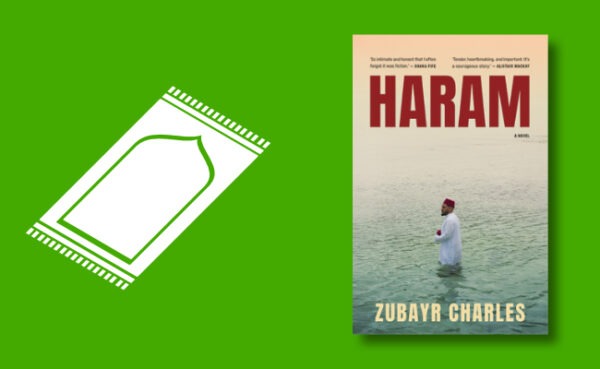
You have just read a part of my story. A part I could finally say out loud, because Zubayr Charles has shared his first. That is what Haram does. It does not give you permission. Permission is the wrong word – too small, too transactional. What it gives you is recognition. The terrifying, tender, chest-splitting sensation of seeing yourself on a page written by someone who has never met you, who could not have known, who somehow knew everything.
I need to tell you about Muhammad. From the first pages of Haram, Muhammad made my stomach turn in the best and worst ways. Butterflies, nerves, excitement, dread. All of it so tightly bundled together, I could not separate one feeling from another. That knot in my gut was not discomfort with the book. It was recognition. The specific vertigo of seeing yourself clearly.
Muhammad is getting married on the day the novel opens. But the true story, the one Charles is really excavating, lives in the past. In the fragments. In what was buried so that life could continue on its surface.
I saw myself in Muhammad, in Kashief, in so many others. I saw myself in Riyaaz. I saw myself in the calculated nastiness of what I did in Tim’s bedroom that night, the deliberate seduction, the power I reached for because it was the only kind I had left. Riyaaz lives in me. I am not proud of that. But Charles makes you look at it without blinking; and somehow, looking at it without blinking is the beginning of something cleaner.
Mark was my Riyaaz. Now I know what to call it.
Haram collides between the layered time of memory and present. The novel cuts between Muhammad’s wedding and the formative chapters of his past with a structural precision that keeps the tension alive, never letting you settle, never letting you look away.
He captures Cape Town’s Woodstock with the kind of intimacy that can come only from having lived inside a community. Charles skilfully, humorously and painfully dives into the pain inflicted by religion onto queer bodies. He shows you, with unflinching care, how silence strangles and how the body learns to carry what the mouth is not permitted to say, until the weight of it changes the way you walk, the way you pray, the way you love.
There is a distinction I have been sitting with since I finished the book: haram and harm. One letter. One letter separates what is forbidden from what is damaging.
Charles understands that what is labelled haram in queer Muslim lives is not the identity itself. It is the system that names it forbidden. The harm is not in being queer. The harm is in what straight Muslims and institutions do with that queerness. The harm is in what the Muslim Judicial Council’s Fatwa Committee issued on queer Muslims, and how families have enforced it in silence, in shame, in exclusion. The harm is in Muslim groups who call for our execution, who wrap violence in the language of God and expect us to receive our extermination as love.
...
He shows its cost not as an argument but as a story, which is always the more devastating form of truth.
...
Being a queer Muslim is not the hard part. We manage. We have always managed. It is straight Muslims who make it hard for queer Muslims. Charles does not say this gently. He does not dress up the insidiousness of heteropatriarchy or the expectation that heteronormativity is the default and everything else must be kept out of sight, apologised for and performed away. He shows its cost not as an argument but as a story, which is always the more devastating form of truth.
Reading Haram, I thought of all the ways I told myself I was fine. The vodka that didn’t alter my mind. The one-night stands that didn’t hurt anyone. The elaborate theology I constructed around my own survival. Allah is merciful; this cannot be what He meant. I pray, I fast, I am still here; surely that counts for something.
It does count for something. But Charles, and the teachings of Imam Hendricks, whose work saved me in ways I am still understanding, taught me that the question is not only: Is this haram? The harder, more honest questions are: What is this doing to me? What is this doing to the people I love? How am I walking this earth?
What Zubayr Charles gave me is harder to name than a book recommendation. He gave me language for my Riyaaz. He gave me a mirror that did not flinch. Quietly and without ceremony, he shines a light on my path – not out of my faith, not out of my queerness, but through the place where they live together, messily and beautifully and without apology. I walk that path gently with hope, love and compassion.
If you are a queer Muslim, or someone who loves one, or someone who has ever felt the violence of being told your love makes you less than, this book is not just recommended reading. It is the book that was written for the silence you carry. If it is not safe for you to write about what it makes you feel, or to speak it, let your truth sit in your heart. Beautifully. Silently. With honour and with courage.
Haram lights a path. I am on it. I hope you will find your way to it, too, and when you do, reach for my hand. We can walk it together. Shukraan, Zubayr. Thank you for your light.
Haram by Zubayr Charles. Highly recommended.
See also:
Zubayr Charles se Haram is ’n waarskuwing aan almal, gelowig of nie: ’n lesersindruk