

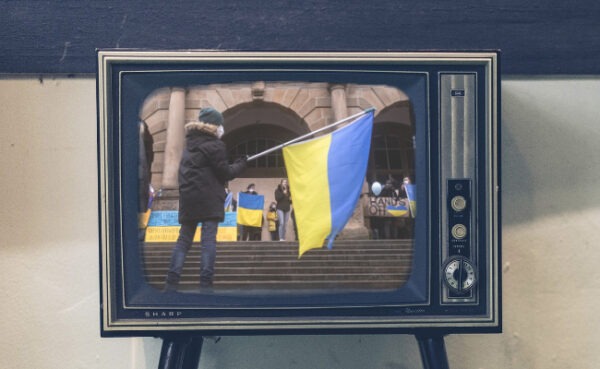
Millions of words cascade every day onto our heads about the war in Ukraine, now a year old. No sentient being on the planet can have failed to notice the consequences – food and energy inflation being the most immediately apparent. When will it end? Will it end? Skies darken, the seas grow higher yet, and the recently trialled mass warning signals on mobile phones in America and Europe – a long, electronic shriek like that painting by Munch – seem like a harbinger of things to come.
.....
When will it end? Will it end?
.....
Among the welter of educated opinion of what is most likely to happen, some gems of insight stand out. I was impressed with an as yet unpublished analysis of Russia’s apparent determination to forge ahead with the war, regardless, by Charles Crawford CMG, a communication consultant who has drafted speeches for prime ministers and other senior figures. He is an expert on central Europe, having served as British ambassador in Warsaw, Belgrade and Sarajevo, and he advises clients of the Ambassador Partnership.1 His view of where things stand now – including a reference to South Africa – appears below on LitNet, with his permission.
“Yeah, things didn’t all work out according to the best scenario. No problem, we’ll press on. We’re prepared to shed as much blood as necessary on this, and they’re not.” These lines describing Vladimir Putin’s Ukraine policy come from Meduza, an excellent source of independent Russian analysis: for Vladimir Putin and the people who surround him, a state of war is now normal. “Stop thinking that peace is the natural state, and you’ll see the situation through (Putin’s) eyes.”
The foundational assumptions of the modern “Western” world can be presented as a range of simple principles variously articulated during the Enlightenment. They include a commitment to rationality, the consent of the governed, human freedom and human rights, limits on rulers’ power in constitutional checks and balances, the rule of law, and so on. All of them, in one way or another, derive from a moral worldview emerging from Europe’s long tradition of big ideas: from Aristotle’s virtue ethics through to Immanuel Kant’s claim that moral rules can be deduced by reason, and then pragmatic British utilitarianism.
Where does Russia, and especially its current leadership, fit into this picture? What are their foundational assumptions?
.....
Russia’s imperial soul itself gives all the moral basis they need.
.....
They lie in a very different political-philosophical place. For most of its existence, Russia has had autocratic if not despotic rule. Russia missed the Enlightenment and its focus on reason and accountability. Its leaders see their legitimacy as coming only from their struggle to advance Russia’s unique traditions and interests, constantly menaced by jealous outside powers. Russia’s imperial soul itself gives all the moral basis they need.
Russia’s greatness is so great, in part exactly because it does not fall into puny categories of ethics and reasonable behaviour set by non-Russians. This approach reached giddy depths under Lenin and then Stalin. Destroy thousands of churches. Use famine as an instrument of policy. Mass deportations. Mass show trials and executions. Commit stupendous war crimes, such as the Katyn massacres, then deliberately lie about them for decades. When it comes to war, do whatever it takes to win. Throw wave after wave of young Russian conscripts into battle, shooting anyone who turns around. Steal thousands of children.
For a few years after the Berlin Wall came down, Russia’s post-communist leaders – including Vladimir Putin in his early years in power – tried to accommodate themselves to the broad Western approach. But these deeper, darker instincts have come back and, if anything, become more extreme in the past few years. Putin has increasingly fallen back towards Stalinist iconography and Soviet rhetoric. Human rights now count for nothing in Russia. Opposition to the war is effectively outlawed, down to the persecution of the family of a young schoolgirl who made a pro-Ukraine drawing.
As Grigory Yudin puts it in Meduza, Vladimir Putin produces a sense of “monstrous, endless resentment. Nothing can mollify this resentment. It’s impossible to imagine what could compensate for it. It doesn’t allow people to think about establishing any kind of productive relationships with other countries.”
This focus on angry resentment leads to crazed threats of a nuclear Armageddon regularly appearing on Russian TV channels. Yet it does strike a chord with many millions of ordinary Russians who are scarcely aware of any other way of thinking about the world. And it resonates in China, South Africa and other countries around the world, whose leaders enjoy the idea that it is high time “the West” was toppled from its sanctimonious perch.
Perhaps Putin is on to something in vaunting his account of Russia’s greatness. Maybe there is something “great” in committing open acts of astounding villainy (including against one’s own people) and being proud of them – with the idea that the usual tedious moral codes and sense of proportion and well-established norms of international law simply don’t apply. And with the idea that there are no limits of any sort, other than those suggested by studied cynicism and opportunism. What if my greatness doesn’t fit into your feeble categories of greatness?
Putin not incorrectly calculates that when faced with the sheer sustained enormity of his policies, much of the world will stare intently at its own shoes. Look what’s happened. Days after the International Criminal Court issues an arrest warrant for Putin’s arrest on various war crimes charges, Russia takes its turn to sit primly right at the top of global order, chairing the UN Security Council. Business as usual. It’s all Western manipulation and propaganda! As usual, Western governments huff and puff about it, but can do nothing. They look weak.
.....
Insofar as Putin has a problem in grinding on with this war almost regardless of the cost in Russian lives and wealth, the Ukrainian people know exactly what he is up to.
.....
Insofar as Putin has a problem in grinding on with this war almost regardless of the cost in Russian lives and wealth, the Ukrainian people know exactly what he is up to. They, too, have had the same Soviet psychological training. They, too, can be ready to do whatever it takes to win and suffer the costs. Plus, they are clever at playing on the deepest Russian insecurities, talking up the prospect of Russia disintegrating under the weight of its own contradictions, and even boasting that Ukrainians are the “real” Russians, ie the natural descendants of the historical Kyivan Rus’, which flourished from 880 to 1240.
The Ukraine-Russia war drags on, slowly but surely getting more dangerous as Western weapons pour in and the Russian army suffers absurd losses but keeps grinding into battle anyway. None of us knows what level of calamity it might take for some senior Russians to summon the courage to bring Putin down. But if he doesn’t get toppled, he will keep going. As I have written before – soon after the Russian invasion of Ukraine in 2022 – one of the central tenets of Russia’s negotiation posture is this:
- We can take more pain than you can imagine.
- We can take more pain than you’re prepared to inflict.
- Whatever you do to us, we’ll do worse to you.
And so it’s proving.
Endnote
1 The Ambassador Partnership LLP is a partnership of former ambassadors with networks of influence in almost 100 countries.
Also read: