

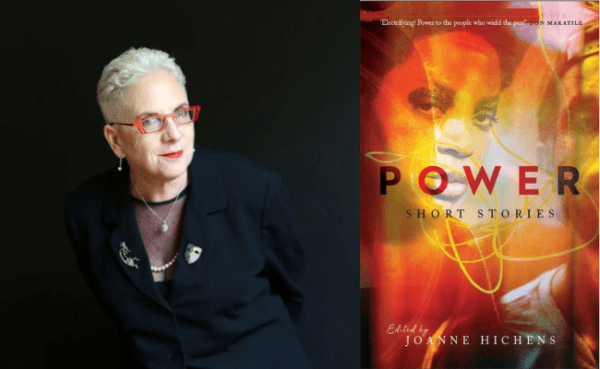
Photo of Lynn Joffe: provided
Short.Sharp.Stories is a platform showcasing established and emerging South African short story writers. For the 2025 anthology, Power: Short stories that light the dark, writers imagined “power” in fictional terms – how it influences and affects us, including political and personal power, and the ever-present issues of loadshedding.
In this Short.Sharp.Stories interview, Joanne Hichens chats with Lynn Joffe, author of the short story “Homecoming”, a raucous tale of women losing – and then gaining – their personal and collective power.
Lynn Joffe, author and storyteller, has penned and produced an abundance of multicultural campaigns for South Africa’s top brands and edutainment platforms. She holds a BA from Unisa and an MA in Creative Writing from Wits. She presents interactive storytelling and writing workshops for universities, literary festivals and conferences across South Africa and internationally. Her debut novel, The gospel according to Wanda B Lazarus, was published to acclaim by Modjaji Books in 2020. Her latest brainchild, Solid gold story time, won Podcast of the Year in the SA Podcast Awards and Best Children’s Podcast at the APVA Awards.
This story is upbeat and celebratory, and is the perfect end to the collection. What does “homecoming” mean to you, and how does it attach itself to the theme of “power”?
As a fair-skinned convert to this country – I only landed here in my mid-teens – I didn’t have a real sense of home. I’d been schlepped to four continents before I was 12, and South Africa was an itinerant holiday destination to visit family here. After Nelson Mandela was released and I’d returned here after a two-year sojourn, I felt that this miraculous turnaround of our circumstances gave me the right to be a South African citizen. I turned in my green card, held onto my British passport and committed myself to the New South Africa, for better – or worse. So, this is home now. Wherever I may roam. That is the power of belonging. Quitting the wandering. Knowing who your people are. Being the change I wanted to see.
You wrote this story over a number of years, yet it feels contemporary, even referencing loadshedding. How did you manage this? Are some stories meant to simmer until they’re ready for release?
Yes. I call it marinating. Perhaps even hibernating. This story really did happen to me, and by placing it in the third person after several redrafts, I could become more objective to the story arc and characters. It did start as memoir, as many of my stories do. A draft of this was written as and when it happened. But a life story does not always a good short story make. I had this in my trunk for years, and when the opportunity to submit it for Power came around, I wove in the power cuts so that it had a literal symbol, and then realised I’d thematicised the voyage from disempowerment to empowerment of the women in the story. The theme forced me to become conscious of what I’d written. And strengthen the storytelling. So, the past, present and future tend to merge, with the intention of telling a fully fledged constructed story.
........
It did start as memoir, as many of my stories do. A draft of this was written as and when it happened. But a life story does not always a good short story make. I had this in my trunk for years, and when the opportunity to submit it for Power came around, I wove in the power cuts so that it had a literal symbol, and then realised I’d thematicised the voyage from disempowerment to empowerment of the women in the story.
........
“Homecoming” is based partly on the truth of a chance encounter in a parking lot with a star. Clearly, this stayed with you. What was so momentous about the encounter that it has been recreated as fiction?
As it happened, in real life, Mama Afrika never did pitch up in the car park that evening. To make the story zing, I asked, “What if?” What if she had pitched up? What if the women she left behind had questions and challenges for this great woman. It felt surreal at the time that I was leading the Women of Dorkay House in a sing-song in an abandoned car park. So, the seed was there. The story tightened later, using my imagination and story structures to gain momentum.
The unfolding action is told through Sophie’s eyes. She’s brave and likeable. She takes no nonsense. How did you fashion her character so that she becomes distinctive and sassy?
It must have been based on aspects of myself. I’ve always been a sassy type. Chutzpah, some call it. By including other female characters, I massaged her personality into a definite character separate from my actual self. I wish I could still be more like Sophie.
As a musician yourself, how did you use music to your benefit in the story? And where does your love of Afrojazz stem from?
I was told I rose from the womb singing “Summertime”. That I could sing before I could talk. I hail from a musical family. It’s like being an idiot savant. Many of my stories include music as metaphor for self-actualisation. I’m probably a much better writer than I am a musician. But all writing must have pace, rhythm, a melody line. They are not that dissimilar. Perhaps all art follows this dictum.
My love of Afrojazz comes from the music itself. I know American jazz and the immortal American Songbook. Much of what I have performed and sung comes from this canon. But South African jazz bejazzles the clichés. I love the music. I love the people. And in terms of artistic development and self-empowerment, this is the music that brought me home.
If there were a soundtrack to your story, what would the songs be?
I’ve referenced the song “Mayibuye”, which is Zulu for “Come home”. The composition has claimed to be originated by several different composers. It sings to me still. I can play it in my sleep. I also began to learn jazz guitar from the immortal Johnny Fourie. Using Afrojazz as my passion and music lessons as my guide, my natural music chops grew exponentially. The Women of Dorkay House taught me many different songs, both traditional and jazzy, which I can now comp for myself. In my key. At my pace. Always with counterpoint rhythm and rhyme. So, they’re all my favourites. “Mayibuye”. “Hlala phansi”. “Makwinya ke mofao”. “Lady is a tramp”. They can all be done in Afrojazz fashion. And still continue to thrill me.
And, of course, melding this all together – the short form, music, your own personality somehow being channelled though Sophie – even though it reads as a joyous tale, what were the challenges for you?
It was a real challenge to transform my own experience into a third person character. Having been restricted to Wanda’s eponymous voice in my novel, I’ve needed to explore different perspectives. This story began as autobiography and morphed into fiction through storytelling beats, imagination and the will to creative power. And a massive number of drafts. I’m not sure if writing is actually “fun”, but authors need to give themselves credit for not living in endless procrastination. When you let go of expectations and self-judgement and the words begin to flow, that’s where the games begin in earnest. And, as our literary uncle, Ernest, says, “There is nothing to writing. All you do is sit down at a typewriter … and bleed.”
........
I’m not sure if writing is actually “fun”, but authors need to give themselves credit for not living in endless procrastination. When you let go of expectations and self-judgement and the words begin to flow, that’s where the games begin in earnest.
........
In a broader question, not only were you involved with Short.Sharp.Stories, but you were also a judge for the DALRO Can Themba Short Story Awards, as well as lead judge for the National Arts and Culture Awards, NACA 2025. What can you share about the value of the South African short story?
It’s been fascinating to read, objectively, the many short stories that were entered for Short.Sharp.Stories, the DALRO Can Themba Short Story Award and the DSAC’s National Arts and Culture Awards, for which I was lead judge. The literary critical eye I’ve cast has improved my own writing dramatically. I’ve read that the short story is South Africa’s superpower; we don’t have a “common narrative”, thus our plethora of stories from diverse writers of diverse ages and cultural backgrounds, emerging and established. There should be more short story collections out there. Selling locally and abroad. There is also place for short stories in mother tongue, which need to be encouraged to be written. The standard does need to be raised, but some stories just shine out as unforgettable and, with practice and mentoring, will surely find a publishing home.
And what is next for Lynn Joffe?
Having come through a period of literary judging, I’ve had the opportunity to conduct an intense critique of a wide array of South African authors and books. This gives me a strong foundation to take the next step in my writing recovery journey after the tragic death of my sister. A slew of short stories were started for a PhD which I’ve had to put on ice. These are being written back to life. I’m about halfway through a fictional biography, from multiple perspectives, about my time in Australia in the ’60s, where the suicide of a famous comedian in our home brought about the downfall of my family. And a deeply personal, yet universal memoir to my sister – a dialogue with the dead – of her Year of Dying Courageously. Wanda may even be waiting in the wings for a sequel. I just didn’t want her voice to overwhelm my inner author. I feel the creative flow returning after a long, cold, lonely winter. All I need to do is find the structure and discipline. And the audacity to write again.
Joanne Hichens, author, editor and publisher, is based in Cape Town. She believes in the multiplicity of South African writing talent and has edited numerous anthologies of short stories showcasing the diversity of the South African voice. She is best known for curating the Short.Sharp.Stories series, including anthologies Bloody satisfied, Incredible journey, Adults only and Fluid: The freedom to be, winner of the National Institute for the Humanities and Social Sciences (NIHSS) Award for Best Edited Collection (2024). The latest of the collections is Power: Short stories that light the dark (2025). She has written crime fiction, YA and, most recently, the acclaimed Death and the after parties (2020).
Power is available at good bookstores and directly from Tattoo Press: joanne.hichens@gmail.com.
Tattoo Press is an independent small publisher, specialising in contemporary South African short fiction.
Also read:
Short.Sharp.Stories anthology, Power: interview with David Medalie, author of "A recreated world"
Short.Sharp.Stories anthology Power: interview with Mthobisi Myeni, author of "The denizens"
Short.Sharp.Stories anthology, Power: interview with Uthimna Gqangeni, author of "Jiti morale"
Short.Sharp.Stories anthology, Power: interview with Tanya Faber, author of "Standing still"
Short.Sharp.Stories anthology, Power: interview with Tiisetso Lekopa, author of "Canvas"
Short.Sharp.Stories anthology, Power: interview with Ross Ian Fleming, author of "The k word"