

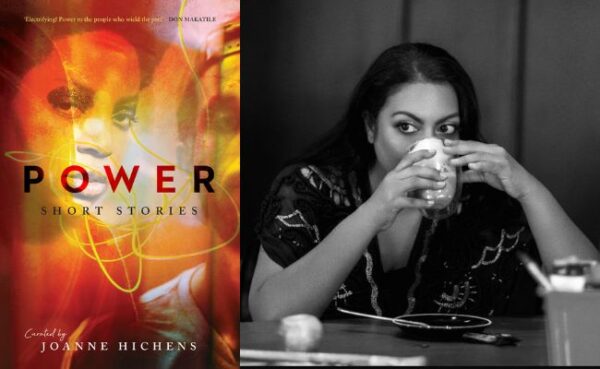
Picture of Cythina Kistasamy: provided
Short.Sharp.Stories is a platform showcasing established and emerging South African short story writers. For the 2025 anthology, Power: Short stories that light the dark, writers imagined “power” in fictional terms – how it influences and affects us, including political and personal power, and ever-present issues with loadshedding.
In this Short.Sharp.Stories interview, Joanne Hichens chats with Cynthia Kistasamy, author of the short story “Kameel and the firecracker dog”. Kistasamy’s story is a hilarious tale of a feud between neighbours, that underscores how anger and frustration bring racism to the fore.
Cynthia Kistasamy is an artist and writer living in Johannesburg, South Africa. She started writing in 2016 after the death of her father, and has since seen success with her short stories: “Pepsi, pie and swimming pools-in-the sky”, published in the anthology We mark your memory (University of London and Commonwealth Writers, 2018); “Shiva eyes”, published in the anthology Yellow means stay (Afritondo, 2020); “The beach house”, published in the anthology Travelling men don’t die (Afritondo, 2024); and the flash piece “The great Kili”, published in In other stories (Karavan Press, 2024). She self-published her first contemporary romance, The missing ingredient, in 2022.
Your story deals with racism and the ways we label each other and, in fact, accuse each other of “not belonging”, which speaks to fundamental racism. You tread carefully, though, in a story that is characterised by bathos and humour. How important was it to include humour in this story?
South Africans are a unique people, often described as a rainbow nation due to the many ethnicities that make up our population of 64 million. We, as a nation, have also never been shy to speak of our differences. We live in a landscape that still bears wounds from apartheid, many of us having lived during the apartheid era, which was marked by violence. Humour, in my story, was used as a tool to lighten what could otherwise be considered a volatile social issue, while still taking the bull by the horns. Our perceptions of other race groups exist; we have preconceived ideas that need to be unpacked and discussed, ideas that have perpetuated hatred simply because of how a person looks or acts. The idea of not belonging is something South Africans of Indian descent have had to deal with in both apartheid and post-apartheid South Africa. South African Indians have always had to deal with the psychosocial issue of not belonging, even though we are now fifth generation South African citizens.
The humour in my story was used as a device to soften an otherwise crucial concern. I wanted my readers to have a good laugh, but also to take away – long after the story has ended – that racism, racial hatred and dangerous perceptions of the “other” still exist, even now after 30 years of democracy. We are, after all, known as one of the friendliest nations in the world, a people who can gather in unity at a rugby final and party in the streets long after the match has ended. We love a good story, and hopefully “Kameel and the firecracker dog” is just that.
Indeed, your story elicited roars of laughter from the audience at the Johannesburg launch at which you read an extract. Was the response a surprise?
I was highly nervous at the Joburg launch, but I have to say my anxiety completely melted away with each laugh I managed to elicit from that wonderfully kind audience that evening. (A big thank you to David Mann, who did such a sterling job of hosting the evening.) When I first wrote “Kameel and the firecracker dog”, I had no idea which direction the story would take, but even I had good laughs late at night in bed after reading a scene I’d just written. I have to say my two dogs (my first audience I read to) were none too pleased for being roused from sleep late at night. So, the response at the Joburg launch (by a kinder, more forgiving, human audience) was a refreshing surprise that restored my confidence as a writer and almost convinced me to take up stand-up comedy.
Kameel, your protagonist, appeals from the start. How careful were you to ensure he remained a sympathetic character?
Kameel, I found as the story progressed, was a needy character. The more I got to know him, the more I felt sympathetic towards him. What with all his hang-ups and phobias, who could not lean on the side of his cause? He’s just a man doing what men do, creating a safe home for those he loves (which is probably what Smith is doing, too, but we only get the point of view of Kameel). If written from Smith’s point of view, Kameel would have been presented as totally different, I’m sure.
Kameel’s ongoing vendetta with Mr Smith, his neighbour, becomes more and more hilarious as the story considers the way neighbours obsess about the minutiae – the uncut lawn, the noise. What were your influences in your local environment, growing up in the Indian culture? And is this story based on a fragment of truth from your experience of petty quarrels between neighbours?
This question brings up memories of times past, of my childhood, one which my own children will never experience. A time when there were no fences between houses, when neighbourhood kids gathered in flocks and were as wild as the hills, barefoot and running. A place where you walked down the road, to a wedding five doors away that needed no written invite or RSVP. And when all the festivities ended, you gathered around at trestle tables in the backyard under a tent and ate curry and rice off banana leaves.
........
This question brings up memories of times past, of my childhood, one which my own children will never experience. A time when there were no fences between houses, when neighbourhood kids gathered in flocks and were as wild as the hills, barefoot and running. A place where you walked down the road, to a wedding five doors away that needed no written invite or RSVP. And when all the festivities ended, you gathered around at trestle tables in the backyard under a tent and ate curry and rice off banana leaves.
........
How much has changed since moving to Johannesburg, with its high walls and electric fences. Where play dates have to be booked weeks in advance and curated by anxious mums hovering over their kids. And, of course, don’t forget to state your dietary requirements, because allergies are a real thing these days.
Yes, a lot of the story is based on my own experiences, or stories told to me. I have lived in seven homes and in three provinces to date, so I’ve been through the wringer with both good and bad neighbours. I won’t go into details over the bad neighbours for fear of being sued, LOL. There are, in fact, so many bad ones that I could write a book.
And, as an aside, what about good memories with neighbours?
Yes, there are those. I remember living in a little flat when I first moved to Joburg, with neighbours above and below me, and bringing home a colicky baby who cried nonstop every night for three months. The first two weeks were awful; come sunset, and I’d be filled with dread at soothing a baby who was unsoothable, and wondering which neighbours were being kept awake by my crying baby.
At the end of the two weeks, the inevitable knock on the door came. And there stood a beaming, beautiful young woman, Tinay, with a box of chocolates and flowers. She told me not to worry and that the baby would settle soon, and if I needed anything she was one floor above. There were several more knocks from other neighbours, all with well wishes, some from older women with advice and home remedies or just some kind words. It was really heart-warming and a reminder to me always to be kind and respectful, because you never know what the next person is going through. So, “Kameel and the firecracker dog” is definitely drawn from real experiences from real people.
It seems as if you really had fun with the theme, “power”. How would you sum it up?
I was intrigued by the theme of power that Short.Sharp.Stories chose for their call this year. Usually, short story calls centre around emotive themes like love or hatred, which in retrospect are emotions that can all stem from the play of power within a human ecosystem. I decided to take two very “ordinary” characters, Naidoo and Smith, with a history of conflict and power play between them, and I placed them in a tiny room to see how they would react. And yes, they did not disappoint!
Ultimately, your story transcends the “smallness” of feuding neighbours to become a story of universal relevance. Do you see the feuding neighbours as indicative of larger society and how we treat each other?
This story was always intended to carry the message of universal racial intolerance. I’m not sure if it was just me, but I noticed that when COVID hit, there was not just a global panic and fear about the virus, but a series of racial incidents that unveiled the racial intolerance that exists in every corner of the world, like the George Floyd incident in 2020, which reignited the Black Lives Matter movement. And then there was the hatred that spilled over from social media into everyday life – the keyboard warriors – that accused entire nations of creating and spreading the virus. It was sad to watch, but it was also an eye-opener for me, as a South African, to realise that it’s not ever greener on the other side.
The lockdown revealed the racial intolerance, the racial tension, the cracks, that global media powerhouses manipulate or hide. Racial misconceptions, racism and xenophobia exist throughout the world. How we perceive people due to physical appearance has been dictated by centuries of colonialism and a dominating Western ideal. It still very much exists.
The wonderful thing about South Africans is that we are able to address these issues in open discourse due to our history of apartheid. We don’t shy away from the problems; we speak our minds and can agree to disagree. This story is a universal story, just with a sprinkling of South Africanism.
This story seems so completely indigenous to who we are as a people. Do you think it could be set anywhere other than South Africa?
This is a home-grown, 100 percent South African tale. I think only South Africans will get all of the humour. I mean, nobody else but South Africans would know what loadshedding even is. We are a unique nation, with our own quirks and off-beat sense of humour.
........
This is a home-grown, 100 percent South African tale. I think only South Africans will get all of the humour. I mean, nobody else but South Africans would know what loadshedding even is. We are a unique nation, with our own quirks and off-beat sense of humour.
.........
That being said, if the story were stripped down to its bare bones, it could be set in any part of the world, because feuding neighbours and racial intolerance exist everywhere. So, yes, with some tweaks here and there and some major rewrites in some scenes, this story could be placed in a setting other than South Africa.
Do you have a love of the short story? And what has it been like for you, entering the space of “writer” in South Africa?
My writing journey started with a love for writing, not in particular short stories, but just writing. A poem here, a paragraph there. To be honest, I had no idea what a short story was, or what it entailed, at the very beginning. After my father’s death in 2016, I wanted to document the stories he had told me as an exercise to remember him. My father had the best stories to tell.
It was at this point that I started researching “how to write a story”, and I remember coming across Short Story Day Africa’s Facebook page, a platform that celebrates the African short story form. Back then, they used to run writing sprints every Saturday morning. I think it was 250 words. I was hooked. I used to look forward to that, and the community and feedback from the writing experts there were invaluable. It inspired me to research some more and learn about crafting a short story. And now I love short stories, especially short stories from the African diaspora. They have a particular magic realism to them that I identify with.
Another reason to be brave and press the “send” button is that you may just get lucky and get to work with an experienced editor, like I got to do with Joanne Hichens. I have also followed Short.Sharp.Stories for a long time and find their resources very helpful.
On a personal level, as a stay-at-home mum for 15 years, I wanted something that was my own. I wanted to be something other than “mum”. Reading, researching and writing provided that escapism while I was still able to do school pick-up and cook dinner. And then I started entering competitions. It takes a lot to press that “send” button, and rejections are crushing; but since my writing journey began, I’ve slowly acquired some publications and am comfortable enough to call myself a “writer”. I still have to pinch myself sometimes when I’m included in anthologies with such well-known and accomplished writers like those in Power. I’ve since found a love for the short story form and consider it my niche, for now.
Joanne Hichens, author, editor and publisher, is based in Cape Town. She believes in the multiplicity of South African writing talent and has edited numerous anthologies of short stories showcasing the diversity of the South African voice. She is best known for curating the Short.Sharp.Stories series, including anthologies Bloody satisfied, Incredible journey, Adults only and Fluid: The freedom to be, winner of the National Institute for the Humanities and Social Sciences (NIHSS) Award for Best Edited Collection (2024). She has written crime fiction, YA and, most recently, the acclaimed Death and the after parties (2020).
Power is available at good bookstores and directly from Tattoo Press: joanne.hichens@gmail.com.
Tattoo Press is an independent small publisher, specialising in contemporary South African short fiction.
Also read:
Short.Sharp.Stories: Interview with Anna Stroud, author of "The power station"