

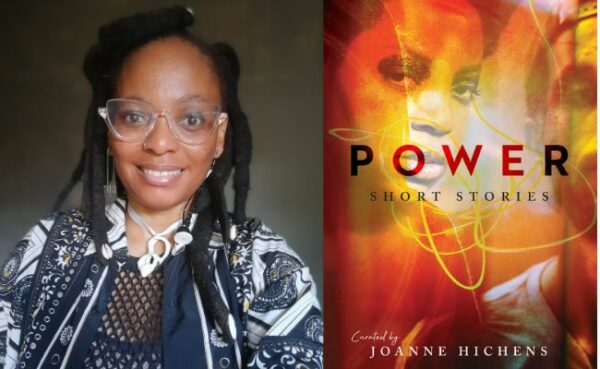
Picture of Vuyokazi Ngemntu: provided; picture of anthology’s cover: https://joannehichens.com/anthologies/
Short.Sharp.Stories is a platform showcasing established and emerging South African short story writers. For the 2025 anthology, Power: Short stories that light the dark, writers imagined “power” in fictional terms – how it influences and affects us, including political and personal power and ever-present issues with loadshedding.
In this Short.Sharp.Stories interview, Lynn Joffe chats with Vuyokazi Ngemntu, author of the short story “The cost of freedom”. Ngemntu is the winner of this year’s award for Curator’s Choice.
The story is described as: "This incisive piece, of speculative fiction, speaks to the root of power and powerlessness of the New South Africa. As a parallel and a parody of our first democratic election, and a reflection of the abuse of power, the story challenges the notion that the freeing of Nelson Mandela was the ultimate attainment of power for the people. Conceptually intriguing, this story pushes boundaries."
Vuyokazi Ngemntu is a writer-performer in Cape Town, South Africa, whose praxis uses poetry, song, physical theatre, storytelling and ritual to navigate epigenetic trauma and to centre indigenous knowledge systems in the creation of new black imaginaries. Her short story “Binnegoed” was selected as the overall winner of Ibua Journal’s 2022 “Bold: Food” regional. Her short story “Blood and ballots” was featured in The year’s best African speculative fiction: Volume 3. Her work has appeared in World Literature Today, Kalahari Review, Herri, Ibua Journal, Short.Sharp.Stories, New Contrast, Ake Review, Pepper Coast Lit, Culture Review and elsewhere.
I sense your thematic consistency of merging political polemic with dystopian science fiction. How did you come to this approach, and can you speak about this as your “oeuvre”? What comes first, the idea or the genre? Who do you consider to be your “literary antecedents” for this form of writing?
We’ve gotten to a place in global history where truth is stranger than fiction. The age of social media has created a news climate in which propaganda and disinformation have made it challenging to discern between fact and conjecture. Historical revisionism as a subgenre of SFF (science fiction and fantasy) allows my writing to divorce itself from the confines of realism, while still speculating on reality. Having made this my domain, the idea immediately performs in this uninhibited space, where the playing field is vast and the rules of “real life” don’t apply. It’s this sense of freedom that allows me to revisit history with a critical lens, build alternative worlds where humans and cyborgs can pursue social justice, and reframe the reader’s gaze on current affairs.
........
Having made this my domain, the idea immediately performs in this uninhibited space, where the playing field is vast and the rules of “real life” don’t apply. It’s this sense of freedom that allows me to revisit history with a critical lens, build alternative worlds where humans and cyborgs can pursue social justice, and reframe the reader’s gaze on current affairs.
........
I can only hope to be conversant with the writers who constitute the vast canon which nourishes me and who have carved a space for my voice just by existing! These include Octavia E Butler, Amos Tutuola, NK Jemisin, Aimé Césaire, Tlotlo Tsamaase, Lesego Rampolokeng, Stacy Hardy, Marlon James, Cheryl Ntumy, Dambudzo Marechera, Akwaeke Emezi, Donald Oghenechovwe Ekpeki, Helen Oyeyemi, Ta-Nehisi Coates, Namwali Serpell, Lidudumalingani Mqombothi, Emmanuel Iduma and so on.
What prompted the writing of your story, and can you enlarge on the meaning of the title, “The cost of freedom”? Whose freedom?
I’d written it a few months prior to Short.Sharp.Stories announcing the call for submissions. When the call came out, I’d just received critical feedback on the story from a few peers, and I was working on a redraft. The timing was immaculate! The title interrogates South Africa’s post-apartheid zeitgeist and questions the validity of the change we’ve managed to achieve after the 1994 elections.
Can you enlarge on the importance of challenging power structures and how this pertains to your story?
In a world where 1% of the population have a monopoly on economic and, by extension, political power, the general masses suffer under the weight of inequality. What we do have are our voices. Apathy is a natural response to powerlessness, but the danger of remaining silent is the perceived acquiescence of the oppressed. South Africa is an inequable country where the divide between the haves and the have-nots is still very much along racial lines, with black families living in shacks, children falling into pit latrines at under-resourced government schools, etc. All I did in the story was ask, “What went wrong, where?” and concoct a scenario that tries to make sense of where we find ourselves by interpolating the fantastical into the factual!
........
Apathy is a natural response to powerlessness, but the danger of remaining silent is the perceived acquiescence of the oppressed. South Africa is an inequable country where the divide between the haves and the have-nots is still very much along racial lines, with black families living in shacks, children falling into pit latrines at under-resourced government schools, etc. All I did in the story was ask, “What went wrong, where?” and concoct a scenario that tries to make sense of where we find ourselves by interpolating the fantastical into the factual!
........
“The cost of freedom” parodies the South African status quo by speaking to the danger of the euphoric “rainbow nation” gaze in the face of the manipulation and continued oppression of the majority population. I challenge history by using my words to express my rage at the present, and hopefully spark the desire for change in the future.
Your protagonist’s name, Siphamandla, references freedom and power. Can you say more about the merge of human and cyborg? How does this feed into the humanity of your story?
Siphamandla’s name translates into “Give us (the) strength/power”. She embodies the aspirations of a part of the country’s demographic whose yearnings for transformation remain to be redressed. It made sense for her to be a transhuman being: hers is the duty of fulfilling the dream of political and economic freedom that the likes of Mandela were unable to fulfil.
Can you speak more to the disappointments of our politics that may have given rise to channelling our country’s history with the bizarrity of having Mandela as a doppelganger?
Given what we know about the brutal torture tactics of Eugene de Kock in Vlakplaas, the biochemical warfare practised by Wouter Basson to eliminate enemies of the state, and other forms of psychospiritual annihilation practised by the regime, the idea of a doppelganger is not as implausible as it sounds! For instance, people question how Mandela’s last few years were spent, not on Robben Island with the other political prisoners, but in a cottage on the John Vorster prison grounds. This meant visitation rights, improved living conditions and increased freedom of movement. That alone gives rise to speculation as to how he would’ve earned those privileges – what he traded in exchange.
Compare this with the treatment received by Mangaliso Sobukwe, for example, who, in serving what was officially meant to be a three-year sentence, was considered such an insurgent that he was held in solitary confinement, away from the other prisoners, lest he incite retaliation through his Pan-Africanist ideologies. Not to mention the assassination of Chris Hani in 1993, before power traded hands. Fast-forward to the present, where the ruling party serves as nothing but a front for Western superpowers and is so deep in the pockets of white monopoly capital, that they continue to protect the interests of power while the people continue to suffer economic exclusion, land dispossession, abject poverty and other forms of indignity.
What is the value of speculative fiction, and how do we retell our past using this genre?
........
Specfic gives us the audacity to reimagine the world. We’re not obligated to accept one truth as absolute and empirical.
.........
Specfic gives us the audacity to reimagine the world. We’re not obligated to accept one truth as absolute and empirical. Instead, writing in this genre allows us to use the historical archive as a point from which we can diverge into endless contemporaneities and futurities. Each retelling can steer us in a different direction by filling in the gaps and colouring in the grey spaces.
You have a wide range of creative arrows in your quiver. How do they influence each other? How do you choose which to develop and which to craft at some other time?
At the core of it all are words. Think of it as spell-casting: I’m always navigating the chaos of life to invite magic. When I’m not writing short fiction, it channels itself through poetry, song, story or plays. All I do is find stillness within myself and go where the words lead.
I’ve read that “slam poetry” is more about the spoken word than the written word. Given that you do both, what’s your take on this?
Ideally, there should be no qualitative distinction between work that’s written for the page and work that’s written to be devised and performed.
Lastly, could you tell us a little about your love of the short story, and why you believe it is important in South Africa to carry on this tradition?
Whereas long-form writing allows room for an elaborate backstory, short fiction drops the reader into a transitory moment, where a character must contend with precarious given circumstances while pursuing a goal which transforms them and the world as they know it. So much truth is compressed and distilled in the telling, that it takes meticulous craftsmanship to do it effectively. And, as many tools and rules as there are, it’s something a reader instinctively feels.
Our psychological wounds as South Africans demand us to feel. As a country, we decorated these wounds with farcical processes like the TRC, bypassed the real work of redress with social cohesion, and scapegoated the sugary placebo of ubuntu for healing. This avoidance of our long-festering wounds shows up in moments of conflict as well as in the racial tensions that belie our “braai culture” and “shosholoza” camaraderie when the world is looking. The short story has the potential of mirroring these realities at a microscopic level, encouraging self-scrutiny, and collectively imagining different outcomes. If we do it with honesty and integrity, we might even be able to laugh at ourselves!
Author and storyteller Lynn Joffe has penned and produced an abundance of multicultural campaigns for South Africa’s top brands and edutainment platforms. She holds a BA from Unisa and an MA in creative writing from Wits. She presents interactive storytelling and writing workshops for universities, literary festivals and conferences across South Africa and internationally. Her debut novel, The gospel according to Wanda B Lazarus, was published to acclaim by Modjaji Books in 2020. Her latest brainchild, Solid gold story time, won Podcast of the Year in the South African Podcast Awards and Best Children’s Podcast at the APVA Awards. Joffe was one of the team of editors for Power.
Power is available at good bookstores and directly from Tattoo Press: joanne.hichens@gmail.com.
Tattoo Press is an independent small publisher, specialising in contemporary South African short fiction.
Also read: