

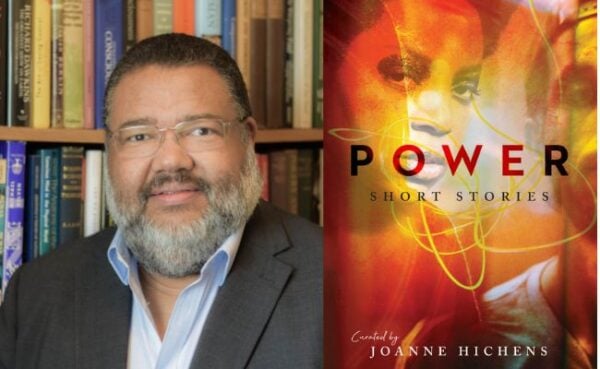
Photo of Athol Williams: provided; picture of anthology’s cover: https://joannehichens.com/anthologies/
Short.Sharp.Stories is a platform showcasing established and emerging South African short story writers. For the 2025 anthology, Power: Short stories that light the dark, writers imagined “power” in fictional terms – how it influences and affects us, including political and personal power and the ever-present loadshedding.
In the first Short.Sharp.Stories interview, Lynn Joffe chats with Athol Williams, author of the short story “The ring around Saturn”. Williams is the winner of this year’s award for Best Story.
The story is described as: "A beautifully crafted narrative that interweaves past and present, fantasy and reality, self and other. With whispers from the canon of Arabian Nights, the story-within-a-story becomes a narrative tapestry, as two outspoken protagonists, father and son, elucidate the power of the planets, of the personal, and the immense power of storytelling itself."
Writer Athol Williams is a poet and applied philosopher at Oxford University, where he focuses on ethics and possibility. He holds seven degrees, including a doctorate from Oxford. He has published seven books of poetry and twice been awarded first prize in the Sol Plaatje EU Poetry Contest. He is the author of the Oaky series of children’s books and three books of nonfiction. He is the founder of the Cape Flats Book Festival and recipient of the Cape Town Mayor’s Medal for Extraordinary Bravery for his anti-corruption activism. “The ring around Saturn” is his third published short story.
In the story, you channel the son’s childhood through the father’s imagination. Did this come from your own reality growing up? How similar to your own childhood is the relationship between father and son?
The drama of a father telling stories to his son mimics my own childhood. My father was well read and had a wild imagination, so regularly told tales to me and my siblings. The difference was that I was not as enthusiastic a listener as the boys in the story. I preferred reading than having stories narrated. Perhaps the story addresses a yearning I have now to hear my father’s tales – he passed away almost 30 years ago.
You mentioned that the inspiration for the story emanated from a poem. Is this part of your creative process? How did you adapt it to the theme of the anthology?
Using narrative poems as springboards for short stories has been a deliberate part of my short story writing process. There are occasions when the poem form seems unable to allow the essence of the story to blossom fully, leading me to transplant the seed of the story from poetic form to richer soil in a short story. It is a form of experimentation that is an important part of my creative process. I am happy to take risks, not for their own sake, but if I think they may produce something beautiful.
I assume the cultural background is authentic to your own experience. It resonates. Do you draw on your childhood for your writing? How do you channel your inner child?
My childhood was filled with fantasy and dreams. I would close my eyes at night and picture other worlds, images that I still reflect on today. My drive to escape the poverty and hardships of the Cape Flats started in my imagination. As early as the age of ten, I would tell my younger brother stories as we went to bed. A popular theme in my stories was the kitchen utensils coming to life.
........
My childhood was filled with fantasy and dreams. I would close my eyes at night and picture other worlds, images that I still reflect on today. My drive to escape the poverty and hardships of the Cape Flats started in my imagination. As early as the age of ten, I would tell my younger brother stories as we went to bed. A popular theme in my stories was the kitchen utensils coming to life.
........
This was before anyone had a TV in the house. In my writing, I regularly draw on specific episodes or even scenes from my childhood. It was a time of wonder and innocence that I enjoy recapturing. I refuse to outgrow this aspect of my childhood.
I love the story-within-the-story you have created. And the way you’ve infused magic realism with the realism of the ordinary lives of poor fishermen. Do you think this is an important aspect of the human or creative condition? It contains aspects of Arabian nights in the children’s delight and the episodic nature of Derra’s story. This comes from a long history of mythical stories. What are your influences?
In 2017, the American literary publication New Orleans Review published a special issue that challenged the stereotype of African literature as reflections on slavery, colonialism and poverty. I was pleased to have a poem included in this publication, and it was the poem at the core of this short story about Fataju. I wanted to contribute to the statement being made that Africans write about fantasy and magic, even though, ironically, I do include a “slaveboy”.
I think the Fataju story portrays a reality that no matter the circumstances under which people live, we all have the ability and often the desire to enter mythical and magical worlds. I think we find escape in these worlds, perhaps escape from misery around us, but I think we also find hope and courage in them. The world often doesn’t make sense to any thinking person, so taking flight to imaginary worlds can offer comfort – here, often the world does make sense. Magic realism can be a form of sense-making of the world around us, a need that seems to be escalating.
I read extensively, so other authors are my greatest influence. I am particularly interested in the mystical writing of William Blake and WB Yeats, and the way writers like HG Wells told stories within stories. As I poet, I allow myself to roam freely in mythical forests. I think this freedom is essential for creative writing. I am enjoying drawing on this practice in my short stories.
Does the myth emanate from your own upbringing or culture, or is it completely imaginary? The winged bull. This archetype is part of your own personal brand. Did you make up this myth? Is it based on anything you already know? What metaphorical myth do you draw on?
I constructed the myth myself from scratch. I see the world as filled with problems that seemingly have no solutions, violent conflict being one of them. And so, in my academic and creative work, I explore possibilities – even wild possibilities – of resolving these problems, such as acts of love that require us to embrace our “tormenter”, especially when we realise that they are often “tormented”, as in the story.
The story captures important elements of my social philosophy. To live together, we need less division, which requires us to find ways of working through or transcending differences, real or imagined. This is the idea of the “act of love” in the story – only acts of love enable us to resolve our divisions. The boy looks into the bull’s eyes “in love”. Looking with love at our “enemy” is how we move from despair to hope, and often this hope is greater than we can imagine – this encapsulates the core message in the story.
Why the winged bull as metaphor?
Personally, the bull has been symbolic for me since my teenage years. It represented my willingness to barge through obstacles in pursuit of my dreams. It represented resilience and strength, which were attributes I deemed to be necessary to survive. In adulthood, I gave the bull wings to represent the idea that I could rise above obstacles, not always needing the struggle, pain and violence of charging through them. Symbolically in my broader philosophy, this bull with wings suggests that we as humanity need both these attributes – sometimes we need to wrestle to move ahead, but other times we simply need to transcend, rise above, that which stands in our way.
How fully resonated are you with Fataju? Speak about how you/Derra came up with the name.
I named the bull with wings “Bohmn” many years ago; this was a name that I heard in a dream. The name “Fataju” comes from the first two letters of the names of the three main characters in the story – FAizel, TAsriet and JUnaid – as a symbol of unity or togetherness of the father and two sons. The idea of together being greater is also found in the merging of the boy and the bull. My social philosophy does not require that we merge, but that we walk hand in hand, maintaining our uniqueness but travelling closer to each other.
........
My social philosophy does not require that we merge, but that we walk hand in hand, maintaining our uniqueness but travelling closer to each other.
........
As per the theme of the anthology, you’ve interpreted this as the power of storytelling. Can you speak more to its relevance in your writing and your life?
I see the power of storytelling in bringing to life wisdom in a form that we otherwise might not want to consume. Very few of us read philosophy texts, mostly because they are dense and really hard to chew, let alone swallow. But weaving philosophical ideas into fun and entertaining stories makes the ideas more accessible and demonstrates their power more tangibly. Academia and business are learning about the power of storytelling as a way to connect knowledge with human understanding and human emotion. This is where the magical potential of storytelling lies. We can tell stories to entertain, but equally to move people. All the great prophets of old told stories and parables to move people. This is the power I see in the pen and in being able to connect with others through story.
Power is available at good bookstores and directly from Tattoo Press: joanne.hichens@gmail.com.
Tattoo Press is an independent small publisher, specialising in contemporary South African short fiction.
Also read:
Short.Sharp.Stories anthology Fluid: interview with KL Bohle, author of "My name is"