

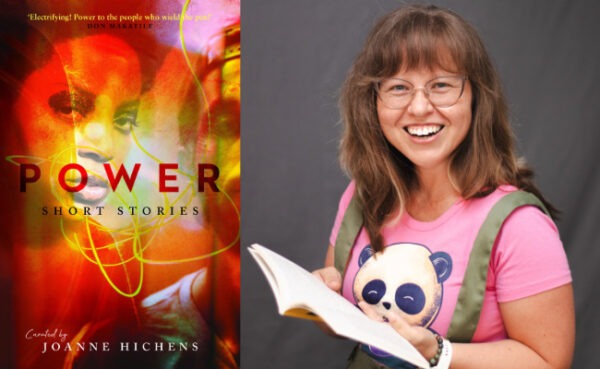
Short.Sharp.Stories is a platform showcasing established and emerging South African short story writers. For the 2025 anthology, Power: Short stories that light the dark, writers imagined “power” in fictional terms – how it influences and affects us, including political and personal power, and the ever-present issues of loadshedding.
In this Short.Sharp.Stories interview, Lynn Joffe chats with Anna Stroud, author of the Highly Commended short story “The power station”.
Anna Stroud is a South African writer and editor based in Johannesburg. She has a degree in journalism and media studies from Rhodes University and a master’s degree in creative writing from the University of Pretoria. She has written for Books LIVE, Business Day, City Press, Grocott’s Mail, The Johannesburg Review of Books and Sunday Times, among others. Her debut novel, Who looks inside (Karavan Press, 2024), is an intricate and compelling exploration of family trauma, small-town secrets and the decisions that seal our destinies. This novel saw her awarded Best Emerging Fiction Author at the NIHSS Awards 2025.
I sense your legacy of copywriting in response to the brief. Did you write this specifically to brief? Had this story been percolating for a while?
I had never thought about Janneman or the Technician, my protagonist, until I read the call for the Short.Sharp.Stories Power edition. I struggle to make time to write, and so answering a call or writing to a brief is a way of giving myself permission.
How does your training in copywriting and commercial writing affect your storytelling smarts? Is it a different approach, or does one feed the other?
I’ve always been a reader and an aspiring writer. I remember rewriting (*cough* plagiarising) fairytales in those red and black hardcover books, adding my own spin to them. In grade three, I entered M-Net’s Write Stuff competition for kids. I wrote a story about a robbery at the local corner café (“Kry die cash!” was one of the iconic lines) and got my first taste of rejection. I wrote bad poetry, bad song lyrics, bad reviews of whatever was on television the night before. In high school, I wrote speeches that won prizes and a nice bit of cash, too. When I studied journalism and later pivoted to copywriting, I learned different ways of writing and different approaches to communicating ideas.
I’ve read many books about different kinds of writing, and it all whirls around in my subconscious and becomes part of this weird soup I draw on when I write. I don’t really think about it when I write fiction. It’s very different from writing copy where you have formulas and KPIs. I don’t want my fiction to follow a formula. I want it to be something new, even if it fails.
I love how you have infused politics and magic realism into this story. It definitely feels Kafkaesque with a dollop of Orwell. Is all your writing like this, or is this a segue into unknown areas? What are your dominant influences? Do you feel that this story is part of the dystopian canon? Other art forms? Movies? Art?
I think everything I read – books, poetry, newspapers, Chappies wrappers, Daily Maverick’s newsletter – sits in my head and comes out in weird and wonderful ways. Some stories and writers stick around indefinitely. I don’t know if it’s dystopian or just the way I see the world. I watch many foreign films, especially Korean movies and television series. I channel a bit of Parasite, a bit of Beef. I love the high stakes of live theatre. I love watching boxing and reading about boxing. The more I read, the more I want to read, and a lot of that is a reflection of the world we live in or what it could turn into if we continue to make the same decisions. America has gone mad, and the world follows along. People get their news on TikTok. We ignore the climate crisis. So, ja. Is it dystopian if it’s the way things are right now?
You seem to have deliberately channelled recent global politics into the story and the rise of the oligarchy/technocrat. How much Musk is in this? How much tRump? Or is this a universal story of power?
Men like Trump and Musk are dangerous, but what’s even scarier is how many people support them and agree with them. I didn’t start out wanting to write about them, but they edged their way into the narrative anyway. Typical. My story started out as a man turning off the lights, and became something very different in the end. I like it. I’m glad I let the characters take over.
The story seems divided into three acts. Is this the way you structured it up front, or did it turn out this way? Describe your writing process.
Sjoe, what writing process? The first draft was only the story of the Engineer – Janneman – and his humdrum existence as the keeper and extinguisher of the light. After writing and rewriting that section more times than I’d like to admit, I still needed over a thousand words to meet the word count. So, I revisited Janneman in the desert where I’d left him to die, and this vulture popped onto the scene and started narrating (no doubt a throwback to Kevin Carter’s famous photograph). I let the vulture do his thing, and then, when he was done, a different type of predator came in to round off the story, hence the third act. But I hadn’t set out to write three acts.
It's funny, because you asked about my copywriting. When I write for a client, I plan it all out, working backwards from the call to action to craft the headlines and supporting copy, making sure it all fits the format (SMSes, WhatsApp messages, mailers and so on). But I don’t plan at all when I write fiction.
My writing process is a bit like throwing a pebble into a pool and following the ripples. I never know how it’s going to turn out. Maybe one day, when I’ve written more books, I’ll have figured it out.
Your story is a fascinating fusion of classic storytelling and mythology. What brought on the vulture anthropomorphism? Did you conceive this as a juxtaposition to the dreadful dystopian fate of the protagonist?
To be honest, my protagonist was tired and dying, so I thought I’d give him a break and let someone else pick up the tale. The nearest living creature was the vulture, so he got the job. I couldn’t exactly plonk down a new person in the middle of the desert. Where would they have come from? When my husband read the story, he pointed out that it reminded him of the talking crows in the Netflix series Beef, so that is probably where I stole borrowed the idea from.
The vulture is neither good nor bad. It is an animal driven by hunger. There’s a moment of tenderness between Janneman and the vulture that is more human and beautiful than any of the interactions between the Technician and his team of developers. But that’s nature for you.
How did you happen upon this kind of story? Why the magic realism when all else is so tactile and vicious. The last act is almost a coda. The anonymity of the final characters – was this deliberate? Is all lost? How universal is this story? How pertinent to today’s politics?
I’m an optimist in the streets and a pessimist in the sheets (of paper!). I believe that everything is going to be okay and that we’re heading towards certain devastation, both at the same time. The anonymity of the final characters signifies the impersonal, cold and callous world run by tech bros. We have our own home-grown tech bro treating America’s governmental institutions as his personal sandbox. It’s this universal callousness and carelessness that’s always around us. While we can still write and read and share stories – real human stories – I like to believe there’s hope. I don’t know if I write magical realism, or if I write what’s in my head and it comes out that way. I grew up in the Klein Karoo, playing make-believe among the fynbos and the trees. Maybe I’m touched. I have to ponder this some more.
How close is the story to your own life experience? Or is it all imagination? What influences do you draw on for your writing? How do you channel your inner child?
This story is all imagination. I dream a lot, and I like to believe that my dreams are a portal to a past life or a future world or something else entirely. Sometimes my dreams have nothing to do with me, but they’re always vivid and they always linger.
My inner child is never far away. I watch a lot of Studio Ghibli movies. I love fairytales and pantomimes. I was part of a community theatre in Roosevelt Park for a while – the Franklin Players – and that was a lovely space in which to play. I was a crocodile in their 2024 pantomime. I make up songs for my dogs. I doodle. I moisturise. I talk shit. My inner child is always on the surface.
What is the main message of your story? Your “big idea” or “core concept”?
I’m wary of having a message or a core concept, because I don’t like reading books that are too didactic or prescriptive. I can’t claim a moral high ground; for that I am too flawed, too contradictory. I suppose something I’ve been thinking about a lot is that empires fall – and how right now feels like the end of something.
Author and storyteller Lynn Joffe has penned and produced an abundance of multicultural campaigns for South Africa’s top brands and edutainment platforms. She holds a BA from Unisa and an MA in creative writing from Wits. She presents interactive storytelling and writing workshops for universities, literary festivals and conferences across South Africa and internationally. Her debut novel, The gospel according to Wanda B Lazarus, was published to acclaim by Modjaji Books in 2020. Her latest brainchild, Solid gold story time, won Podcast of the Year in the South African Podcast Awards and Best Children’s Podcast at the APVA Awards.
Power is available at good bookstores and directly from Tattoo Press: joanne.hichens@gmail.com.
Tattoo Press is an independent small publisher, specialising in contemporary South African short fiction.