

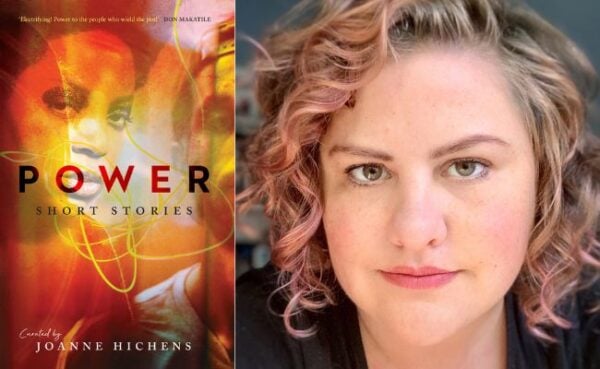
Picture of Kate Thompson Davy: provided
Short.Sharp.Stories is a platform showcasing established and emerging South African short story writers. For the 2025 anthology, Power: Short stories that light the dark, writers imagined “power” in fictional terms - how it influences and affects us, including political and personal power, and the ever-present issues of loadshedding.
In this Short.Sharp.Stories interview, Consuelo Roland chats with Kate Thompson Davy, author of the short story “Still the sun rises”, speculative fiction that captures the power of the sun.
Kate Thompson Davy is a full-time writer and editor. She’s worked in journalism since 2006 and went freelance in 2013. Kate has contributed hundreds of articles to top publications, including Financial Mail, Business Day, Woman and Home, CFO SA, SA Homeowner and the Sunday Times. She also helps companies shape their communications and edits financial analysis. She’s dabbled in all genres – you can still find old episodes of her podcast, It Happened Here, on Spotify – but her first love is reading fiction, and she is now trying her hand at writing it. She hails originally from the Eastern Cape. She has a bachelor’s in journalism from Rhodes University, a master’s degree from the University of the Witwatersrand and a headache from writing in the third person.
Firstly, what draws you to writing short stories? Or, more specifically, for what reason do you love speculative fiction short stories?
.......
Short stories are ideal vessels for big ideas; something about their form really lends itself to boundary pushing.
........
Short stories are ideal vessels for big ideas; something about their form really lends itself to boundary pushing. And, of course, all your stories are short ones when you first become a “consumer” of stories, with children’s books and “fairytales” proffered like bite-sized treats.
So, it felt like a good place to start for me – new to fiction, and trying to find my feet in it. Practically speaking, this call for submissions came at the right time, when I was seeking a project to test my nascent fiction muscles, with the bonus of external structure: a theme, word count and deadline. Those three are a comfort to me, after having worked in journalism for so long.
Plus, I had the world and central characters already half-formed in my head. The thing about speculative fiction is that it’s always about now. It might be set in another world or be futuristic, but it works because those imagined conditions create an environment to explore harsh realities. But that’s the after-effect. In the moment, you’re just plunging in, exploring through a new set of eyes. It’s genuinely magic that we can do that.
........
The thing about speculative fiction is that it’s always about now. It might be set in another world or be futuristic, but it works because those imagined conditions create an environment to explore harsh realities. But that’s the after-effect. In the moment, you’re just plunging in, exploring through a new set of eyes. It’s genuinely magic that we can do that.
........
Employee 3014 is indeed a fascinating protagonist and has some great lines in conversation with her (deceased) partner, Hlub: “Such a simple wish – to see the sun.” The sparse dialogue gives a visceral sense of vulnerable lives endured in a future time. Is writing dialogue something that comes naturally to you?
Does it come naturally? I’m not sure, but I do deeply dislike reading dialogue that is burdened by unwieldy exposition, especially when there’s an assumed intimacy between the speakers. I wouldn’t say to my brother, for example: “Do you know that our older sister, Sandi, is coming to visit South Africa in July?” I’d say something like, “Did Sandi tell you she is coming out in July?”
I want my dialogue to sound natural and fluid and to fit the character. My narrator – Employee 3014 – is worn down and pragmatic. I think she’s going to skip over niceties and perfect syntax. In contrast, Hlub is endlessly whimsical. He delights in pattern and contrast. I confess I often “see” a character better from what they say and how they say it, than from whether their hair is brown or their eyes blue.
The writing is packed with details and yet feels pared down, perfectly conveying the dystopian quality of a future Johannesburg. Tell us something about how you came to place your characters in that landscape and in that situation? Did you experience any challenges in creating this new world?
Place is so evocative in fiction. Through a handful of details – say, a convex mirror or the colour-coded umbrellas in a hall stand – we know that the Commander’s house in Margaret Atwood’s The handmaid’s tale, for example, is a paranoid and hierarchical place. It’s classic “show, don’t tell”, and if it’s done well, you don’t even know you’re getting the full briefing and all the clues. I’m no Atwood, Gibson or the like, but it’s good to have aspirations, right?
For this particular flavour of dystopia, I wanted concrete, corrugated iron and silicon panels – harsh, bright, brutal, the emotional equivalent of overhead fluorescent lighting. Plus, it’s heavily implied that the action takes place after some climate watershed moment that would probably have drowned the coastal cities.
So, I had a clear idea of what I wanted; the challenge was in constructing that, and – eish, the Jozi “stans” are going to hate me for this, but for all its dynamism, this story was always set there for me. I am not the biggest fan of the built environment in Joburg. Blame the brutalist architecture or the fact that I was raised on the Wild Coast, but even a successful and fun decade in Joburg couldn’t make a fan of me.
Maybe, next time, I’ll write a Cape Town that hides its malice in the fuss and fustiness of broekie lace porches and whitewashed gables.
I love that your inspiration for “Still the sun rises” came from a lingering dream about a child (a symbol of hope). Do you see speculative dystopian fiction as having the ability to shift perspectives on an intellectual and/or emotional level, and do you feel that you achieved your aim?
I think it – fiction, and particularly the speculative type – is our best tool for perspective shifts, especially when it has a strong POV or voice. What could be more empathy-sparking than this intimate excursion into someone else’s life? To capture 3014’s despair, I had to take you on a journey with her. I hope that I managed to do that.
Getting back to the more general, do you have a favourite short story or collection you turn to for inspiration? Why does this particular story/collection stand out for you?
I vividly remember the punch and pay-off of reading Shirley Jackson’s The lottery in school. I think we read it out loud in a single class, and then spoke about little else for the rest of the term. It’s one of a handful of “classic” short stories I read way-back-when that arguably shaped my worldview.
More recently, I picked up a copy of Things we lost in the fire by Mariana Enríquez (2016), which is packed with atmospheric and chilling stories. If you want to recreate the feeling of reading ghost stories under the bedcovers with a torch, but as an adult, try this one.
As a writer chosen for inclusion in this latest Short.Sharp.Stories collection, Power, could you share what value you see this competition adding to the South African literary scene, and what tip would you offer to aspiring writers who enter the competition?
Over and above the experience of each story in its own right, an anthology like Power (and the other Short.Sharp.Stories collections) is really like a delicious sampler of local voices and views. One minute I’m under a fountain with a mermaid, the next I’m sneaking across the border to watch Bob Marley. What a pleasure. And my tip would be “write your own story” – not as in autobiography, although that’s always an option, but don’t try to write what you think is required of you. Write the story you want to write. It’s the plethora and spread that’s the delight for me.
You’ve worn many hats as a writer – journalist, media consultant, podcaster, editor and now speculative fiction author. Do you have a preference, and why?
I have loved being a journalist, and later finding my own voice as a columnist and podcaster. It’s one of those jobs that feels dangerously defining. And I wish I could find the time to make podcast episodes again. It’s a wonderfully intimate medium. I do not take for granted that I’ve had two decades of paying my bills through writing and editing. With that said, this new fiction focus is a scary one for me. It is my longest held and most neglected desire to write fiction. I guess I finally accepted that the conditions would never be “right” and my discomfort with this vulnerable process would never lessen, so I’m doing it scared, doing it doubtfully and doing it anyway.
Your language is completely precise. Do you spend hours getting it right – writing and rewriting? (Or do you take dictation from God, like Edna O’Brien self-reportedly did?)
I confess I am a compulsive editor. I cannot read over my own writing without tweaking a word here, a sentence there. It makes me very slow. Thank goodness I type fast. When I was working in Rosebank, I often ran into my late friend Eusebius, and he’d be banging out a column or book over his lunch break, chatting with the waiters and having a grand time. He had such clarity of thought that the writing seemed – to me, on the outside – just to pour from him. I have far more hesitancy, and I really am aiming for precision, as if it’s protection against being misunderstood.
Your story has a certain mood and sense of inevitability from the first to the last line. How do you feel about opening and ending lines generally – which is the more important? And which gave you more trouble while crafting your story?
Opening lines are critical. There’s a fine line between handing over too much upfront and withholding and losing a reader’s interest. But it’s still a cold opener that you can take in any direction. An ending has to be satisfying, and that’s hard. Thankfully, there’s always editing for that.
........
Opening lines are critical. There’s a fine line between handing over too much upfront and withholding and losing a reader’s interest. But it’s still a cold opener that you can take in any direction. An ending has to be satisfying, and that’s hard. Thankfully, there’s always editing for that.
........
When I finally “found” the ending of this story, I went back to the beginning and middle, to plant the seeds I needed to have in place for the ending to work. We were still doing that right into the editing process with you, Consuelo. And I think it got better with each tweak.
“Still the sun rises” is a beautiful read, full of pathos and longing, and yet the humanity of your protagonist’s actions (or lack thereof) leaves a lingering feeling of hope. Thank you. We are looking forward to more of your stories. Would you like to share a little of what we can expect in the future?
Thank you for that kind assessment. I’m writing another short story and a crime novel as we speak, and I have a Google Drive folder full of half-baked and semi-fleshed ideas. I took on a new corporate client and resigned from my columnist positions late last year, and the combo of these moves has given me more – not time, but certainly more predictability of schedule. So, I am dusting off those fiction dreams and am determined to give it a go. I don’t have any deals or representation. I am writing these for myself and an imagined future reader, and that’s okay. The writing is an end in itself.
If I put anything out into the world, I’ll share it on BlueSky (@katetd.bsky.social), Instagram (@katiepossum) or thereabouts.
Consuelo Roland is a writer, editor and writing coach. She holds an MA in creative writing from the University of Cape Town. The new edition of her acclaimed debut, The good cemetery guide, is now available from Karavan Press. With her subsequent novels in the Limbo series, Lady Limbo and Wolf trap, she continues her exploration of human relationships and the power of possibility. Her poetry, essays and short stories appear in various journals and anthologies. She lives with her husband and animal family in Hout Bay, a coastal town on the Cape Peninsula.
Power is available at good bookstores and directly from Tattoo Press: joanne.hichens@gmail.com.
Tattoo Press is an independent small publisher, specialising in contemporary South African short fiction.
Also read:
Short.Sharp.Stories anthology Power: interview with Peter-Adrian Altini, author of "Ndiyindoda!"