

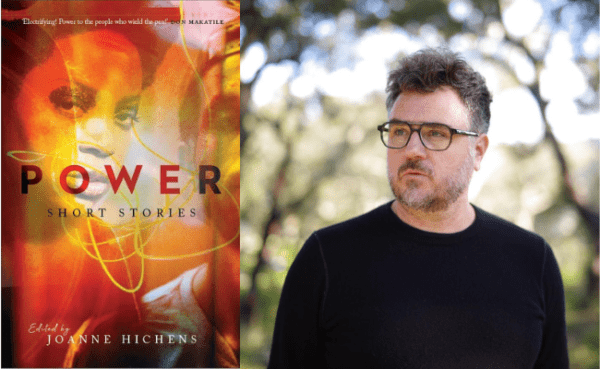
Photo of Peter-Adrian Altini: provided
Short.Sharp.Stories is a platform showcasing established and emerging South African short story writers. For the 2025 anthology, Power: Short stories that light the dark, writers imagined “power” in fictional terms - how it influences and affects us, including political and personal power, and the ever-present issues with loadshedding.
In this Short.Sharp.Stories interview, Lester Walbrugh chats with with Peter-Adrian Altini, author of the short story “Ndiyindoda!”, a coming of age story that focuses on forbidden lust during apartheid.
Peter-Adrian Altini is a South African writer based in Paris. His screenplays have been optioned by production companies in the UK, and his short stories have been published in the Fish anthology (2019), the Iron Horse Literary Review (2021), Storgy Magazine (2021), Fluid: The freedom to be (Short.Sharp.Stories) and ADDA Literary Magazine (2023). He was the winner of the Ernst van Heerden Creative Writing Award and shortlisted for the Commonwealth Short Story Prize. Salt water pool boy, published by Karavan Press, is his debut novel.
Your story makes for uncomfortable reading, as it goes back to apartheid and places the reader in the position of witnessing the unequal power dynamics between your characters, the boy and the gardener, one privileged, the latter oppressed. Why go back to apartheid? And why choose this dynamic?
I didn’t set out to write a story set during apartheid, but I wanted to write about my childhood and explore the dynamic of an adolescent coming to terms with what power is; what it means to have power (or the lack of it), both at school and in a domestic setting; and, in particular, how to view those he has been taught by society to believe are in some way “inferior” to him.
I tend to be drawn to the autobiographical in my work, so perhaps I was trying to exorcise my own demons? I’d always wanted to go back and explore this dynamic through the guise of fiction. I find myself more and more often mulling over what it was like growing up white and privileged in the context of apartheid, and how as children we don’t have the capacity to address what’s wrong about the world around us, even if, on some level, we realise how profoundly unjust it is, or even “innocently” use the status quo to our advantage.
It is in many ways a visceral story about, ultimately, lust. Would you agree? And how does this speak to the theme of power?
That’s a very astute observation. In writing about lust, it must be visceral, and it most certainly speaks to the theme of power, for the objects of our affection (or lust) will always be dictated by the rules of the society around us. Coming of age in the ’80s, I didn’t know even being gay was an option. As puberty hit, I knew only on a deeply instinctive level that this was who I was, that these were the bodies I was attracted to.
......
In writing about lust, it must be visceral, and it most certainly speaks to the theme of power, for the objects of our affection (or lust) will always be dictated by the rules of the society around us.
......
My protagonist allows himself to explore these feelings freely, which is in itself a form of power. He questions what it means to be a man, because he lives in a macho society and goes to an all-boys school, where notions of manliness are pushed to the extreme, but it is only in his own private space, with those he feels least threatened by, that he is able to explore the nature of his lust. He is powerless in one sphere, but powerful in another. It’s convoluted and complicated, but hopefully mirrors real life.
Could you share more about how your characters navigate power dynamics in their different ways?
David is bullied at school, doesn’t have many friends and hides his sexuality from the world (but is attracted to the power it offers him). He is able to lord it over those in the employ of his family, but even here he has to tread carefully, as he is sexually attracted to the gardener, and his domestic knows about his secret and so has power, too. Another theme I wanted to delve into was what it means to be a man, and how David’s choices at the end empower him but belittle those around him.
Vuyo, the young gardener David is attracted to, is certainly not powerless. Within the dynamic of their relationship, Vuyo does not let David have the upper hand. We see this in the dialogue, of course, but also in their casual interaction. Vuyo’s masculinity is made manifest when he returns after having undergone a successful circumcision. For those in his community, there is no question he is a man. This very certainty is what David lacks (and craves), and what he seeks to rectify in the story’s final paragraphs.
Did you approach the concept of power primarily from a personal, political or social perspective? Or perhaps a combination?
The political context of growing up gay in ’80s South Africa cannot be denied. The social context of masculinity in an all-boys Catholic school and the personal privilege that comes with being white and middle-class – these were all aspects of the story that I was interested in exploring.
......
The most interesting power struggles are those that characters experience inside themselves.
......
Ultimately, I think all stories are fundamentally stories of power. Power is at the very heart of drama and conflict. There are those who have it and those who want it. I can’t think of a short story I have written that didn’t explore power in some way. The most interesting power struggles are those that characters experience inside themselves.
What were the challenges you faced while writing this story drawn from your past?
As the story is deeply personal, the biggest challenge was remaining true to its rather dark themes without censoring myself. My protagonist, David, is attracted to Vuyo, a young African man who tends the garden, and the power dynamic between them was something I was interested in exploring on many levels – the privileged schoolboy trying to tentatively navigate his attraction to someone he has been taught is less than him in a society that places straight, white men at the very top of the pyramid.
The intriguing title, “Ndiyindoda!”, references “manhood”. Is this also a reference to “masculinity” more generally?
It’s a Xhosa concept of masculinity which means “I am a man”, or refers to a traditionally circumcised person – the most honoured form of masculinity. So, even within this world, there are notions of power, and a medically circumcised man would be considered weaker and subordinate, and would fall victim to stigma and discrimination. In Western society, being a heterosexual male has always put you on top, and being gay at the bottom, so this was an interesting parallel I wanted to explore.
For the contemporary reader, how does your story speak to the present? Or was your aim to show a snapshot of a particular time?
I’d like to believe I have done both. It’s a snapshot in time, most certainly, but the legacy of apartheid still lingers – if not in the very real sense of enduring economic inequality, then certainly in the mindset: how we might still make judgements about others based on stereotypes or preconceived notions. Race debates are necessary and still happen today. We can make sense of the world only through our own lived experiences or through the stories we read. Writing this story was my attempt to do just that. If it speaks to a contemporary reader and allows them to question or confront something within themselves, then I have succeeded.
My hope, above all, is that this rather particular story transports readers to a time from my childhood that remains very vivid to me, and yet somehow also allows the readers to recognise something of themselves in the characters and setting. I hope it allows them to question the intricacies of power in their own lives.
Where can readers find more of your work, and do you have any upcoming projects you’d like to share about?
I have had a story selected for a previous edition of Short.Sharp.Stories, Fluid: The freedom to be, and my debut novel, Salt water pool boy, has recently been published by Karavan Press. It has taken ten years from first sentence to final proofread, and I’m very excited to share my novel with the world.
Lester Walbrugh’s stories have been published on the online platforms Kalahari Review, Cha: An Asian Literary Journal and Itch Magazine. Entries are also found in the Short.Sharp.Stories anthology Die laughing; Hair: Weaving and unpicking stories of identity from Tattoo Press; Hauntings from Jacana Media; and Short Story Day Africa’s ID and Hotel Africa. A collection of these and new stories, Let it fall where it will, was published by Karavan Press in 2020, and a novel, Elton Baatjies, was published in 2022.
Power is available at good bookstores and directly from Tattoo Press: joanne.hichens@gmail.com.
Tattoo Press is an independent small publisher, specialising in contemporary South African short fiction.
Also read:
Short.Sharp.Stories anthology Power: interview with Mthobisi Myeni, author of "The denizens"