

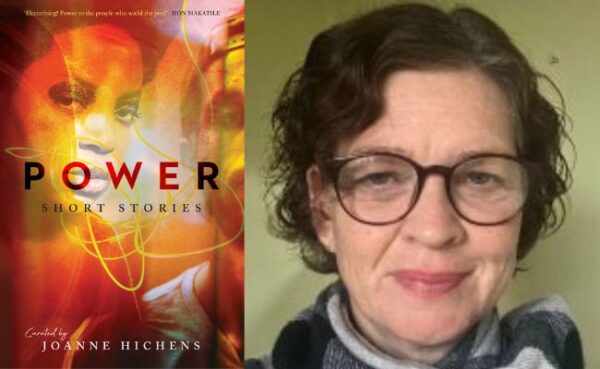
Picture of Tanya Faber: provided
Short.Sharp.Stories is a platform showcasing established and emerging South African short story writers. For the 2025 anthology, POWER: Short Stories that Light the Dark, writers imagined “power” in fictional terms – how it influences and affects us, including political and personal power, and ever-present issues of loadshedding.
In this Short.Sharp.Stories interview Joanne Hichens chats with Tanya Farber, author of the short story “Standing still”.
Tanya Farber is a writer, journalist and communications specialist living in Cape Town with her husband, two daughters, four dogs and many succulents. She grew up in Johannesburg and holds a master’s degree in journalism from Wits. She also holds an honours (achieved cum laude) in applied linguistics, and another honours in history and gender studies. Over more than two decades in journalism she has covered arts and culture, social justice, science and the environment. Trained in narrative non-fiction, she has won three international human rights journalism awards and three national awards. She is the author of two non-fiction books published in South Africa, and three true crime novels published in the United Kingdom. She is currently working on her first fictional novel.
The start of the story is almost mesmeric, with a description of horses in a horse box. It’s an unusual beginning. And brings to mind horses as therapeutic animals. Did this cross your mind?
I did not consciously think of the horses as therapeutic, but perhaps there is something about their quiet strength that foreshadows a theme that is explored in the story. I also wanted to start with the horses because they could be symbolic of so many other elements too, that the mystery surrounding them sets up the tension from the beginning.
With reference to the title, can you speak about the predicament of “standing still” of which the horses are a part?
“Standing still” was first inspired by an image that existed in real life: a vehicle broken down on the side of the M3 in Cape Town with a horse box attached to it. As I drove past, I noticed the horses peeking out at the traffic passing by and I couldn’t help wondering what the story was. Another real-life event from a decade ago then came to mind and they merged to form the story. But “Standing still” also explores the relationship of our young democracy with the notion of power because in some ways we have moved forward, and in many ways we certainly have not.
We’ve spoken in the past about how life as a journalist “brings” you stories, in a sense. Can you share more about the other real-life event that influenced your story?
........
Many years ago I wrote a story about a young woman living near Strand who had been raped because she was a lesbian. Her attacker had told her he was “doing her a favour”.
........
Many years ago I wrote a story about a young woman living near Strand who had been raped because she was a lesbian. Her attacker had told her he was “doing her a favour”. Around the same time I tracked down and interviewed a rapist – not her rapist but another one who had carried out the same crime – and he told me that the police made it clear they were on his side. I wrote a two-part series based on these two interviews, and have been haunted by it ever since.
Your story speaks particularly to this crime of homophobic rape. Although the story underscores understandable anger towards perpetrators of such crimes, as one of the characters has suffered such a rape, how does the story also make space for healing?
Such stories raise the question of what freedom truly is in a democratic South Africa, and the ways in which prejudice and hatred corrupt power and the instruments of the state that are meant to work in the public’s favour. And yet, if we give up on those instruments and say there is no recourse because we don’t trust the system, then we have truly sacrificed our beautiful and sophisticated Constitution on the altar of passivity. This story poses the question: At what stage do we make our institutions accountable for taking on the responsibility to ensure justice?
........
This story poses the question: At what stage do we make our institutions accountable for taking on the responsibility to ensure justice?
........
How did you navigate the dynamics between your protagonists, Christellie and Phumla, as they, too, are “standing still” at the side of the road?
For me Christellie and Phumla, as they grapple with their issues through conversation, are the fictional and heartfelt creation of this reality in the country. Their relationship and different life experiences represent the range of histories in South Africa that are shaped by race, class, language, sexual preference and so many other aspects of demography. But at the same time, while we acknowledge how different forms of privilege shape one’s daily experiences, one can never truly “place” any South African and make assumptions about what sort of experiences, and violence in particular, they have or haven’t experienced. Christellie and Phumla, and the way they love but wrangle which each other and their own spirits, are representative of that.
Could one assert that Christellie and Phumla are somehow representative of our young democracy?
Inadvertently, Phumla and Christellie are symbolic of post-apartheid democracy. They are different races and are both women, but are free to love each other. They have also overcome some of the barriers of structural and interpersonal racism. However, the state apparatus has not caught up and fulfilled its mandate. They do not feel they have recourse.
On a symbolic level they are exactly like the young democracy itself: brave and full of hope and promise, but addled by past wounds and prejudices.
Looking particularly at the power between the women, and the power they hold, but also what has rendered each of them powerless, can you say more about how power plays out in your story?
This is what I love about short stories, in fact. They are able to plant a seed of one theme and then watch it bloom in a hundred ways. Within the scope of my story, there is the power (and powerlessness) of the connection between the two women – at some moments unshakeable and at others tenuous.
........
This is what I love about short stories, in fact. They are able to plant a seed of one theme and then watch it bloom in a hundred ways. Within the scope of my story, there is the power (and powerlessness) of the connection between the two women – at some moments unshakeable and at others tenuous.
........
There is also the power of the horses – innate and visceral and all there below the skin but curtailed by the box in which they’re standing. Then there is the power of the perpetrators and the psychological scars they leave on their victims or survivors, and ultimately there is the power or powerlessness of the “system” which is meant to mete out justice but sometimes only gives out false hope, until people reclaim their power and take agency over the situation.
This is one of the truly “light in the dark” stories. And I was left, after reading it, with a sense of hope. Extending beyond the story, are you personally hopeful for South Africa and its institutions?
I am hopeful, and not because I have reason to be. I am hopeful because when we accept that things will not change and that transformation is a dream, we play into the hands of the apartheid ghosts from yesterday and the corrupt souls of today.
Getting to process, this is also your first published short story. Congratulations! How has it been different for you from writing creative non-fiction? Are there similarities?
When I was a reporter at The Star in the early 2000s the author of King Leopold’s ghost, Adam Hochschild, visited from the USA and a few of us were selected to attend writing workshops. It changed my life. He taught us how to write about real life while using literary devices in a powerful but non-flowery way. Now, as I venture into fiction, I deeply feel how this has empowered me as I build each scene. What I did not anticipate was that making up a story could feel more challenging than doing meticulous research to write about what has already happened.
Could you be more specific about how this foray into the imagination has challenged you?
In a strange twist of fate, it’s almost impossible to describe what it's like to write fiction. It is at once biological, spiritual, practical, creative and mechanical. But always, always, it is magical. A human brain conjures up a scene, a person, a dialogue, a setting ... and then conveys that on the page using this code system called the alphabet. Another person reads it and imagines the story. It is the most wonderful thing. It gives me deep satisfaction to know that I am creating something out of nothing and that another person can then enjoy his or her own imagining of it.
That said, and with reference to my earlier answer, it is indeed challenging, because it originates in nothing other than the mind. My process always begins with a single moment and I build it from there. I admire writers who have their story plotted out beforehand, but for me it happens as it happens. That said, I do lie awake in bed quite a bit thinking about it when I should be sleeping.
And finally, what next for you, as a newly inducted writer of fiction?
I am over a third of the way through my first full-length work of fiction and I am hoping to have my first draft completed by the end of the year. I have wanted to be a novelist since I was about six or seven years old, and now, in my early fifties, I have walked through the delicious mud of journalism and narrative non-fiction, but now, finally, I am giving my seven-year-old what she dreamed of.
Joanne Hichens, author, editor and publisher, is based in Cape Town. She believes in the multiplicity of South African writing talent and has edited numerous anthologies of short stories showcasing the diversity of the South African voice. She is best known for curating the Short.Sharp.Stories series, including the anthologies Bloody satisfied, Incredible journey, Adults only and Fluid: the freedom to be, winner of the Institute for Humanities and Social Sciences Award (NIHSS) for best edited collection (2024). She has written crime fiction, YA, and most recently the acclaimed Death and the after parties (2020).
POWER is available at good book stores, or directly from Tattoo Press: joanne.hichens@gmail.com.
Tattoo Press is an independent small publisher specialising in contemporary South African short fiction.
Also read:
Short.Sharp.Stories anthology, Power: interview with Tiisetso Lekopa, author of "Canvas"
Resensie: Blood on her hands: South Africa’s most notorious female killers deur Tanya Farber