

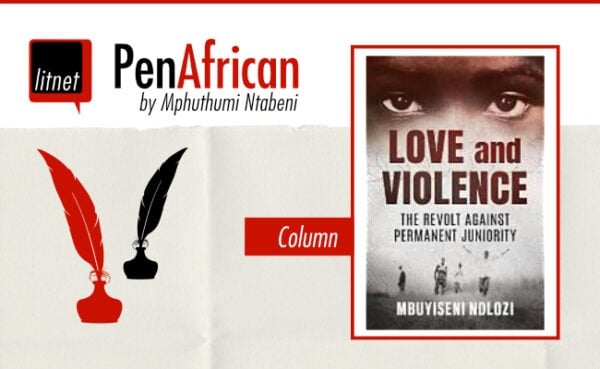
Love and violence
Mbuyiseni Ndlozi
Jonathan Ball
SKU 9780624096603
- Mphuthumi Ntabeni writes regular book columns for LitNet.
........
Mbuyiseni Ndlozi’s Love and violence: The revolt against permanent juniority is an ambitious work of memoir, theology, psychoanalysis and decolonial theory. Its central insight is that intimate life bears the marks of collective history, and fatherhood offers a way of understanding how power reproduces itself across generations.
..........
Mbuyiseni Ndlozi’s Love and violence: The revolt against permanent juniority is an ambitious work of memoir, theology, psychoanalysis and decolonial theory. Its central insight is that intimate life bears the marks of collective history, and fatherhood offers a way of understanding how power reproduces itself across generations. Through the concept of “permanent juniority”, Ndlozi extends an inquiry into our political sphere, examining how colonialism denied black people the authority to determine their own maturity, identity and future. The philosophical reflections from lived experience and historical detail are convincing. But sometimes the expansive theoretical claims outpace the evidence and flatten the distinctions between different forms of domination: colonisation, apartheid, patriarchy and class.
Chapter one: “The absent father”
In “The absent father”, Ndlozi uses paternal absence as a personal wound through which he explores black subjectivity, colonial authority and the inheritance of historical violence. His image of a body walking forward with its head facing backwards gives physical expression to the persistence of the past in the present. Likewise, his confession that “God was the only father I knew” opens a compelling reflection on personal deprivation, desire and authority. The declaration that his father “did not die; in fact, he was never there” captures the particular grief of mourning the loss of a relationship that never existed. This is a recognisable experience in many black South African communities, where paternal absence has been shaped by migration, economic hardship, apartheid and personal estrangement. The turn towards a divine father becomes understandable as an attempt to find elsewhere the authority and belonging denied in earthly relationships.
The chapter’s most promising conceptual move is contrasting the absent personal father with the overbearing colonial father. Where the former leaves a space of longing, the latter claims the authority to discipline and govern people it refuses to recognise as autonomous adults. Ndlozi calls the concept that captures the permanent political infantilisation of the oppressed “permanent juniorisation”.
Ndlozi moves from personal experience to collective diagnosis. Drawing on Achille Mbembe, he examines colonialism’s representation as the source of law and order while depicting black people as inherently delinquent. As a critique of colonial ideology, this works but requires greater historical precision. African societies possessed diverse systems of law, governance and dispute resolution before colonial rule. Colonialism often displaced or appropriated these institutions, while presenting its interventions as the imposition of order upon supposed lawlessness. Distinguishing colonial representations of Africa from historical African realities is essential to avoiding the reproduction of the assumptions under critique.
The movement from “my father” to “the black youth” raises a further question of representation. Connecting private wounds to collective history is necessary, but the collective pronoun “we” can conceal differences in experience and circumstance. Paternal absence is not reducible to a single historical explanation, even when its social conditions are inseparable from South Africa’s colonial and apartheid past. Ndlozi’s experience is sometimes unjustly universalised in an attempt to illuminate a wider condition. The autobiographical narrative loses momentum, which interrupts the emotional immediacy, when, for instance, it is extended into engagements with Lacan, Žižek and Walter Benjamin. A more effective entry point might have been the scene in which Ndlozi interviews his father, allowing the reader to encounter the human relationship before approaching its philosophical implications.
The relationship between the archive’s “dead letters” and the dead letter of the law likewise requires clarification. Be that as it may, the chapter’s enduring strength is in its recognition that intimate grief can illuminate the structures of domination without being reducible to them. Then, the moving question is in how a person who inherits personal and colonial wounds, while struggling to become his own person, is able to live authentically.
Chapter two: “Black youth and ‘permanent juniority’”
Chapter two extends the first chapter’s concern with authority and self-determination from fatherhood to racial and generational politics. The absent father raised questions about who has the authority to shape a child’s identity. The “permanent juniority” describes a colonial order that denies black people the right to determine their own political maturity. Ndlozi now explains black youth as being beyond a mere demographic category and becoming a political subject. This helps explain their activism – from the ANC Youth League to Black Consciousness – which culminated in the Soweto Uprising. These were challenges not only against racial domination, but also against the authority of elders and institutions that presumed the right to decide when the youth were ready for political agency.
The chapter traces the genealogy of the colonial infantilisation of black people by European thinkers such as Kant and Hume, and South African political figures such as Jan Smuts. Ndlozi demonstrates how racial domination depended, beyond the material coercion, on assumptions and perceptions of black incapacity, immaturity and dependence. His discussion of black women, especially the formulation of woman as the “possession of a possession”, adds an important gendered dimension to this hierarchy by describing the black subject as child, beast, object, consumer and living dead. Ndlozi’s historical continuity between segregation and apartheid often obscures their distinct forms of political logic. The discussion of women raises the related question of gender politics as part of black subordination through the denial of adulthood. Ageism remains the defining category, while gender introduces its own forms of possession and control. Patriarchal politics also infantises women. Though the book makes it clear that patriarchy is the denial of women’s agency and uses the paternal metaphor to illuminate a way to approach colonial authority, it doesn’t bring enough narrative force to the argument.
The point of hijacked political agency is made succinctly in how black youth inherited political adulthood through successive struggles, which asserted their capacity to determine their own political futures – from Soweto, Nyanga and Mdantsane to the #FeesMustFall movement. Youth politics has repeatedly exposed the injustice of a system that claims the authority to decide whether black people are mature enough to govern themselves. Contemporary youth movements elsewhere, including those in Belgrade and Paris, invite comparison, although their historical circumstances should not be treated as interchangeable. The question carried forward is whether “permanent juniority” can explain these different experiences without becoming an all-encompassing description of black subordination.
Chapter three: “Race, gender and the ‘living dead’”
Chapter three attempts to give the condition of permanent juniority a more developed philosophical explanation. Drawing on Fanon’s distinction between the zones of being and nonbeing, Marx’s account of money and Mbembe’s necropolitics, Ndlozi argues that colonialism establishes a racial order in which whiteness becomes the measure of value while black people are reduced to commodities, reserves and, ultimately, the “living dead”. Black men acquire only a derivative patriarchal authority, exercised over black women and youth in ways that reproduce rather than overturn the original relations of domination.
Apartheid schooling, for instance, did not simply segregate black students; it sought to produce compliant subjects by instilling an inferiority complex in them. Against this project, Biko’s Black Consciousness offered a form of counter-subject formation, rejecting the internalisation of whiteness and reclaiming black identity as a basis for political agency. Ndlozi’s broader discussion of township masculinity, gangs, prisons, militarisation and women’s participation in the liberation struggle extends this analysis into the social practices through which power is reproduced.
The difficulty lies in his tendency to make the imitation of sovereign power explain widely differing forms of violence, from gang rape and prison hierarchies to political militancy. When violence is interpreted primarily as the reproduction of colonial structures, individual responsibility and the experiences of victims recede from view. The discussion of the “girl comrades” exposes an unresolved contradiction. If appropriating the master’s masculine authority reproduces juniorisation, under what conditions can resistance employing similar forms of aggression constitute liberation? This question remains unanswered by the chapter.
The central insight is that emancipation requires more than reversing the positions of master and subordinate. It demands a transformation of the relations through which people are assigned value and denied subjecthood. Yet Ndlozi’s dense vocabulary of currencies, reserves, objects and markets obscures the mechanisms he seeks to explain. His materialist Marxist account leaves unclear how ideological transformation, such as that proposed by Black Consciousness, can challenge structures that appear to determine subjectivity in advance. Nevertheless, the chapter advances the book’s argument from paternal and colonial authority to the racialised and gendered structures governing agency. The question of whether the “living dead” can become subjects is now explicitly political, preparing the ground for the historical examinations of schooling, liberation movements and township life that follow.
Chapter four: “Against the pedagogy of offence”
Chapter four moves from the theory of permanent juniority to its institutional expression in Bantu Education. Focusing on Nkgopoleng Secondary School in Zamdela, Sasolburg, Ndlozi examines the paradox through which an educational system designed to reproduce racial subordination became an incubator of black political consciousness. The state sought to manufacture obedient labourers, yet the very capacities fostered by schooling – literacy, argument and critical reflection – enabled students to question the conditions of their existence. The contradiction recalls the history of missionary education, whose graduates sometimes turned the intellectual resources of their schooling against the imperial order it was intended to serve.
This chapter is especially persuasive when grounded in the everyday realities of student activism – where students challenged school fees, corporal punishment, teachers’ misconduct and their exclusion from decisions affecting their lives, including the language of instruction. Through study groups, debating societies and student representative councils, they established alternative centres of authority. The rivalry between AZASM – associated with Black Consciousness – and COSAS, aligned with the ANC and the United Democratic Front, demonstrates that black youth politics was neither uniform nor uncontested. Its ideological divisions reflected competing visions of South Africa’s political future.
I like how Ndlozi resists romanticising liberation politics. His account of the violent rivalry between the organisations, culminating in the so-called seven-day war in Zamdela in 1991, exposes the capacity of political movements to reproduce the brutal domination they oppose. Particularly troubling is his discussion of female students being treated as territorial possessions, with male activists using coercion, abduction and sexual relationships to assert organisational power. This showcases that the struggle against apartheid did not automatically abolish patriarchal authority; political commitment could coexist with the abuse of those ostensibly being liberated. This willingness to confront the contradictions within youth activism gives the chapter historical and moral seriousness. Nkgopoleng was beyond merely an instrument of disciplinary power, but was a contested institution in which students developed their own political practices and challenged the authority of the state, teachers and rival organisations.
This chapter is among the book’s most historically grounded sections, demonstrating that resistance to permanent juniority was not simply a demand for the recognition of being politically mature, but a practical assertion of agency – the right to organise, learn, dissent and determine the conditions of one’s life. Bantu Education sought to make black youth objects of governance; through their resistance, students insisted on becoming subjects of their own history. The emancipation was neither automatic nor morally uncomplicated, as the violence within the student organisations makes painfully clear.
Chapter five: “Township violence and self-hatred”
Chapter five opens with the disturbing image of Ismael Bojosi’s body, exhumed after an Inkatha funeral in Evaton in June 1993, after being burned and tied to a cemetery fence. Ndlozi uses this desecration to explore Fanon’s argument that colonial violence can be redirected towards other colonised people, postponing confrontation with the oppressor. Moving between the history of Cape banditry, Vaal gang politics, Boipatong and the apartheid state’s covert operations, he examines how violence generated under domination can become violence among the dominated.
The historical discussion of the Cape’s Drosters and the bandit Estienne Barbier is particularly productive. The distinction between social and antisocial banditry presupposes a shared moral order against which criminal conduct can be judged. Enslaved people, denied recognition as moral and political subjects, do not fit comfortably into either category, though. Archival evidence of branding and mutilation exposes colonial law as an instrument of force as much as justice. So, the comparison between eighteenth century Cape society and the Vaal in 1993 rests largely on analogy rather than strict historical evidence. Barbier’s own violence against the Khoikhoi also complicates any suggestion that violence directed against the colonised is peculiar to the oppressed, or that its reproduction can be justified simply by the history of oppression.
Bojosi’s particular circumstances further complicate the philosophical interpretation. Ndlozi suggests that Bojosi was probably not a gang member himself, but that he became entangled in political violence through his marriage into the Khethisi family and his residence in a KwaMadala hostel occupied by Inkatha supporters. His exhumation was an act of reprisal following Boipatong. This specific history does not necessarily contradict an interpretation of the desecrated body as an expression of colonial self-hatred, but the relationship between the historical explanation and the philosophical claim remains insufficiently established.
Ndlozi’s account of the apartheid state’s “Third Force”, including its support for Inkatha and the covert operations of the National Security Management System, provides an important corrective to the reductive language of “black-on-black violence”. It raises, however, a question the chapter does not fully resolve: To what extent did the state merely exploit existing antagonisms, and to what extent did it actively manufacture and sustain them?
The interviews with members of the BZ gang in Zamdela offer a more grounded account of the transition from political activism to robbery, territorial conflict and deadly rivalry with COSAS. Status, material resources, masculine identity and respect emerge as powerful motives, although the language of necropolitics does not always deepen these explanations. The interviews also privilege former male gang members and activists, leaving the experiences of women, elderly residents and other victims largely unheard. Ndlozi’s suggestion that women sometimes accept or defend sexual violence is particularly problematic without testimony from the women concerned.
A further tension runs through the chapter when Ndlozi presents the township as a place in which anyone might become a criminal, while distinguishing the tsotsi as one who makes a conscious decision to carry criminality to its conclusion. This emphasis on individual choice sits uneasily beside an account of colonial domination that repeatedly portrays the colonised as objects of power. The challenge is to explain how structural violence shapes individual action without absolving perpetrators or reducing their agency to the conditions that formed them.
The chapter’s closing reflections on theology, the money form and self-hatred are compelling as philosophical meditations. Chapter five asks one of the book’s most difficult questions in what happens when the violence of domination becomes violence among the dominated. It becomes limited when analogy substitutes for historical demonstration, and when perpetrators’ voices displace those of their victims. These problems become especially important in chapter six, where Ndlozi turns to the underground liberation movement in search of an alternative to self-destruction.
Chapter six: The work of love
Chapter six turns from hatred to love, seeking within the underground liberation movement a response to the self-destruction examined in the preceding chapter. Reading Fanon through Maldonado-Torres, Ndlozi argues that decolonisation must overcome the permanent war imposed by colonialism. The colonised do not simply seek recognition from a world that has rendered them invisible; they must recover the capacity to give in love. The revolutionary must therefore be “armed with love”. Through the story of VALIMO, an underground ANC-aligned network of youth units in the Vaal in the early 1990s, Ndlozi asks whether armed resistance can become an expression of solidarity rather than another form of criminal violence.
The chapter is at its most vivid when it recounts the police raid on the Maguma family home, and the rules governing a robbery at the Heilbron police station. Ndlozi’s treatment of the fighters’ occult world is particularly valuable. Rituals, prohibitions, funerals and cleansing ceremonies were practices through which young activists negotiated fear, danger and responsibility. Whether these beliefs sometimes diverted attention from the political enemy or helped fighters endure clandestine struggle remains an open question. Comparison with the Marikana massacre might yield valuable results here.
An important ethical moment comes in returning to the abducted woman discussed in chapter four. Ndlozi confronts the assumption, shared by political comrades and gangsters, that a woman’s refusal is merely a temporal obstacle to overcome with manliness. His willingness to consider women’s complicated choices exposes the persistence of patriarchal authority within liberation politics. But Ndlozi, too, fails to impose the necessary responsibility on men. An ethic of love cannot rest on the hope that perpetrators will transform themselves; it must also address accountability and the protection of victims.
This problem reaches the heart of Ndlozi’s attempt to distinguish the comrade from the criminal. According to Ndlozi, the criminal acts to sustain himself, while the comrade gives himself for the community. But VALIMO’s activities included armed robbery, intimidation and violence, while its fighters valued fearlessness, loyalty and defiance in terms not unlike those invoked by gangs. Political rituals and collective commitment do not, in themselves, establish the moral distinction Ndlozi seeks.
Ultimately, Love and violence asks whether a society formed by the violence of domination can imagine a freedom that goes beyond the reproduction of that violence and the formation of new wounds. The answer lies in the difficult task of becoming human without denying the humanity of others.
Conclusion
In his final note, Ndlozi brings his argument about black humanity, colonial domination and the possibility of freedom to its philosophical conclusion, by insisting that colonialism’s deepest violence goes beyond dispossession or political subjugation to deny black people their humanity, which is the foundation of freedom. The task, therefore, is not to recover some lost civilisation as proof of humanity, but to recognise that black humanity has always been present, even where colonial knowledge has refused to see it. The transition beyond apartheid, despite its subsequent mutations, was a miracle, an interruption that exposed the limitations of Western conceptions of human nature and opened the possibility of imagining a genuinely human world. Ndlozi understands his book as an act of historical fidelity, of keeping hope alive by returning to the past and giving voice to what has survived its violence. In this spirit, he closes by invoking Tiyo Soga, whose words provide the book with its most powerful concluding affirmation. Soga’s vision of the African, enduring through the rise and fall of empires, displacement, enslavement and the contempt of those who have claimed to represent civilisation, refuses the idea of black extinction. His insistence that the African continues to multiply and remain unconquered becomes more than a declaration of historical survival; it is an affirmation of individuality, dignity and an irreducible humanity that no empire can extinguish. The final “Selah!” invites us to pause and consider the enduring force of that inheritance.
Also read:
On Donica Merhazion’s Born at the end of the world: a gift from the grave of history