

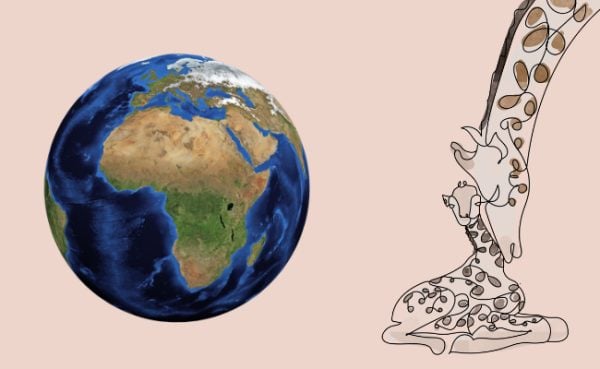
Image by Arek Socha and Bianca Van Dijk from Pixabay
...
To put things into perspective, Africa’s economy is about $2,83 trillion; Italy, which is ranked number eight in the world, has an economy of $2,74 trillion.
...
Now that the year is coming to an end, it is important that we look at one of the most topical issues of the past 12 months: Abahambe – let them go (back to their own countries). From the outset, let it be clear that in South Africa, there are also illegal immigrants from other continents besides the rest of Africa, but for the purposes of this article, I will focus exclusively on the rest of the African continent, because, for better or worse, I am an African.
In all this noise about Abahambe, the bigger picture has, maybe deliberately, been completely ignored. Let us look at the depressing facts. Africa has a population of about 1,58 billion people, which represents approximately 19,1% of the world’s population. And yet, Africa's contribution to the global economy is just below 3%. To put things into perspective, Africa’s economy is about $2,83 trillion; Italy, which is ranked number eight in the world, has an economy of $2,74 trillion. It gets even worse if you compare Africa’s total economy with that of a country like Germany, which is projected to finish 2026 with a $5,45 trillion economy. Simply put, Germany’s economy is almost twice that of the entire African continent.
It is this very conversation that we as Africans avoid having among ourselves: How can we contribute 19% to the global population, but when it comes to the economy, where it matters most, we are just a drop in the ocean? Fact number one: Africa as a continent is extremely weak economically.
It gets worse. According to the World Bank, Africa has 22 of the 26 low-income economies (very poorest countries) in the world. If you consider that there are 55 countries (including Western Sahara) in Africa, it means that 40% of Africa’s member states are the very poorest in the world. Fact number two: Africa is the poorest continent on earth.
It does not get any better. Out of all the African countries, there is not even a single African country that is a military powerhouse (in global terms) or a superpower. There is not even a single African country which has nuclear power (which, seemingly, makes you respected globally). As was the case during the Cold War, it is still happening today: African governments must be protected by some superpower in either the East or the West, but never from a country within the continent because we are all just a bunch of weak countries. A case in point occurred a few months ago, when there was an attempted coup in Mali; it was the Russians who went to the aid of the Malian government (which, ironically, gained power through a coup in 2021). The Malian government could have never relied on another African country in its hour of need. Fact number three: Africa, in global terms, is extremely weak militarily.
...
Fact number four: Africa has one fundamental problem – leadership (or lack thereof).
...
Fact number four: Africa has one fundamental problem – leadership (or lack thereof). As a continent, we currently hold the record, through Paul Barthélemy Biya (93) of Cameroon, of having the world’s oldest president. As if showing off, Africa actually occupies five spots of the top 10 oldest presidents in the world. That illustrious list includes Malawi’s Peter Mutharika (85), Togo’s Jean-Lucien Savi de Tove (87), Ivory Coast’s Alassane Ouattara (84) as well as Teodoro Obiang Nguema Mbasogo (83) of Equatorial Guinea (EG).
To be fair, Togo’s president is just a figurehead. The man who possesses real power is Faure Gnassingbé, the son of Eyadéma Gnassingbé. Gnassingbé Senior was the president for 38 years (from 1967 until his death in 2005), and his son immediately succeeded him for a 10-year stint; he is now the president of the relatively newly created council of ministers, while 87-year-old Tove is officially the president of the country.
...
As if that were not enough, the top four longest serving presidents in the world are from – yippie – Africa.
...
As if that were not enough, the top four longest serving presidents in the world are from – yippie – Africa: EG’s Nguema Mbasogo has been in power since August 1979 (47 years). That, in itself, is the current world record. Paul Biya, the world’s oldest president, has been at it since 1982 (44 years). Not to be outdone, Denis Sassou Nguesso of the Republic of Congo has been at the helm for more than 40 years, and Uganda’s Yoweri Museveni has just started his 40th year on the throne. And let’s not forget Isaias Afwerki of Eritrea, who has been in power since 1993 (33 years).
Exactly 10 years ago, EG’s President Nguema promoted his first son, Teodorin Nguema Obiang, to be the country's vice-president, and the young man is still at it. Five years ago, Congo’s President Nguesso appointed his son, Denis Christel Sassou Nguesso, as the minister of international cooperation and promotion of public-private partnerships. Not to be outdone, two years ago, Uganda’s President Museveni appointed his son, Muhoozi Kainerugaba, as chief of defence forces, the highest rank in the military.
Given these uncomfortable facts about a flimsy economy, weak military and frail dictators who spend most of their time in health facilities in Europe, it is quite easy and very convenient to simply scream, “South Africans are xenophobic.” The loud silence from the “Pan-Africanists” when Zimbabwe’s governing party, ZANU–PF, literally collapsed the country’s economy still echoes today. The Pan-Africanists, again, were nowhere to be found when, a few months ago, the ZANU–PF extended President Emmerson Mnangagwa’s term, which was due to end in 2028, by another two years. This constitutional amendment means he will now finish in 2030, aged 88. As if that is not enough, a decision was also taken that, from this year, Mnangagwa’s birthday, the 15th of September, will be a public holiday.
What do we, as a continent, have to show for all the gold, copper, oil, diamonds and coltan – to mention but five strategic minerals – that we have in abundance? Does anyone want to start a dialogue about how, for example, the Democratic Republic of Congo has totally and dismally failed to change the lives of the Congolese? Must we still, in this day and age, be holding conferences in order to, er, talk about the importance of beneficiation (ie, adding value to the minerals before exporting them)? While the world is moving in leaps and bounds in high-tech innovation, the question that most of us should – in fact, must – be asking is: Where is Africa’s Silicon Valley? Does anyone want to talk about how Nigeria’s government has failed to deal effectively and efficiently with insurgency in the northern part of the country?
...
What makes our African brothers and sisters leave their loved ones in their own countries, only to end up, at least for some, being economically exploited by (some) South Africans?
...
We must never conveniently forget to talk about the push factors: What makes our African brothers and sisters leave their loved ones in their own countries, only to end up, at least for some, being economically exploited by (some) South Africans? Why is it normalised that the ministers and former presidents from the Southern African Development Community (SADC) region fly down to South Africa whenever they need serious medical attention? Why can’t they develop their own world-class health systems? I must hasten to add that a vast majority of South Africans do not even have access to most of these fully functioning hospitals, because less than 16% of South Africans have medical aid.
The united states of Africa, which some among us keep talking about, is a non-starter. We need individual member states to develop themselves optimally before we can start seriously considering full integration. Logic and common sense dictate that you cannot have a strong continent made up of weak member states. It is simply impossible.
South Africa, lest we forget, has its own fair share of problems: We have one of the most unequal societies in the world; 81% of grade fours read without meaning; over 60% of youth aged 15–34 are unemployed; only 27% of our soldiers are fit enough to be deployed; and, as if that were not enough, we have – and have had – presidents who will use every trick in the legal book not to account for their actions – to mention but a few of our challenges.
Until we, as Africans, solve the leadership problem at a national level, we will never turn the tide. It is indeed a long-term project that must be driven by grassroots patriots who are willing to put in the work. It needs a well-resourced, multipronged strategy. It is not easy. In fact, it is very hard and can be extremely dangerous. That explains why we opt for an easier route: Go to South Africa (by hook or by crook) and, once there, call South Africans “xenophobic”.
...
Africa, thanks to the lack of leadership, continues to be a continent full of potential...
...
Africa, thanks to the lack of leadership, continues to be a continent full of potential, and for all these decades it has remained exactly that – a continent with loads of untapped potential. And some African countries – thanks to the visionless, selfish and greedy leadership – are a burden to South Africa. Until we solve – at a continental level – Mama Africa’s fundamental problem, which is leadership (in fact, the lack thereof), all the other stuff is just theatrical drama filled with philosophical mumbo jumbo, which solves – in the medium to long term – absolutely nothing.
*
Sihle Khumalo has explored more than 20 African countries and has written award-winning and bestselling books based on his Rest of Africa (RoA) expeditions. He recently published a collection of short stories in Zulu, titled Siyobonana emathuneni (We will meet at the cemetery).
See also:
(Illegal) immigrants, migration and immigration: What is next?
Conversations beyond the comfort zone | Etienne van Heerden Veldsoirée 2023