

And still, on the summit of that hill he paused. He remembered the people he had seen in that city, whose eyes held no love for him. And he thought of their feet so swift and brutal, and the dark grey clothes they wore, and how when they passed they did not see him, or, if they saw him, they smirked. And how their lights, unceasing, crashed on and off above him, and how he was a stranger there. Then he remembered his father and his mother, and all the arms stretched out to hold him back, to save him from this city where, they said, his soul would find perdition.
– Go tell it on the mountain, James Baldwin
Last night I dreamt/ of our simultaneous death/ last night I cried/ out of happiness, how strange it made me feel.
– “Anoche”, Arca
*
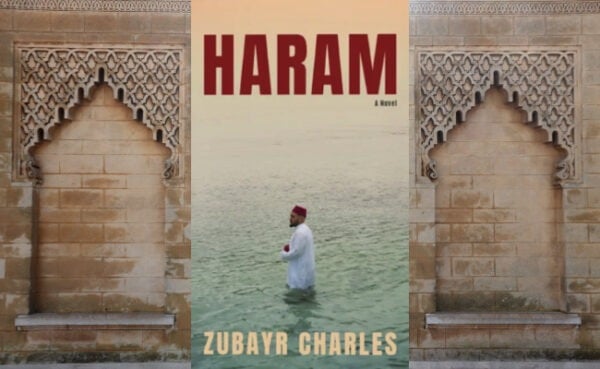
Haram is a vulnerable tale. It wants you to see the story of Muhammad Gilbert, a young man longing for nothing but acceptance, even if the odds are against him. It wants the reader to know of the confusion and vitriol experienced by the dissimilar. Zubayr Charles writes the work with a seriousness and humour which ask the reader to have an open mind, and which want us to think about the rules and hypocrisy of acceptance in communities. While there are some moments which could make the work more capacious and enterprising as a novel, this story is real, raw and honest, and I cannot ignore how important and relevant the story is. I read Haram psycho-sociologically as a call for religious reform, and I explored moments in the project where the religious and secular world clash with Muhammad’s desire for love, belonging, paradise and freedom.
We meet Muhammad as he enters the masjid on the day of his nikkah. There is a sense of hesitancy, fear and excitement that Muhammad offers us. From this prologue, we are met with a sense of anxiety; the body is under siege: “Right foot first – I’ve always whispered that to myself before entering any mosque. As I enter the mosque, the tall wooden doors greet me with peace, but there were many times I didn’t feel welcome here” (5). We are drawn to see that Muhammad is very aware of how he is supposed to behave, even saying that “before (he) can greet (his wedding guests) and thank them for being witnesses, (he) must complete (his) wudhu and salaah” (5). Even in the tenderness of devotion and ritual, there is a frantic body holding a very cruel history. Muhammad notes that this is an action that he is determined to see through, even if he doubts it (7). As nervous as he is, trying to find steadiness in himself, he sees someone who makes his heart pound – a feeling of fight, flight or freeze – as memories of the past four years come rushing in. Throughout the rest of the work, these memories piece together the timeline of Muhammad’s journey with faith, queerness, mental health and acceptance.
For Muhammad to tell us this story is a radical act, as in most Abrahamic faiths homosexuality is still an endangering topic. This also brings me to the title of the work: Haram. I don’t think Charles uses the title of the work to promote sensationalism, but rather as a way to question how some words prevent us from being charitable and warm to one another. It’s asking us how we use religion and belief as a way to keep others out, rather than to invite others in. To offer refuge to one another.
As a storyteller, Muhammad does his best to tell his story truthfully. He tries to place himself as a son, friend, lover and believer; yet, he has a shortage in the language of authentic acceptance. As a 17- or 18-year-old male in Cape Town, he’s struggling not only with his faith and burgeoning desires, but also, moreover, with finding places to explore these in earnest and to become himself. During a khutbah where Sheikh Khaled delivers damnation rhetoric against the queer body, Muhammad feels “(i)nvisible fingers” smothering him and “sharp nails scratching (him)” (101). He feels singled out in the congregation, and starts to question his safety in the religion that has given him structure and a sense of protection. It is in this moment that he realises that if the mosque condemns him, the world might accept him instead (105). As he turns from his faith, he finds consolation in the world of clubbing and partying.
Muhammad has been taught that the lifestyle of clubgoers is forbidden. While curious, he knows that entering a club or bar would be an act that renders him sinful. One evening, Muhammad goes out clubbing and drinking with Raziyah, a friend who reached out after Muhammad was outed through a school tabloid, and says after the experience that it “was a start to a new life” (171). Muhammad feels “invincible” (169) and starts to feel a sense of escape and freedom. He becomes dependent on alcohol and the feeling of recklessness. Raziyah and other characters in the project are sightless in seeing the behaviour as Muhammad’s way of coping and disengaging from his struggles. Muhammad is unable to find solace in either the club or the mosque, and is seemingly left alone to struggle with his anxieties. I read this as Charles writing the value of both religious and secular spaces, and highlighting the importance of a good and caring community, asking all to be considerate in the making of home.
Haram is not just about the tension of authenticity, but, moreover, about the limits of sin and redemption. Charles writes about the way in which shame silences and stifles the other. I mentioned earlier that Muhammad’s body is under siege; his anxiety and incaution take over, and after being betrayed he is moved to suicidal ideation. He finds little rest in religion or the secular world. Muhammad decides that the pain of his existence is too burdensome, and he is beyond repair and heartbroken. Muhammad prepares himself for suicide and the ghusl mayyit, a ritual of purifying and honouring a deceased body before burial. Realising that there might be no one who would cleanse his body after his impious death, he decides to perform the ghusl mayyit by himself, professing, “I (deserve) a proper burial, just as Allah prescribed” (199). As Muhammad shares what his final thoughts are, the reader is given solemn and daunting thoughts and scenes of a body trying to release a pain indescribable.
This is a reality for many queer and divergent people who feel suppressed in religious communities. The desire for something transcendent and renewing is often complicated by turmoil, and what compounds it, is when an individual cannot be found worthy by this transcendent power or its exemplars. Charles writes about the cornering and feelings of isolation that many go through because they are not allowed to waiver in their faith, knowing that shame and rejection are waiting like a dead-end. I read this moment in the text, the blending of the sacrilegious and virtuous, as Muhammad’s expression of desperation. His spirit wants rest and release from all of the confusion and pressure he feels; he tries to re-establish a connection with the divine, in spite of his irreligious habits – an act of retribution, apology and restoration. He seeks grace – as blood and water mix, he realises he wants to live again; he wants to bear witness to something radical (201).
I turn to chapter 26, the final chapter before we return to the present day. Through Muhammad’s journey, we see a struggle with sexuality, mental health and religion. It is a troublesome journey that a perplexed but resilient and determined man endures. At this point in the work, after being apostate, Muhammad returns to his local mosque and seeks counsel from Sheikh Khaled. In a tender moment, the sheikh reminds Muhammad that “Allah will always be with (him)” (259). This reminder gives our narrator a sense of stillness – an ambiguous moment of both surveillance and comfort. Before the epilogue, Muhammad “star(es) at the morning light from the window that illuminate(s) the mat that create(s) a pathway in the direction of the qiblah”; it is a moment where hope and grace appear once more, reminding him of the guiding force (259). In this moment of the text, I think faith is not free from irregularity; it is not simple.
My final thought on Haram is that it is an important story. I know of many people who have done the work of reconciling faith and sexuality. Unfortunately, these are stories met with reticence and militant dogma. While I think the work could take much more pleasure in the pop culture references and the metaphoric richness of the religious text, I note the effortlessness of Muhammad’s voice. It reaches out to the reader, asking for something simple, stripped down, easy. Haram does its best work by way of representation and the starting of conversation. I think the conclusion of the work might be found to be counterintuitive, perhaps; however, Charles allows this to point out the lived reality of many bodies under siege by values, religion and communities that they didn’t choose, but also the values, religion and communities that haven’t chosen them. Charles wants us to think about how we should heal one another instead.
We must allow religion to become poetry again.
See also:
Zubayr Charles se Haram is ’n waarskuwing aan almal, gelowig of nie: ’n lesersindruk