

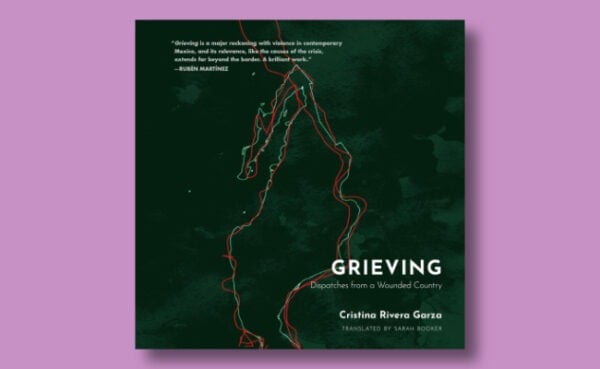
Cristina Rivera Garza’s Grieving: Dispatches from a wounded country
South Africa has been waking up to the name of a dead woman every few weeks. A student, a jogger, a mother, a girl on her way home who never reaches it. We learned Uyinene Mrwetyana’s name in 2019 because she walked into a Cape Town post office to pick up her parcel and never walked out. The candles guttered for a while before the hashtags cooled. Tsontso Moselakgomo, a 38-year-old runner from Kempton Park murdered in September on her routine afternoon run, reignited them. Similar killings have reached pandemic proportions. We have awoken, almost daily, with news of 12 women – so far – killed within the vicinity of the Ekurhuleni municipality, including the following:
- Busisiwe Mahlangu (37)
- Itumeleng Kekana (32)
- Nomfesane Mjobo
- Gracious Nkomo (28)
- Dineo Evelyn Motepane (38)
- Jabulile Ntimba (30)
- Ntombifuthi Nxumalao
- Boitumelo Gift Mashita (23)
This latest wave of gender-based violence has sent me back to a book I read a few years ago: Cristina Rivera Garza’s Grieving: Dispatches from a wounded country, translated by Sarah Booker. I haven’t been able to put it down since. Though its subject is Mexico, its question travels far beyond those borders.
What is a writer for, when a country has learned to live among corpses? Rivera Garza’s answer is that writing must not just be about describing the status quo of suffering. It must become a way of grieving with others, so that the dead, the disappearing and the violated stay in the room with us to help assist us in building the kind of society we want.
The book has an unusual origin. A young man named Saúl Hernández walked into her classroom and asked for a book about the state of the country, from the point of view of a historian, a writer, a mother, a daughter and a sister. She gathered essays, chronicles, poems and testimonies, and arranged them in three movements: “The sufferers”, “What countries are these, Agripina?” and “Writing as we grieve, grieving as we write”. It resulted in this collection of political essays, written in an elegiac form of literary criticism as a manifesto for nonfiction writing ethics. Reading the book, the South African reader will think of Antjie Krog’s Country of my skull, another book that understood that a wound this size cannot be healed in one genre.
Rivera Garza’s most original idea is the part titled “Visceraless state”. She builds it from an unlikely document. In 1939, a young tuberculosis patient wrote to the governor of Baja California, describing her lungs, her teeth, her chronic cough and the ribs the doctors meant to remove. She even begged that her body not be autopsied or burned after death. There’s a startling confidence and courageous facing of death in her letters. She believes her organs are the state’s business. Rivera Garza sets this beside a photograph from the last day of 2010 – a woman’s body hanging from a bridge in Monterrey. Between the two lie the visionless failures of the neoliberal political hegemony of modern politics, and a president – Vicente Fox – who answered a question about state responsibility amid such violence with a shrug: Why should I care?
I thought of this when I listened to the last “family address” by President Cyril Ramaphosa. Not that our president doesn’t care – he obviously does, but he is just out of his depth, lost in the collective forest of visionless political leadership. I couldn’t help contrasting it with the fresh approach of the British prime minister; whether you agreed with his solidarity politics or not, you could not help admiring the depth of true vision and fresh ideas coming from his mouth when he addressed the Labour Party Conference last week.
Rivera Garza’s claim is that the modern state hasn’t merely failed its citizens, but withdrawn the organs of care – the heart, bones and innards of the relationship. And the eviscerated body in the street is what that indifference looks like. As she puts it, “State is a verb, not a noun.”
Read from South Africa, this is uncomfortably familiar. We are a country whose Constitution promises bodily security and the right to health, whose protection orders go unserved and whose rape cases die in the gap between the police station and court. The apartheid state was brutally, obscenely attentive to black bodies; the democratic state wrote a magnificent promise of care, and has then too often looked away. I think of the miners shot at Marikana in 2012; and I think of every woman who has stood in a queue to report a man who has threatened her, who has been sent home and found dead later. Rivera Garza gave me a name for that distance between promise and presence.
Drawing on Adriana Cavarero, Rivera Garza separates horror from suffering. Horror, as she describes it, is the Medusa’s head: It turns the witness to stone. We stare, mute with paralysis, unable to act. Violence wants exactly this. Suffering is different, because suffering has a voice. Those who suffer have faced horror and come back, and the language of pain is how they break the spell.
That is why she distrusts writing that merely reproduces the spectacle. South African literature has argued with this temptation for decades. Njabulo Ndebele’s call for the “rediscovery of the ordinary” was a plea against the spectacular, and every newsroom that leads with a photograph of a body should hear it again.
Rivera Garza’s demand is that we write differently after catastrophe, that fragments find their connections, and that the form itself carries an ethic. Her reading of María Luisa Puga’s Diary of pain makes the point clearly. Chronic illness turns pain into a character, an unwelcome intimate with whom the writer has to negotiate; and a diary breaks into pieces because beginning-middle-end cannot hold it. We must write inside the wound, not outside it. And we cannot be inside if we keep othering each other. We need to live the condition of each other deeply through deeper genuine solidarity.
For all its theory, the book carries a private blow. On 16 July 1990, the author’s sister Liliana, a 20-year-old architecture student, was murdered. The police quickly named a suspect, an ex-boyfriend who had stalked and threatened her, and in the book’s own account he has never been brought to justice. Rivera Garza is plain about what writing means after that. She did not turn to language to escape the pain. She turned to it, she says, because it is the only secular way she knows to keep her sister alive.
From there comes the sentence that holds the whole book: It is impossible to grieve in the first-person singular. Mourning is relational. We grieve for someone and with someone, and the circle widens from witness to family to community to nation. She refuses the silly Western habit of treating grief as a private, as just an interior, condition. Anyone raised with the umuntu ngumuntu ngabantu philosophy will immediately recognise the argument at once. A person is a person through other persons, and so is a loss.
Judith Butler’s question about which lives count as “grievable” haunts the book. And it should haunt us, too. South Africa has always sorted its dead into those whose names the newspapers print and those who are reduced to a number. There are still organisations who regard a death of one farmer as more significant than thousands of young black lives in the townships.
The essays on femicide are the most urgent for us now. Rivera Garza follows the killing of women in Ciudad Juárez, and the mothers who searched for their daughters when the authorities would not. She follows the young feminists who answered with glitter bombs, hashtags and mass marches, and she records, as 2019 statistics put it, ten women murdered every day in Mexico. Alongside the archive of violence, she keeps a second archive, that of the refusal to be silent. Anyone who joined the Mexican 2018 #TotalShutdown marches or stood in the #AmINext protests in 2019 will recognise it. The women declined being only victims and insisted on being witnesses, organisers and authors of their own survival.
In “On 2 501 migrants”, Rivera Garza walks among the clay figures that Alejandro Santiago made in Oaxaca, and compares them with the terracotta soldiers of Xi’an, with one decisive difference. These figures are not an emperor’s army. They are the departed, each with a face, a story and a wound. This essay is about the people left behind, and the melancholy of villages hollowed by absence.
I couldn’t read it without thinking of our townships, the streets of Ekurhuleni or even the Eastern Cape rural areas, for that matter, where a century of migrant labour emptied homesteads of their men and left the countryside waiting. And I thought of what we do to the people who come here – the foreign nationals who were burned in 2008, Ernesto Nhamuave among them, and the campaigns of marches and vigilante “checks” that keep targeting people for their accents and their papers. Perhaps it is easier to throw my lot in with the migrants, for I, too, like the biblical Israelites, have been a stranger in strange lands. Rivera Garza’s insistence on embodiment of political policy is the proposed corrective. The migrant is a body that travels, can be broken and must be remembered, too – never as a mere statistic or an economic unit, but as human.
What makes the book especially useful to a writer of historical fiction is the author’s refusal to separate present violence from the long past. In “War and imagination”, she moves between today’s cartel war, the Revolution of 1910 and colonial conquest. She cites Andrés Molina Enríquez’s argument that Mexico’s great problem was never the ballot box, but land, and that inequality left unresolved keeps feeding a cycle of violence. South Africans do not need that translated. We voted in 1994 and are still arguing about the land and the wealth beneath the vote.
She then turns to Nellie Campobello’s Cartucho, where a little girl sees the dead of the Revolution as her toys, and asks whether a child in today’s Juárez might grow up the same way. How does a society become accustomed to corpses and fear as an everyday technology? Pumla Dineo Gqola asks the same question of our own country in Rape: A South African nightmare and Female fear factory. And Rivera Garza’s reply about imagination as another form of resistance is the one I keep returning to as a writer, because anyone who can see the city differently can see that its order is not natural, and therefore not inevitable.
The final movement, “Touching is a verb”, treats the pandemic as an emergency brake pulled on a runaway train, and as a giant X-ray of everything the book has already shown. The most affecting passage is short. Rivera Garza, living in Houston, sends her 76-year-old mother home to Mexico, because on a tourist visa she has no health insurance and would be turned away from any hospital. In the United States, her mother shares the “eviscerated destiny” of countless uninsured people. In Mexico, ironically, her pension and public hospitals will keep her safe. The supposedly universal human body turns out to be protected according to passport, income and geography.
South Africans lived the same lesson in our own idiom during the lockdown – who had running water to wash their hands, who had a hospital bed, who could stay home and who had to go out to earn bread? How do you do social distancing in the sardine-packed shanty towns? Who could afford the privilege of private transport?
The book ends with a short piece, “Keep writing”, which is really a litany of becauses. Because we become social in language. Because the secret mechanism of writing is imagination. Because it is through a book that we speak with our dead, and all the dead are our dead. It is the culmination of everything before it. Writing is what remains when horror has tried to take language away.
By the last page, I understood that Rivera Garza is grieving more than a sister. She is grieving a country and the collapse of civic responsibility, and she is grieving beside everyone still alive. The opposite of horror, she tells us, is not happiness but relationship. South Africa is also a wounded country, and our writers are being asked again to do what she does: to stand beside the grieving, to refuse disappearance and to keep writing as a way of allowing the dead to speak to the living.
During the Open Book Festival last month, someone asked what my recent book, Multitudes, is all about. I answered: “It is about the dead speaking to the living.” By the way, she looked at me with something approaching irritated incredulity; I think she thought I was being frivolous or giving lazy answers. I was being dead serious. It is also about writing as I grieve and grieving as I write.