

Like a good beverage, a good book holds promise from the first sip. This extract is used with the permission of NB Publishers.
About the author

Raymond Ledwaba is a Chartered Accountant and the CEO of ITTHYNK Smart Solutions, ITTHYNK Gaming and Diski Nine9. He lives in Johannesburg.
About the book
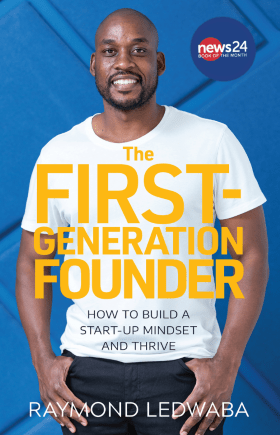
The first-generation founder by Raymond Ledwaba (Tafelberg, 2025)
Title: The first-generation founder: How to build a start-up mindset and thrive
Author: Raymond Ledwaba
Publisher: Tafelberg (2025)
ISBN: 9780624094104
Epub ISBN: 9780624094111
First Sip – Extract:
Does your background determine your destiny?
I cruised through Grade 8 to Grade 11 with very average grades after being in the top of the class at primary school. So it was that my father sat me down for a chat in 2002 and explained that there was no money for university and that if I wanted to get somewhere in life, I’d need to quickly pull up my socks and apply for a bursary.
I knew that my father had saved up for our education but family drama wiped all that out, especially after my mother’s stroke. The message was clear: “Bursary or you are going to sit in the township – it’s either that or the streets.”
So that’s what I did: I pulled up my socks, going from a below average student to above average as my grades steadily improved.
Eventually, I scored three As, two Bs and one C in matric and managed to land a bursary to study accounting with Metropolitan Life after they attended a career open day at school. My first year of university in 2004 was the year before Rand Afrikaans University became the University of Johannesburg, but remained a very conservative white space. While I enjoyed my years living commune style in Afslaan men’s residence, I am still shocked when I think back to that environment. University usually teaches dedication and perseverance, but those years were on another level as a black person in a changing white space.
Don’t get me wrong: My time at RAU was amazing, especially the first year. Freedom is a wonderful drug when you’re 18, out of the house and have a small stipend to enjoy as part of your bursary.
My entertainment budget certainly did go a long way when it was only R5 a beer at the student centre and I prioritised a good time over many other things – including my studies. Another distinct memory from that first year was gulping down industrial quantities of Bioplus the night before an exam in order to pull an all-nighter and somehow make it through with a pass.
As second year rolled around, though, I was faced with a rude awakening. Looking around, I realised I was one of the few of the partying crowd I had fallen in with to have survived. That was all I needed to remind myself that I would find myself back in the hood if I didn’t take my studies more seriously and risk my scholarship.
So, from second year through to the end of my fourth, having taken that look over the edge and not liking what I saw, I put my head down and made it work. Back to the books I went and came out with my honours in accounting at the end of 2007, managing to transfer my bursary to PricewaterhouseCoopers (PwC) for my final year. Not that I didn’t like Metropolitan, but they wanted me down in Cape Town and I had no interest in leaving Johannesburg.
My mother’s condition was precarious and my father was soon to retire, so I was needed at home – to repay the good faith and support my family had shown me over the years.
It was around that time that my father decided to retire after reaching the age of 65 and Transnet – the successor to Spoornet – put him out to pasture. My brother Jeff and I took one look at my father’s pension plan and were immediately depressed. Our father had dedicated his entire professional life to one place and came out with what really looked like pocket change after 40 years! This is when the seed of entrepreneurship was first planted. Jeff and I came to the conclusion that that would not happen to us. While we may end up working for companies along the way, our future would be in business.
In the meantime, though, I had to get my academic qualification certified with articles, so off I went to PwC in Sunninghill for a couple of years. Staying at home in Soweto and making the treacherous trek every single day to Sunninghill and to client sites all around Gauteng made me hate the commute. Those two hours in traffic each morning were horrific and I regularly arrived at the office angry and tired. This was exacerbated by having to compete in a work environment with peers who didn’t face the same challenges, like a horrendous journey into work every day, operating in a language that is not your own or navigating Black Tax.
My thoughts on that last chestnut is something I unpack in full later, but suffice to say my years completing my articles allowed me to take a long, hard look at what a corporate career of struggling painstakingly up the ladder of success looked like. I didn’t like what I saw and decided early on that this wasn’t for me in the long run, but it would take me another 10 years to work up the courage and conviction to take the plunge and branch out on my own.
I’ll be the first to admit that those years did have their benefits and cherished moments. Articles are a slog but I was rewarded in 2010 with a secondment to Chicago and Cincinnati. A year later I found myself as a capital markets assistant manager on Victoria Island in Lagos, Nigeria, doing conversions from International Financial Reporting Standards (IFRS) to Nigerian Generally Accepted Accounting Practice (GAAP) for companies listed on the Nigerian Stock Exchange.
I returned to South Africa in 2012 to assume the title of Innovation Manager at PwC, a position in many ways created just for me. Unfortunately, it was one of those positions with a big title, little actual authority and shifting deliverables that sound good on paper but are torture in practice. So in 2013 I shifted to Absa Capital as a change analyst for Africa Product Control in South Africa, Kenya, Nigeria, Ghana and Tanzania. I was eventually promoted to vice president. In spite of the grandiose title (the bank had many vice presidents), the fat salary and numerous perks that came with it, I finally left that job in 2017 to join my brother and pursue entrepreneurship full time.
There had been side hustles along the way with Jeff and others, but 2017 was the year in which I went all in and took the plunge with my brother and joined him in building a software development and consulting business called ITTHYNK Smart Solutions. When I joined ITTHYNK, I had come to a point at which I realised I had to stop romanticising the idea of starting and running a business and actually just do it.
Since then we’ve enjoyed bucketloads of success and secured over R100 million in revenue, building a team of 40 developers, consultants and project managers in an award-winning software-development and IT consulting company. Six years later I co-founded ITTHYNK Gaming to pioneer the development of African video games for a much broader audience on the African continent. Just three years down the line, we are not only developing original gaming intellectual property (IP) but have also managed a game development incubator for Wits University. It feels weird to talk about those things as achievements because I am still in it, living an entrepreneurial life that is often messy, unglamourous and tough as nails. But I suppose I wouldn’t have been where I am today if I hadn’t taken that first step in 2017 to become the master of my own destiny.
Also read:
First sip: The truth about Cape slavery by Patric Tariq Mellet
First sip: One pot cookbook for South Africans by Louisa Holst