

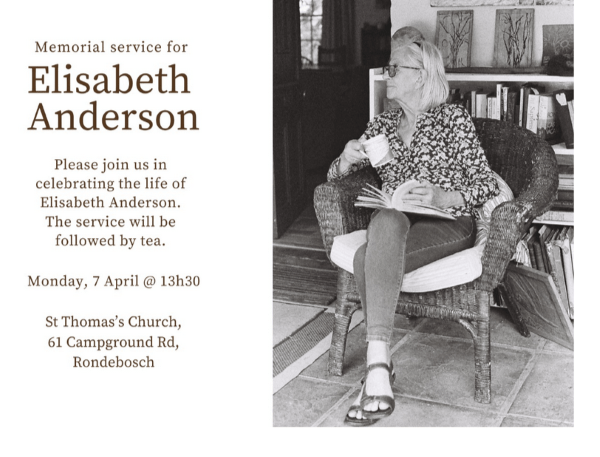
Elisabeth Anderson
2 July 1942 – 27 March 2025
When I learned of Elisabeth Anderson’s passing, I reflected on how profoundly she had shaped not only my career, but the entire landscape of books and reading in South Africa. When I moved to Cape Town in 2000, she became far more than my boss at the Centre for the Book – she was my mentor, champion and friend. Her kindness extended far beyond the workplace: she made a patchwork cot blanket for my daughter, invited my husband and me to house-sit when we first arrived in Cape Town, and welcomed us to spend a week at Kasouga while I was pregnant. When my daughter Kate turned one, Elisabeth encouraged us to celebrate with a staff tea at work. These personal gestures spoke volumes about the warmth and generosity that characterised everything she did.
From 1998 to 2007, Elisabeth served as head of the Centre for the Book, a specialist unit of the National Library. Working alongside the Book Development Foundation, a nonprofit organisation that funded many projects, she transformed the landscape of books and reading in South Africa. This tribute focuses only on her ten Centre for the Book years.

The staff at the Centre for the Book in 2006, Elizabeth at the heart (photo: provided)
Her contagious sense of humour, boundless energy, passion, chutzpah and generosity left an indelible mark on everyone who worked with her. Even through challenging times in her final years at the Centre for the Book, these qualities never dimmed. She did amazing work; indeed, I think that the existence and success of Book Dash is a testament to Elisabeth’s vision. With the First Words in Print project, she pioneered the idea of every child under the age of five owning 100 books. The project won the prestigious international IBBY-Asahi Award at the 2004 IBBY Congress held in Cape Town.
Elisabeth’s leadership style was marked by trust and encouragement. In my first year of working there, she supported me as I curated a one-day exhibition of different kinds of publishing, featuring artists’ books (Peter Clarke), literary magazines, self-published books (many from Monica Cromhout) and books published by small presses (like Deep South and Snail Press). The exhibition highlighted the vibrant creative production happening outside mainstream publishing channels, a tribute to Elisabeth’s commitment to diverse voices and alternative publishing models. As Vanessa Davidson said: “She was brimming with ideas; ideas that challenged the status quo. She burned with a brightness and a vision for books and reading. She took people on her journey, she employed people to help her make her vision a reality and she genuinely cared for every staff member at the Centre for the Book.”
Together with Hannes van Zyl, the CEO of NB Publishers who sourced funding for the Community Publishing Project, Elisabeth encouraged me to take the reins and get it off the ground. In 2007, the project won an Arts & Culture Trust Development Award for its “fine work with writers and grassroots publishing”.
Her open and supportive approach gave me the courage to launch Modjaji Books. Through my time with Elisabeth, I gained invaluable insights into publishing, bookselling and book development, while building relationships that would shape my future in publishing. I also remember and acknowledge how she mentored other colleagues at the Centre for the Book, namely Lorato Trok, Noni Mashologu, Mark Espin and Vanessa Davidson. All of us moved on to work that became a continuation of Elisabeth’s legacy.
........
Elisabeth’s enduring legacy encompasses her commitment to promoting local literature, lobbying for adequate library provision and funding for staffing and buying books, promoting books for babies and children, support of mother tongue education for children, activism for books in local languages, and supporting new writers. Her work at the Centre for the Book laid the groundwork for many initiatives that continue to enrich our literary landscape today.
........
Elisabeth’s enduring legacy encompasses her commitment to promoting local literature, lobbying for adequate library provision and funding for staffing and buying books, promoting books for babies and children, support of mother tongue education for children, activism for books in local languages, and supporting new writers. Her work at the Centre for the Book laid the groundwork for many initiatives that continue to enrich our literary landscape today.
At a two-day symposium on children’s literature in March 2021, Elisabeth’s fearless zeal and characteristic wit were on full display. As reported by News24, while addressing the dire state of library funding, she pointed out that the Johannesburg Metro Council had allocated nothing for book purchases in recent years. “If there was government will, you could not only ring-fence these budgets, you could increase them,” she declared. “One fighter plane would do us very nicely, thank you.”
She advocated a comprehensive national book policy that would involve all government ministries – not just education and arts and culture, but trade and industry, health and social welfare as well. Elisabeth was particularly passionate about challenging the narrow view of children’s books: “There’s still an extraordinary lack of understanding about books and reading. Many people in authority think of children’s books only in the context of education, as textbooks and learning support material. That’s absolute junk. People must learn to read for pleasure.”
What stands out most in my memories is her ability to bring people together. The Centre for the Book buzzed with activity: writers’ festivals, illustrator training workshops, lunchtime writing sessions, conferences, award ceremonies, storytelling and World Book Day and other celebrations. While the staff handled the logistics, Elisabeth loved to create ways for people to connect. Whether at these events, casual meetings or the wonderful lunches she arranged, she had a gift for creating connections and fostering collaboration. Her office door was always open to anyone with an idea or with a problem to solve, or anyone in need of a morale boost.
When Anne Schlebusch heard of Elisabeth’s passing, she said:
Robin Malan always gave Elisabeth credit for inspiring the Siyagruva series published by New Africa Books. She referred to Yizo yizo, which was a popular TV series at the time (early 2000s), and said that teens needed books like that to help them grow as readers. I think her phrasing was books with “sin, sex and soccer”. As the writers of the series, we didn’t use quite those themes/constructs, but certainly she set the bold tone and concept going and there are now over 30 titles in that vibey series. And what a powerhouse she was at the Centre for the Book.
Elisabeth’s retirement in 2007 marked the end of an era at the Centre for the Book. As its driving force departed, the halls grew quieter, the energy dimmed. In early 2008, I too moved on, founding Modjaji Books – a dream made possible through her mentorship.
Thank you, Elisabeth, for showing us what passionate dedication to books and reading could achieve. Your legacy lives on in the countless lives you touched, the initiatives you championed and the reading culture you helped build in South Africa.