


Book cover: The comrade’s wife by Barbara Boswell (Jacana Media, 2024)
- Cliffordene Norton writes a regular book column for LitNet.
Title: The comrade’s wife
Author: Barbara Boswell
Publisher: Jacana Media (2024)
ISBN: 9781431434442
Claire is less cynical. “Fall in love, if you must. But do your research. And meet his people early on. They’ll give you a sense of who he is.” Solid advice. And ultimately, this is how I found myself on a flight to Bloemfontein one Friday afternoon.
An instant classic, the lies and betrayals of love and party politics are told in gorgeous prose with an ear for our time’s intimate and public language. The comrade’s wife follows a turbulent marriage between a rising politician and an academic, told through her life and lens.
During my first year at university, a residence sister told a group of us: “Never trust a man who calls you only by a nickname, eg, ‘baby’ or ‘love’ – especially if he never says your name.”
I didn’t realise how often I would return to that line while reading Barbara Boswell’s The comrade’s wife. The novel crept under my skin and stayed there, warm and unsettling, like a truth I’d known but never dared name.
This novel is brilliant. Difficult. Intimate. It’s the kind of book that forces you to put it down just to breathe, because the emotional weight is honest. Too honest, sometimes.
Roses, rings, silence
We meet Anita one year into her marriage to Neill, a celebrated activist-turned-politician. Their relationship is already cracking. The story unfolds through a reflective, first-person narrative that loops through time like memory. It starts and ends with the same paragraph – a literary device that gives the novel a kind of circular heartbreak. When we return to the beginning, we understand everything differently.
.......
It starts and ends with the same paragraph – a literary device that gives the novel a kind of circular heartbreak. When we return to the beginning, we understand everything differently.
.......
From early on, the red flags are there. Anita meets Neil’s children a week before their wedding – and accepts it without protest. Every argument ends with her apologising first. She tells us she’s “training” him to be better. But the reader sees it clearly: he is training her. To tolerate his silences. To carry the blame. To bend and bend and never break – or at least not visibly.
Boswell masterfully shows how emotional manipulation doesn’t always wear a name tag. It arrives disguised as devotion. First silence, then flowers. The next silence, a ring. The third, a luxury car. Peace becomes transactional. Affection becomes reward-based. Love becomes a negotiation you never agreed to.
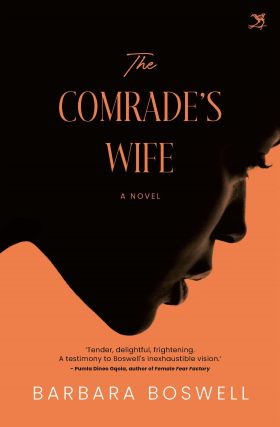
The comrade’s wife by Barbara Boswell (Jacana Media, 2024)
The shrinking woman
But what lingers even more than the romance is the erasure. The undoing of Anita.
Anita doesn’t just lose her sense of self: she’s slowly edited out of her own life. Her vibrant decor is replaced by minimalism. Her boldness softens into passivity. She no longer surrounds herself with women writers or colourful prints. Instead, she begins to curate herself for Neill’s comfort – until there’s almost nothing left that resembles the woman we first met. She at times questions it, and yet her questions feel muted.
This part of the novel resonated deeply. That slow silencing of women in the name of love. That pressure to assimilate – not just emotionally, but aesthetically. When Neill tells her to cut off her closest friend, Tandiswa, because she’s “too much”, it’s clear what he really means: too black, too free, too inconvenient.
And it doesn’t stop with Neill.
When patriarchy sends a woman
When we meet Aunt Sophie, Neil’s mother, I wanted to scream. From the moment she tells Anita, “You’ll never find a better man than my son,” I disliked her.
“Girl, run,” I said aloud, because a mother who worships her son, expects the woman who marries him to do the same. Boswell is unflinching in her portrayal of how women can be instruments of oppression.
One thing I regret is that Anita never challenges Aunt Sophie. She never asks her: “If you want a helpmeet for your son, have you raised him to be a helpmeet?” We know the answer is no, because reciprocity is not open for discussion.
Even as Anita asks, “What about me?” to herself, she knows it’s not welcome in her conversation with Neill’s mother.
The moment everything breaks
There is a scene – the climax that you’ll know when you get there – where Neill calls Anita a “c*nt”. And it lands with the weight of everything unspoken, finally said aloud. It’s not a mistake. It’s a reveal. And for Anita, it is the moment of clarity she’s been avoiding since the first bouquet of apology roses.
Boswell’s use of reflective narration is nothing short of genius. It gives Anita the voice she didn’t have in real time. It also gives the reader a sense of intimacy that feels, at times, overwhelming. It’s like receiving a long voice note from a friend you love – the kind that breaks your heart because you know she deserves more.
.......
No notes. Just awe.
.......
Final thoughts
The comrade’s wife isn’t just a powerful novel, but a necessary one. It interrogates power, silence, gender, race and survival with the tenderness of a friend and the clarity of a scholar. No notes. Just awe.
Also read:
Cliff-hanger: A thousand eyes on you by Mia Arderne – a book review
Cliff-hanger: Ek skryf nie om bruin te wees nie – ek skryf vir my karakters